Hindu spiritual leader laid to rest in Raharki
Updated 1 hour ago

Cabinet approves Rs338.8m for Sukkur development, Rs916m for jail food, diet
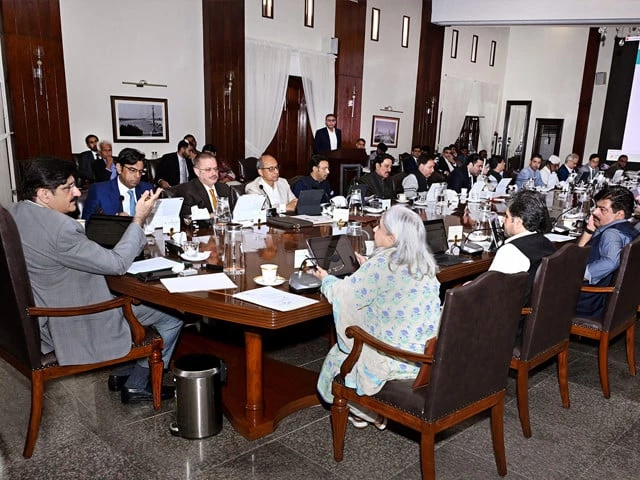
Sindh has decided to impose a ban on the inter-provincial movement of wheat as part of a broader strategy to secure food supplies, curb hoarding, and stabilise market availability.
Briefing the media on key cabinet decisions taken under the chair of Chief Minister Syed Murad Ali Shah, Senior Minister Sharjeel Inam Memon said the move comes amid rising wheat prices and aims to ensure fair distribution and price stability across the province.
He said the cabinet meeting approved a wide-ranging reform and development agenda covering health, education, transport, governance, and infrastructure, which reflects what he described as a "development-driven approach" of the provincial government.
The cabinet approved allocations of Rs338.8 million for development schemes in Sukkur and Rs916.14 million for jail food and dietary requirements. The Sukkur package includes the upgradation of the Shaheed Mohtarma Benazir Bhutto Wellness and Recreational Park and the establishment of a women's block at the Mir Masoom Shah Library, aimed at strengthening cultural and educational infrastructure in the division.
On health reforms, the cabinet approved the Jinnah Postgraduate Medical Centre (JPMC) and National Institute of Child Health (NICH) Operations and Management Act, 2025, formally placing both institutions under a structured provincial legal framework. The law introduces standardised recruitment procedures, performance-based accountability, and improved federal-provincial coordination.
The cabinet also approved continuation of the EPADS procurement system for medicines, vaccines, oncology drugs, and emergency health kits for FY2026-27, while authorising early planning for the subsequent procurement cycle.
A centralised Sindh Postgraduate Residency Policy 2026 was also approved, introducing a unified entry test and merit-based system for 3,794 training seats with an allocation of Rs4.739 billion. The policy aims to eliminate inconsistencies in admissions and strengthen postgraduate medical training standards across institutions.
Sharjeel said Sindh has established more than ten autism centres, with the federal government acknowledging the province's expertise and seeking assistance. He added that an autism centre would now be set up in Islamabad with Sindh's technical support.
In transport and infrastructure, the cabinet approved handing over the BRT Red Line Lot-2 project to the Frontier Works Organisation (FWO) under a government-to-government arrangement to accelerate delayed construction, alongside emergency funding for transport facilitation.
Other decisions included allocation of land for a strategic tide gauge station at French Beach, a 15-day relaxation in the annual fishing ban to provide relief to fishermen, and transfer of the SBOSS platform to the Sindh IT Company to enhance digital governance.
The cabinet also approved amendments to technical education laws (STEVTA), expansion of IBA Karachi's mandate to establish campuses nationwide, and an agreement to export Sindh's autism rehabilitation expertise to Islamabad.
Memon said women-focused initiatives, including free training and the distribution of pink scooters, form part of a broader empowerment programme.
On constitutional matters, he said the federal government has not yet initiated consultation on the proposed 28th Amendment.











This material may not be published, broadcast, rewritten, redistributed or derived from. Unless otherwise stated, all content is copyrighted © 2026 The Express Tribune.



COMMENTS
Comments are moderated and generally will be posted if they are on-topic and not abusive.
For more information, please see our Comments FAQ