Punjab’s school enrolment crisis continues to deepen
Updated 5 minutes ago

Interior minister travels to Tehran for talks with Iranian officials
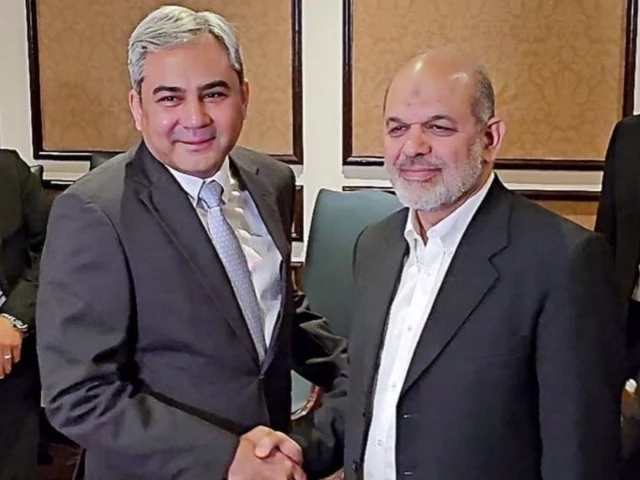
Interior Minister Mohsin Naqvi met Islamic Revolutionary Guard Corps (IRGC) chief Gen Ahmad Vahidi in Tehran during his visit to Iran for meetings with senior Iranian officials, PTV News reported on Wednesday.
Earlier, Iran’s state-run IRNA news agency reported on Wednesday, citing informed diplomatic sources in Islamabad, that Naqvi had travelled to Tehran to hold talks with Iranian officials.
According to the report, the interior minister departed for Tehran for discussions with Iranian authorities.
During the visit, Naqvi held a meeting with Gen Vahidi in Tehran, PTV News added.
وفاقی وزیرداخلہ محسن نقوی اور جنرل احمد وحیدی pic.twitter.com/QYbSq3zqya
— PTV News (@PTVNewsOfficial) May 20, 2026
The visit marks Naqvi’s second trip to Iran in less than a week.
Multiple Pakistani government sources familiar with the matter told Anadolu that Naqvi arrived to discuss a “fresh” US proposal with Iranian leaders aimed at ending the lingering Middle East conflict.
The sources said Pakistan-led mediation efforts between Washington and Tehran had entered a “critical phase”.
Naqvi met Gen Vahidi to discuss attempts to revive stalled talks between the two sides, according to the interior ministry.
He also met his Iranian counterpart, Eskandar Momeni.
According to Pakistani government sources, the minister is also expected to meet Iranian President Masoud Pezeshkian, Foreign Minister Abbas Araghchi and other senior officials to discuss the latest US proposal.
The fragile talks between Washington and Tehran have entered a sensitive stage after the two sides exchanged fresh proposals this week, the sources said.
“Currently, Pakistan's top priority is to further strengthen the ceasefire and persuade the two sides to hold another round of direct talks,” the sources said.
They added that prospects for a second round of direct negotiations in Islamabad had improved following recent developments, including US President Donald Trump’s decision to postpone planned strikes on Iran.
Trump said on Monday that he delayed renewed attacks after several regional countries informed him that a deal to fully end the conflict was close.
He said leaders from Saudi Arabia, Qatar, the United Arab Emirates and other countries asked him to delay strikes “because they think that they are getting very close to making a deal”.
The latest US proposal offers “slightly better incentives” to Iran compared to previous offers, the sources said, without disclosing further details.
According to the sources, the proposal includes issues related to Iran’s frozen assets and international sanctions imposed on Tehran.
However, they said Washington offered “no new concession” regarding Iran’s nuclear programme, which remains the central obstacle to reaching an agreement.
Under a 14-point Iranian proposal previously reported by Anadolu, Tehran seeks separate negotiations on its nuclear programme, including enriched uranium issues, within 30 days after a permanent ceasefire is reached.
Washington, however, wants the nuclear issue to be “discussed and resolved” before any permanent ceasefire agreement.
The proposal for “third-party monitoring” also remains under discussion, mainly on the Iranian side, the sources added.
Regional tensions have escalated since the US and Israel launched strikes against Iran in February.
Tehran retaliated with attacks targeting Israel as well as US allies in the Gulf, alongside the closure of the Strait of Hormuz.
A ceasefire took effect on April 8 through Pakistani mediation, but subsequent talks in Islamabad failed to produce a lasting agreement. Trump later extended the truce indefinitely.
Since then, the two sides have continued exchanging proposals and counter-proposals in an effort to resume direct talks and end the conflict.
During his previous visit to Tehran in recent days, Naqvi met with Pezeshkian, Araghchi, Parliament Speaker Mohammad Bagher Ghalibaf and Momeni.
Naqvi spent nearly 90 minutes in a private meeting with the Iranian president at the Presidential Administration, and his overall visit to the complex lasted around three hours.
Pezeshkian praised what he described as the responsible cooperation of Pakistan, Afghanistan and Iraq in preventing their territories from being used as bases for armed operations against Iran.
The Iranian president also praised Pakistan’s diplomatic efforts during recent tensions, particularly the role of its political and military leadership in supporting ceasefire stabilisation efforts.
As Pakistan continues its diplomatic efforts to seek a “permanent” resolution to the ongoing war between the United States and Iran, it is also reaching out to other stakeholders in an attempt to prevent further deterioration of the regional situation.
Despite several back-and-forth proposals between the two sides, the deadlock persists, threatening a new round of war.
"That is why Pakistan is pushing and persuading both sides not to give up on diplomatic efforts," said a diplomatic source.
What has emerged so far is that Iran and the US remain poles apart on how to end the war.
Iran's semi-official Fars News Agency, considered close to the country's military and security establishment, has revealed that Washington has placed five conditions in response to Tehran's proposal for negotiations.
Those conditions include no war reparations for Iran, transfer of 400 kilogrammes of enriched uranium to the US, retention of only one Iranian nuclear facility, no release of even 25% of Iran's frozen assets, and negotiations linked to an end to the war on all fronts.
Iran, meanwhile, has its own set of conditions, including an end to conflicts across all fronts, particularly in Lebanon, lifting of sanctions, return of frozen assets, war compensation, and recognition of Iran's sovereignty over the Strait of Hormuz.
It is believed that Tehran, via Islamabad, has now responded to the US conditions.
Last month, Naqvi accompanied the field marshal during his visit to Tehran






This material may not be published, broadcast, rewritten, redistributed or derived from. Unless otherwise stated, all content is copyrighted © 2026 The Express Tribune.



COMMENTS
Comments are moderated and generally will be posted if they are on-topic and not abusive.
For more information, please see our Comments FAQ