PSX surges 4% in holiday-shortened week
Updated 12 hours ago

Urge govt to attract Chinese manufacturers, draw lessons from ASEAN solar boom
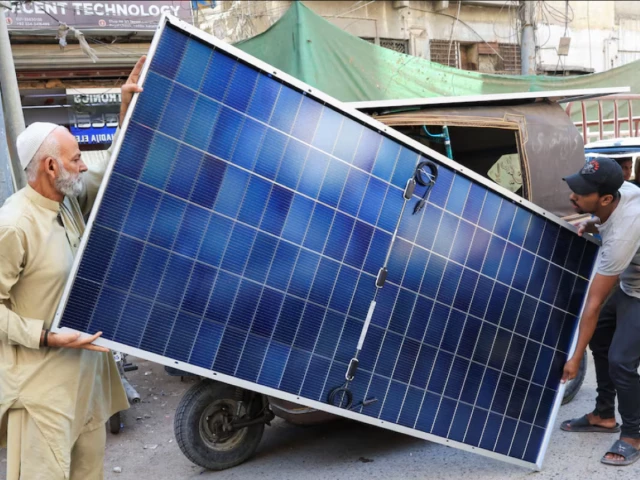
Experts have urged policymakers to introduce policy clarity in a bid to attract Chinese solar manufacturing under the Green CPEC Alliance.
The Pakistan-China Institute hosted a regional conference titled "Asean-to-Pakistan Pathways: Attracting Chinese Investment for Solar PV Value-Chain Manufacturing", aimed at drawing lessons from Southeast Asia's solar boom to anchor manufacturing in Pakistan.
Griffith Asia Institute Director Dr Christoph Nedopil called for focusing on the conditions that made Asean a preferred destination for Chinese solar manufacturing.
He emphasised the role of credible investment facilitation, execution readiness and the broader logic of China's overseas cleantech push, while guiding discussion on what Pakistan must prioritise first to compete for the next wave of manufacturing investment, including closing gaps related to policy stability, Special Economic Zones (SEZ) execution, logistics and investor risk protection.
Pakistan-China Institute Chairman Senator Mushahid Hussain Sayed, in his address, underscored that Pakistan's solar growth was increasingly tied to China's industrial power, citing imports of around 17 gigawatts (GW) of solar panels in 2024 and about 17.9 GW in FY25, taking total imports beyond 50 GW by September 2025, while Pakistan's share in China's solar exports rose to about 12% in 2025 from 2% in 2022.
He highlighted solar's impact on energy security, noting solar provided about 25.3% of Pakistan's utility electricity between January and April 2025.
He pointed to cheap Chinese solar as a one-time strategic window at a time when global solar installations reached around 597 GW in 2024 and module prices fell to $0.07 to $0.09 per watt in 2024 and early 2025. However, production cuts and policy shifts can raise prices by around 9%.
Mushahid Hussain observed that China enjoyed more than 80% of global solar manufacturing capacity, supported by over $50 billion investment and roughly 300,000 jobs.
He linked solar geopolitics with water and resource pressures, citing about 283,000 net-metering consumers in Pakistan by December 2024, around 2.8-4.1 GW of net-metering capacity, around 650,000 solar-powered tube wells and a 30% expansion in rice cultivation since 2023, with implications for water security and future dependence on batteries and critical minerals.
Minister of State for Climate Change Dr Shezra Mansab Ali Kharal, while speaking on "Pakistan's Solar Demand Shock: Why Manufacturing is the Next Frontier," highlighted that solar demand was import-driven as 51.5 GW of solar modules were imported from China by November 2025, following about 16.6 GW in 2024 and slightly over 10 GW in the first four months of 2025.
She noted that deployment was now largely behind the meter with estimates of about 27-33 GW deployed across segments, while official net metering reached 6.8 GW (September 2025), up from around 2.2 GW, and over 156,372 Prosumer facilities as of June 2024.
She mentioned that solar supplied 25.3% of Pakistan's utility electricity in January-April 2025, adding that emerging "negative daytime demand" signals in Lahore, Faisalabad and Sialkot were driving tariff and market reform pressures.
She pointed to economics flipping fast as module prices fell to around $0.08 per watt by 2025 and customs valuation revised to $0.08 to $0.09 per watt. She also noted that import costs exceeded $2 billion by June 2025.
China Three Gorges South Asia Investment Limited (C-SAIL) Senior Adviser NA Zuberi emphasised that while incentives matter, investors ultimately require speed, certainty and enforceability. He cited that Pakistan's competitiveness would depend on defining a minimum investor-ready package that could convert interest into committed capital.
He called for avoiding common policy promises that later backfire when implementation realities, approvals or infrastructure delivery do not match advertised timelines.
Institute for Essential Services Reform (IESR) Director of Communication and Outreach Dr Marlistya Citraningrum discussed how countries such as Indonesia had sought to build domestic industry while staying attractive to foreign manufacturers.
She stressed that Pakistan must balance industrial ambition, including local content and value-addition objectives, with bankability and investability for Chinese and other manufacturers. She added that sequencing and predictability were essential to avoid deterring investors while domestic capabilities scale.
Ember Energy Analyst for Asia Lam Pham discussed Asean's role in attracting Chinese solar manufacturing through tariff-jumping foreign direct investment to bypass anti-dumping and anti-subsidy measures, leveraging trade agreements with major markets, strategic proximity to China's supply chain, competitive fiscal incentives and industrial ecosystem readiness including logistics, infrastructure, workforce, reliable power and water.
Additional Secretary/ Executive Director General-II Board of Investment Dr Erfa Iqbal addressed Pakistan's execution challenges and underlined the importance of removing bottlenecks that prevent SEZs from becoming genuinely plug-and-play for investors.
She focused on what could be realistically fixed within six to 12 months to improve delivery certainty, reduce friction in approvals and strengthen investor confidence in on-ground execution.










This material may not be published, broadcast, rewritten, redistributed or derived from. Unless otherwise stated, all content is copyrighted © 2026 The Express Tribune.








COMMENTS (1)
Comments are moderated and generally will be posted if they are on-topic and not abusive.
For more information, please see our Comments FAQ