External networks sustaining militancy in Balochistan, study finds
Updated 34 minutes ago

Research reveals complex web of cross-border networks, financial aid, and propaganda sustaining violence in province
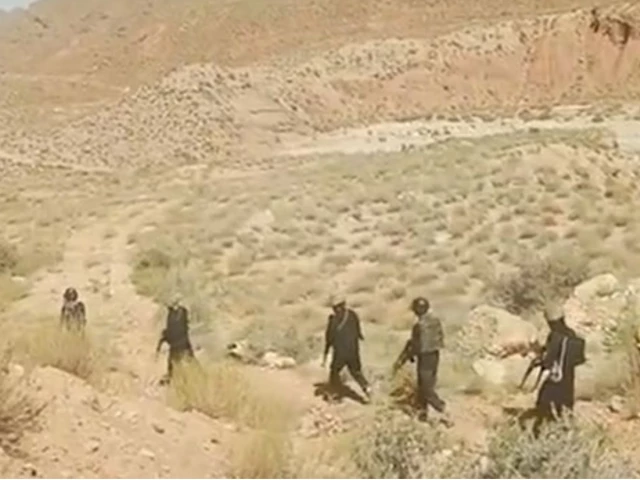
When we talk about violence in Balochistan, attention usually falls on the armed groups themselves. A new study argues that this view is too narrow. Published in the “Journal of International Law & Human Rights” in November 2026, the study suggests that the groups operating in the volatile province are held up by a wider web of outside support, one that helps them rebuild, regroup and carry on even under heavy pressure from security forces.
The research, titled “The Role of External Forces in Exacerbating Security Challenges and Undermining Development in Balochistan,” was carried out by Dr Hafiz Najeeb Ullah and Dr Adnan Mehr, visiting lecturers at the Department of History and Pakistan Studies, International Islamic University Islamabad. They interviewed 16 people working in security, counterterrorism, politics, governance, development, media, border management and the China-Pakistan Economic Corridor (CPEC).
From those conversations, they identified six linked ways in which outside facilitation is believed to sustain militancy: money and material help, cross-border sanctuary and movement, logistical and organisational backing, propaganda, diaspora and transnational networks, and the "internationalisation" of violence through attacks on CPEC and other strategic interests.
The study's central idea is that access to resources beyond Balochistan makes militant groups tougher and harder to dismantle. Outside help can keep money flowing, communications running and people moving. It can also help a group recover after losses. Importantly, the researchers do not picture a foreign puppet-master directing individual attacks.
They describe something looser: a scattered set of actors, each contributing a different kind of help, without any single command structure. That fragmentation is precisely what makes it so hard for investigators to draw a straight line from an external backer to a specific incident.
A security-sector participant stressed that money, safe spaces and communication channels are what keep armed groups going, and that containment becomes much harder when they can draw on support from outside their home ground. Money stood out in particular, described as a flexible resource that can fund many functions at once.
The takeaway for counterterrorism is that stopping the people who carry out attacks is not enough. The networks that enable them need attention too.
Balochistan shares long, rugged and hard-to-monitor borders with Afghanistan and Iran. Interviewees pointed to difficult terrain, informal routes and limited monitoring as gaps that criminal and armed networks can exploit to move around, find refuge and stay in contact across the line.
The researchers were careful, however, not to paint ordinary border life as suspect. Families, traders and communities on both sides have been connected for generations, and crossing the border is simply part of making a living. The real distinction, they argue, is between that everyday movement and organised networks exploiting informal routes.
They also separate three things that are easily blurred: formal state sponsorship, help from non-state transnational networks, and permissive conditions that let armed groups operate across borders without any neighbouring government being involved. The distinction matters, especially given how sensitive Pakistan-Iran relations are, where claims about cross-border militancy have strained ties before.
Their answer is closer coordination with neighbouring countries and better monitoring of illegal networks, without choking off legitimate trade and social ties.
The study also highlights a quieter front: information. Interviewees described how social media, diaspora communications, selective images, short videos, emotional appeals and rumours can turn a local incident into a political storm within hours. One media professional noted how quickly this can happen, and singled out young people as especially exposed when official information arrives late or leaves obvious questions unanswered.
According to the researchers, these narratives can do several things for militant groups: win political visibility, justify violence, attract sympathy, support recruitment, and cast development projects as something imposed from outside. They argue that silence and slow responses leave a vacuum, and blanket denials make it worse. Their recommendation is timely, evidence-based communication delivered by credible voices.
Here too, the authors draw a line. Participants were confident that propaganda exists and travels through transnational networks, but far less sure about who is behind any particular campaign. The researchers warn against assuming that every critical post or politically charged message is foreign interference. Attribution, they say, needs source tracing and corroborating evidence.
Balochistan matters far beyond its borders. It touches Afghanistan and Iran, gives Pakistan access to the Arabian Sea through Gwadar, and sits at the heart of CPEC. That makes its stability a question of regional connectivity and Chinese investment, not just domestic security.
Interviewees said attacks on development projects can shake investor confidence, raise security costs, delay construction, disrupt business and strain Pakistan's diplomatic and economic relationships. China's stake gives such attacks an international dimension, and the researchers note that militants can exploit the symbolic weight of big projects to reach a global audience. A strike on strategic infrastructure can therefore cause political and economic damage far out of proportion to the physical harm.
A CPEC-linked participant spoke of the real benefits of better roads, jobs and business opportunities, but insisted that local people must see tangible gains. The study agrees: protecting infrastructure should not become an obstacle to development, and security arrangements should be designed so that projects can proceed with meaningful community involvement.
The economic toll goes well beyond the immediate damage. Persistent insecurity raises protection costs, restricts the movement of workers and contractors, complicates access to sites and makes investors nervous.
Sectors that depend on long-term planning, such as mining, transport, energy and ports, feel this most. Smaller projects are especially vulnerable, since they often cannot absorb extra security expenses the way large strategic ventures can. A single disruption can ripple through contractors, transporters, service providers, labourers and the households around them. The researchers conclude that externally facilitated violence can cost the economy far more than it costs to sustain.
Although the study leans heavily on external factors, it does not wave away Balochistan's own problems. Political marginalisation, unequal distribution of resources, unemployment and uneven development remain genuine concerns. Yet the authors argue that grievances alone do not explain why organised violence persists. Their suggestion is that militant networks can seize on existing frustrations, present them as proof of deliberate exclusion, and use them to discredit peaceful politics.
An academic interviewee challenged the idea that joblessness automatically breeds militancy, saying it becomes a security problem when organised networks exploit it for recruitment. A political participant emphasised that credible representation and genuine consultation shrink the space in which militant narratives can grow.
The researchers believe better governance, wider political participation and visible local benefits from development can weaken that appeal. But they caution that development spending by itself cannot dismantle networks that supply armed groups with financing, logistics, mobility and organisational support.
The study recommends a comprehensive strategy that combines financial monitoring, stronger border coordination, intelligence cooperation, protection of strategic infrastructure and effective public communication. Security institutions, it says, should aim not only to prevent individual attacks but to disrupt the wider systems that let militant groups survive and rebuild. At the same time, governance and development policy must address legitimate grievances through inclusive politics, fair resource distribution and real community participation.
Also Read: Balochistan's faultlines and external exploiters
The authors are open about their limits. The study is qualitative and rests on just 16 participants, and perceptions shared in interviews cannot independently prove foreign sponsorship. They call for future work using financial records, legal evidence, border assessments and network analysis to build a firmer picture of external facilitation.
Their overall conclusion is that neither military force nor development projects alone can resolve Balochistan's crisis. Counterterrorism must break up organised violent networks, but lasting stability also depends on stronger institutions, credible governance and real economic opportunity for local communities. Protecting the province's future, including CPEC and Gwadar, means tackling both the networks that sustain violence and the local vulnerabilities that give militant narratives their traction.







This material may not be published, broadcast, rewritten, redistributed or derived from. Unless otherwise stated, all content is copyrighted © 2026 The Express Tribune.










COMMENTS
Comments are moderated and generally will be posted if they are on-topic and not abusive.
For more information, please see our Comments FAQ