Stronger industry-academia links urged
Updated 16 minutes ago

Summary not circulated among ministries; IMF deregulation condition unmet
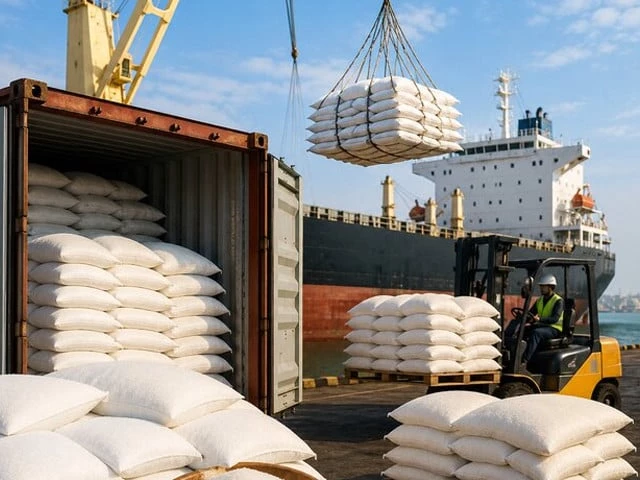
The government on Friday allowed the export of another 416,000 metric tonnes of sugar without circulating the summary among the relevant ministries, amid its failure to deregulate the sugar sector despite a condition by the International Monetary Fund (IMF).
The Economic Coordination Committee (ECC) of the Cabinet approved the export of over 400,000 metric tonnes of sugar, Minister of National Food Security Rana Tanveer Hussain told The Express Tribune after the meeting. He said the crushing season was about to start and there was no shortage of the commodity.
According to the government's draft policy paper, sugar millers have already earned $1.6 billion through exports of the commodity during the past 10 years.
The ECC's approval for the export of 416,000 tonnes of sugar was the third such permission in four months, bringing the total export quantity to 724,000 metric tonnes for this season. The ECC had first allowed the export of 108,000 metric tonnes of imported sugar in August and then another 200,000 metric tonnes of locally produced sugar in mid-September.
The Cabinet Committee on Export of Sugar had recommended the ECC allow the export of 400,000 metric tonnes of sugar. It also sought an additional quota of 16,000 metric tonnes for Sindh, increasing the total export quantity to 416,000 metric tonnes.
An industry player told The Express Tribune that an in-principle decision to export 600,000 tonnes of sugar had been taken months ago, but it was implemented in two phases to avoid media hype. The sources said sugar export-related matters were first settled at the level of Deputy Prime Minister Ishaq Dar and then a summary was presented before the ECC as an additional agenda item.
To keep matters secret, the ECC sugar export summary was not made part of the regular agenda and was not circulated to the relevant ministries. The ECC chairman has the authority to allow tabling any additional item before the committee. However, this practice denies relevant ministries the opportunity to discuss the matter and comment on it.
A participant of the meeting said the ECC chairman, Finance Minister Muhammad Aurangzeb, emphasised the need for deregulating the sector but again permitted the export of sugar, a highly regulated sector.
The IMF had placed a condition that Pakistan should completely deregulate the sugar sector and the government must end its role in the export and import of sugar. But the condition was not met, which Secretary Finance Imdadullah Bosal attributed to the refusal of one province.
The government exercised its power to allow the export of sugar days before a meeting of the IMF executive board. The board will consider Pakistan's request for the approval of the fifth loan tranche of $1 billion under the structural reform programme, $200 million under the climate facility and approval of the Article-IV report.
The IMF's Governance and Corruption Diagnostic Assessment report, released in November last year, exposed a nexus between the sugar sector and the state. "The sugar sector provides a case study of how the intertwined relationship between economic elites and state regulators combine to capture public benefits at deep costs to the overall public," the report stated.
According to a draft of the National Policy for De-regulation of the Sugar Sector, over the last decade, Pakistan exported 3.92 million tonnes of sugar but also imported about 565,000 metric tonnes. The draft stated Pakistan's total export earnings over the last 10 years stood at around $1.6 billion.
Sugar has remained on the first schedule of the Export Policy Order, which lists goods that cannot be exported except with the permission of the federal government.
The draft policy document also depicts the government's admission that despite its strategic importance, Pakistan's sugar sector remains heavily constrained by extensive government intervention, including zoning rules, administered prices and discretionary trade restrictions.
These policies have distorted market incentives, contributed to volatile production and pricing outcomes, and left mills operating at roughly 60% of installed capacity.
With an average annual production of around 6.13 million tonnes, Pakistan ranks as the seventh-largest producer of refined sugar in the world. There are 79 sugar processing mills of various sizes in Pakistan, concentrated in Southern Punjab, Northern and Central Sindh and Southern Khyber-Pakhtunkhwa, as soil, climatic and other conditions here are more suitable for sugarcane.
Total production for the last year was 5.8 million tonnes, valued at around Rs1.1 trillion, but the country's annual domestic consumption is around 6.3 million tonnes, according to the policy draft.
Retail sugar prices have been volatile, rising on average by about 16% per year over the past five years, with episodic peaks approaching 28%. Average sugar consumption in Pakistan is about 14.76kg per person per year, translating to roughly Rs2,302 spent on sugar annually and representing about 3.91% of an average household's yearly budget, according to the Ministry of Industries.
Unlike exports, there is no explicit prohibition on the import of sugar, but the government is discouraging imports through high tariffs. At present, effective protection against the import of sugar works out at 55%, according to the Ministry of Industries. This includes 20% customs duty, 6% additional customs duty, 18% sales tax, 3% additional sales tax and 6% income tax. In addition, a provincial cess at the rate of 0.85% is also levied on all imports.
The ECC also relaxed the criteria for small and medium enterprises (SMEs) to avail Rs50 billion long-term concessional loans for exports.
It waived the upfront export requirement and environmental compliance conditions on the grounds that SME borrowers, particularly newly established businesses, need a transition period to set up production facilities, develop international markets, secure export orders and gradually increase export sales.
A minimum export orientation of 80% at the outset may restrict otherwise viable SME projects from accessing the facility. Relaxing the condition would give SMEs breathing space, according to the finance ministry. It said that to promote SME financing, an Access to Finance (A2F) meeting decided that out of the Rs350 billion envelope, an initial block allocation of Rs50 billion be earmarked for SME borrowers under the long-term financing scheme.
The ECC granted an exemption to SME borrowers from the initial upfront requirement of 80% of sales as exports under the scheme. However, such SMEs will be required to achieve exports equivalent to at least 50% of their total projected sales within four years. It gave exemptions to Long Term Export Financing Facility (LTEGFF) borrowers from the requirement of compliance with the Pakistan Green Taxonomy for availing LTEGFF financing for the next four years of disbursements, till full implementation of the Pakistan Green Taxonomy Framework.
All other terms and conditions of LTEGFF, including the eligibility requirements, will remain unchanged, according to the ministry.







This material may not be published, broadcast, rewritten, redistributed or derived from. Unless otherwise stated, all content is copyrighted © 2026 The Express Tribune.







COMMENTS
Comments are moderated and generally will be posted if they are on-topic and not abusive.
For more information, please see our Comments FAQ