Stronger industry-academia links urged
Updated 15 minutes ago

Gulf remains top destination, Türkiye emerges as notable
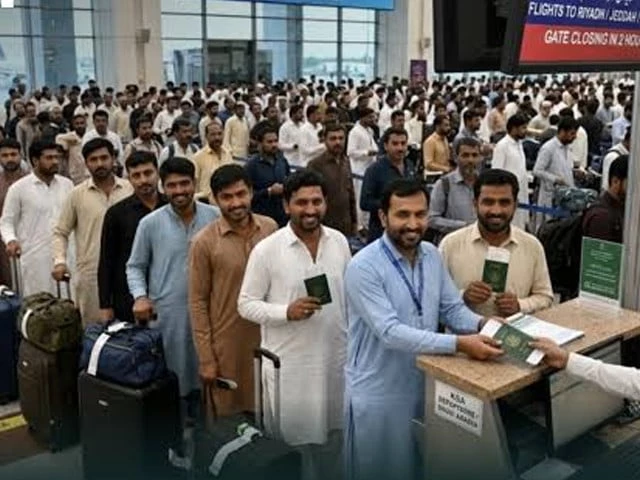
When home cannot offer enough, the search for a better life often begins beyond its borders. For thousands of Pakistanis, an overseas job is not simply a career move or an opportunity to earn a foreign salary; it is a means of securing their families' future, providing better education for their children, supporting ageing parents and finding the financial stability that may remain elusive at home.
From labourers and drivers to doctors, engineers, accountants and technicians, Pakistanis across the occupational range continue to look abroad for employment. The latest overseas employment registration figures reveal the scale of this outward search, with the Gulf remaining the principal destination, although opportunities in Europe and other regions are also drawing workers.
A total of 763,526 Pakistanis registered for overseas employment in 2025, compared with 476,238 during January-October 2026, according to the Bureau of Emigration and Overseas Employment (BE&OE). Since the latter covers only 10 months, the totals are not directly comparable. However, average monthly registrations declined from around 63,627 in 2025 to 47,624 in the first 10 months of 2026, indicating a slower pace, 25.2% lower in the first 10 months of 2026 compared with 2025.
Job categories widen as outward drift gathers pace
The occupational breakdown shows that labourers accounted for the largest share of those seeking work abroad. Their registrations stood at 465,724 in 2025 and 293,401 during January-October 2026. Drivers formed the second-largest group, with 163,718 registrations in 2025 and 94,479 in the subsequent 10-month period.
However, overseas migration is not limited to workers seeking manual or low-skilled employment. The figures also include thousands of professionals and skilled workers. Pakistan registered 5,947 engineers for overseas employment in 2025 and 4,318 during the first 10 months of 2026. The corresponding figures for doctors were 3,883 and 2,529, while accountants numbered 5,659 and 2,844.
The data also records computer analysts, an IT-related occupational category, with 1,564 registrations in 2025 and 1,143 in January-October 2026. Nurses, teachers and technicians also feature prominently, alongside electricians, fitters, welders, carpenters, masons, plumbers and steel fixers. The range of occupations reflects demand for Pakistani workers at different skill levels, from construction and industrial trades to professional services.
Some categories recorded increases despite the shorter reporting period in 2026. Registrations of teachers rose from 1,743 in 2025 to 1,883 during January-October 2026, while those of cooks increased from 10,503 to 11,325. Fitters also registered an increase, from 2,847 to 2,956. These movements suggest that demand is not uniform across occupations.
The BE&OE data shows that of 220,170 foreign job vacancies reported, 106,978 remained available, while 113,192 had already been filled.
Country-wise migration
The country-wise figures underline the Gulf's overwhelming importance in Pakistan's overseas employment market. Saudi Arabia remained the leading destination, with 530,437 registrations in 2025 and 294,297 during the first 10 months of 2026. The United Arab Emirates recorded 52,664 registrations in 2025, rising to 53,018 in January-October 2026. Its monthly average was therefore higher in the 10-month period.
Qatar received 68,386 Pakistani workers in 2025 and 35,934 during January-October 2026, while Bahrain recorded 37,726 and 22,387, respectively. Oman and Kuwait accounted for 770 and 4,515 registrations in the first 10 months of 2026.
Together, Saudi Arabia, the UAE, Oman, Qatar, Bahrain and Kuwait accounted for about 86% of registrations during January-October 2026, compared with around 91% in 2025. The figures point to some broadening of destination patterns, but the Gulf continues to dominate the employment choices of Pakistani workers.
Türkiye is among the destinations showing a notable increase. Registrations rose from 5,288 in 2025 to 10,284 during the first 10 months of 2026. The country-wise record also includes the United Kingdom, the United States, Germany, Italy, Greece and Spain, indicating that Pakistani workers are reaching a wider range of labour markets, even though their numbers remain considerably smaller than those going to the Gulf.
The outward search for work also reflects pressures within the domestic labour market. According to the Pakistan Bureau of Statistics' Labour Force Survey 2024-25, the unemployment rate increased to 7.1%, compared with 6.3% in 2020-21, while the number of unemployed people reached 5.9 million. A growing workforce needs not only jobs, but employment that offers adequate earnings, security and opportunities for professional advancement.
Overseas employment offers households better earnings and financial security, while remittances support families and boost foreign exchange. The opportunities range from personal drivers and vehicle cleaners to loaders, unloaders and chefs, alongside skilled trades and professional jobs. Yet migration comes at the cost of prolonged separation from spouses, children and parents. Ultimately, Pakistan's challenge is to create secure, adequately paid jobs at home so that earning a better living does not mean having to leave one's family and country.















This material may not be published, broadcast, rewritten, redistributed or derived from. Unless otherwise stated, all content is copyrighted © 2026 The Express Tribune.







COMMENTS
Comments are moderated and generally will be posted if they are on-topic and not abusive.
For more information, please see our Comments FAQ