Amazon signs $11.57b deal for satellite firm Globalstar to challenge Musk's Starlink
Updated Apr 14, 2026

Spring Festival Gala turns prime-time spectacle into a statement of AI and manufacturing dominance
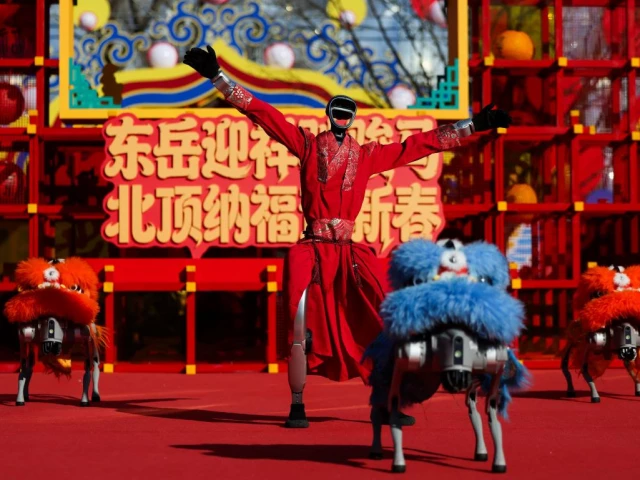
China’s annual Lunar New Year televised extravaganza turned into a high-tech spectacle this year, as humanoid robots vaulted, flipped, fought with swords and danced their way across the stage of the CCTV Spring Festival Gala.
Long regarded as the most-watched TV show in the world, the New Year gala has historically been a showcase for national songs, comedy sketches and cultural symbolism. This year, it became a manifestation of Beijing’s ambitions in robotics and artificial intelligence.
Unitree Spring Festival Gala Robots —a Full Release of Additional Details 🥳
— Unitree (@UnitreeRobotics) February 16, 2026
Dozens of G1 robots achieved the world’s first fully autonomous humanoid robot cluster Kung Fu performance (with quick movement), pushing motion limits and setting multiple world firsts! H2 made striking… pic.twitter.com/MZgXEnGc2p
Broadcast internationally via CGTN, the spectacular show drew massive domestic viewership and quickly went viral online. But it was not the usual celebrity singers or comic performers who captured world attention. Instead, fleets of agile humanoid robots from four rising Chinese startups — Unitree Robotics, MagicLab, Galbot and Noetix — took centre stage.
The contrast with last year’s performance was striking. In 2025, humanoid robots clumsily twirled handkerchiefs in a wobbly folk routine. This year, however, they executed complex martial arts sequences, synchronised dance numbers and gravity-defying parkour moves.
One of the most talked-about segments featured more than a dozen Unitree humanoids performing an elaborate kung fu routine alongside child martial artists. The robots wielded swords, poles and nunchucks in tightly choreographed sequences.
In a technically ambitious nod to China’s “drunken boxing” style, they mimicked exaggerated sways, sudden collapses and backward falls — before recovering fluidly to continue the fight. The display highlighted advancements in motion control, balance and fault recovery, key capabilities for machines expected to operate in unpredictable real-world environments.
Another sequence pushed acrobatics even further. Two dozen humanoids performed the world’s first continuous freestyle table-vaulting parkour by robots. They executed aerial flips, single-leg spins, wall-assisted backflips and even a 7.5-rotation “Airflare” grand spin — a manoeuvre more commonly associated with elite breakdancers than machines.
In a comedic sketch, Noetix’s Bumi robots bantered alongside human actors, delivering physical humour that relied on precise timing and expressive gestures. MagicLab’s humanoids later joined human performers in a synchronised dance during the patriotic song “We Are Made in China,” their metallic frames moving with an increasingly lifelike rhythm.
The opening sketch also featured Doubao, an AI chatbot developed by ByteDance, underscoring how generative AI and robotics are converging in China’s broader technology strategy.
China dominates humanoid robotics
For observers of China’s industrial policy, the gala’s robotic takeover was no accident. The Spring Festival Gala has long served as a cultural megaphone for Beijing’s technological priorities — whether space exploration, high-speed rail or drone innovation. This year’s spotlight on humanoids aligned squarely with China’s push to dominate “AI+ manufacturing,” an initiative designed to upgrade factories.
President Xi Jinping has personally elevated the sector’s profile. In the past year, he has met with multiple robotics startup founders, placing them alongside electric vehicle and semiconductor entrepreneurs in high-level discussions. Such engagement signals that humanoid robotics is not a niche curiosity but a strategic priority.
Behind the dazzling choreography lies a deeper structural advantage. According to estimates from Barclays, China accounted for more than 85% of global humanoid robot installations in 2025, far surpassing the United States. Research firm Omdia reported that China shipped roughly 90% of the world’s 13,000 humanoid robots last year.
Humanoid robots danced and performed martial arts on stage as China showcased its latest technology for Lunar New Year, during the annual CCTV Spring Festival gala. pic.twitter.com/kCe6HjVQv2
— Al Jazeera English (@AJEnglish) February 17, 2026
Analysts attribute this dominance to China’s vertically integrated supply chain. The country controls huge portions of the rare earth elements and high-performance magnets essential for robotics. It also boasts extensive manufacturing capacity for batteries, sensors and precision components. This integration allows Chinese firms to produce robots at lower costs and scale more rapidly than many Western competitors.
Unitree, for example, advertises a base price of $13,500 for its G1 humanoid — well below the anticipated near-term price of Tesla’s Optimus robot. While Tesla aims to reduce production costs below $20,000 at scale, Chinese firms currently enjoy a pricing advantage supported by both supply chain efficiencies and government backing.
Morgan Stanley projects that China’s humanoid robot sales will more than double this year to 28,000 units. If realised, that growth would further entrench China’s leadership in a market still in its infancy.
China’s Strengths
The timing of the gala’s robotic spectacle carries geopolitical weight. Weeks earlier, Tesla CEO Elon Musk told the World Economic Forum in Davos that humanoid robots could soon outnumber humans and become widely available to consumers. Musk has acknowledged that Chinese companies may be his fiercest competitors in embodied AI.
By staging a high-profile demonstration of agility, coordination and scale, China effectively broadcast its progress to global audiences, including US policymakers and investors watching the intensifying tech rivalry.
Reyk Knuhtsen, an analyst at SemiAnalysis, described the leap in performance over just one year as remarkable. The robots appeared “more lean, fluid and capable,” suggesting rapid improvements in control algorithms and hardware integration. As machines approach human-level dexterity, he added, their potential applications expand — from factory floors and warehouses to logistics, healthcare and even household assistance.
The Spring Festival Gala offered more than entertainment. It served as a vivid demonstration of how industrial policy, technological ambition and cultural spectacle can intersect. In China, the pipeline from laboratory to factory to prime-time television appears unusually direct.
As the Year of the Dragon unfolds, the images of sword-wielding robots and synchronised mechanical dancers will linger — not merely as novelty acts, but as symbols of a nation intent on shaping the next era of manufacturing and machine intelligence. Admired as marvels of engineering, China’s humanoid performers have ensured that the world is watching.














This material may not be published, broadcast, rewritten, redistributed or derived from. Unless otherwise stated, all content is copyrighted © 2026 The Express Tribune.






COMMENTS
Comments are moderated and generally will be posted if they are on-topic and not abusive.
For more information, please see our Comments FAQ