Two Pakistan Army pilots martyred after training aircraft crashes near Quetta: ISPR
Updated 1 hour ago

Surgeons in Kuwait remotely perform gynecological operation on patient at Karachi’s Lyari General Hospital
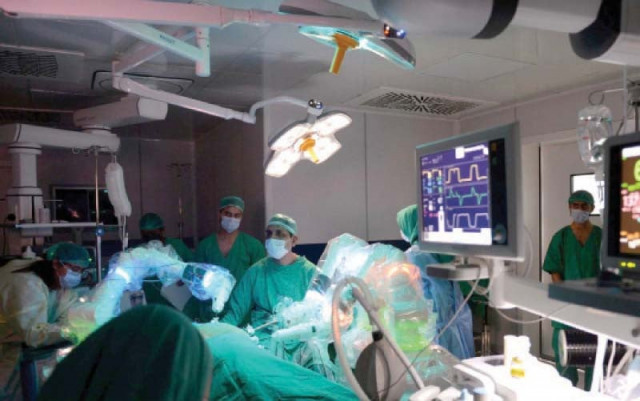
Doctors completed a gynecological operation through telerobotic surgery at Lyari General Hospital, with surgeons from Kuwait conducting the procedure alongside colleagues from Karachi. The operation marks the first time Pakistan has conducted cross-border telesurgery.
Kuwaiti doctors operated from a distance of approximately 1,600 kilometers. During the surgery, an internet speed of 30 megabytes per second was used, while a gap of only 30 microseconds was recorded between the surgeon’s command and the robot’s response.
A ceremony was held at the hospital, where Sindh Health Minister Dr Azra Fazal Pechuho said that she had inaugurated modern medical facilities, including a mortuary, forensic section, advanced laboratories of microbiology, biochemistry, and pathology. Additionally, a laboratory has also been inaugurated for medical students to receive practical training.
Dr Pechuho stated that the average cost of such an operation amounts to Rs400,000 per patient, while Consultant Gynecologist Oncologist Dr Anjum Rehman noted that three to four surgeries are being performed daily through the robotic system, at the cost of Rs150,000.
According to the health minister, robotic surgery does not involve making an incision in the abdomen; rather, a camera and instruments are inserted into the body through small holes. Through this system, tumor, kidney, and gastrointestinal surgeries, along with gynecological procedures, are possible.
Read: SIUT showcases breakthrough in digital surgery
She said that the robotic system has been provided by the Sindh government and the process of staff training is ongoing, with the facilities to be extended to other government hospitals in the coming years.
Explaining the concept of the surgery, Dr Rehman said that it was conducted with the patient present at Lyari General Hospital while doctors, sitting in Kuwait, operated a robotic system. He said that in the future, Pakistani doctors will also be able to treat international patients – a major advancement for the country’s healthcare system.
Drawing a comparison, Dr Rehman said that a laparoscopic surgery takes approximately 30 minutes for one operation, the same surgery is completed in just 15 minutes through the robotic system. Further, he noted that there is a risk of infection in laparoscopic surgery, but a tumor has been removed through robotic surgery with neither blood loss nor any complications.
Director of the company providing the robot, Abdul Rehman, said that the basic purpose of today’s robotic telesurgery is that the surgeon is present in one place while the patient is in another location. He stated that the benefit of this technology is that the surgeon does not need to travel, with surgical commands able to be given from anywhere. He termed this the greatest advantage of telesurgery.
Further, he said that this system requires a minimum speed of 30 megabytes per second, which is generally available; hence, existing internet networks, including PTCL, support this technology. With the introduction of 5G service in Pakistan, Abdul Rehman expressed hope that the system will become even better and more effective.















This material may not be published, broadcast, rewritten, redistributed or derived from. Unless otherwise stated, all content is copyrighted © 2026 The Express Tribune.





1727268465-0/Untitled-design-(42)1727268465-0-208x130.webp "the poor man s burden")
COMMENTS
Comments are moderated and generally will be posted if they are on-topic and not abusive.
For more information, please see our Comments FAQ