TIFF targets younger audience with indie premieres
Updated 1 hour ago

'Mural doctor' Fan Zaixuan devotes four decades to conservation
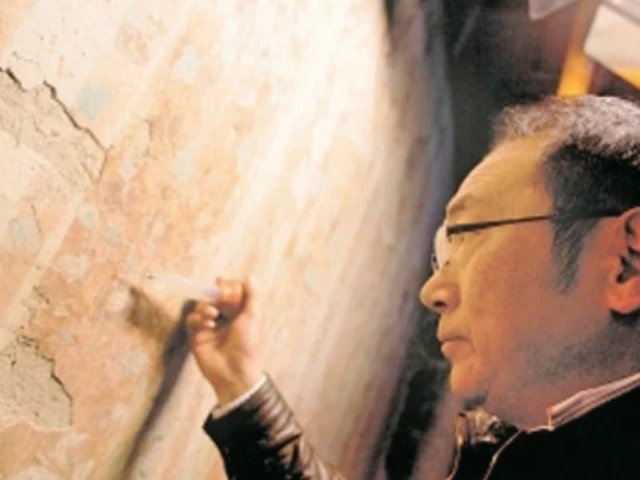
For more than four decades, Fan Zaixuan has devoted his career to treating the ailments of China's ancient murals, earning recognition as a leading conservation expert while developing scientific methods to preserve the country's cultural heritage.
A researcher at the Dunhuang Academy's conservation research institute in northwest China's Gansu Province, Fan recently returned from Nanjing with a new challenge: restoring murals buried underground in a region far more humid than the desert oasis where he built his career.
Fan, 65, joined what is now the Dunhuang Academy in 1981 and spent more than 40 years restoring ancient murals, progressing from an apprentice to a leading figure in the field. Over the years, he has authored multiple restoration standards, drafted more than 30 restoration plans, led more than 10 conservation projects, secured patents for techniques to treat mural damage and received several national awards for conservation science.
Fan has encountered almost every major ailment affecting ancient murals, including flaking, hollowing, detachment, salt efflorescence and biological damage. Each, he said, requires its own "prescription".
Salt efflorescence, sometimes described as "mural cancer" because of its difficulty to treat, once threatened 710 square metres of murals at the Mogao Grottoes, a UNESCO World Heritage Site in Dunhuang.
The damage occurs when soluble salts within a mural's plaster layer dissolve as humidity rises and recrystallise when the air becomes drier. Repeated cycles of dissolution and crystallisation can eventually cause layers of paint to detach.
After eight years of research, his team identified the mechanisms behind salt efflorescence and developed a scientifically grounded restoration method. The technique has since been used to restore more than 500 square metres of salt-damaged murals at the Mogao Grottoes.
The team also developed other conservation solutions, including a surfactant compound capable of dissolving soot without damaging murals and a lightweight, fast-drying grouting material for hollow sections.
Fan has also served as lead author of several technical standards, stressing the importance of turning practical experience into systematic and standardised knowledge. "Turning our experience into something systematic, scientific and standardised preserves the accumulated know-how of past restorers while also providing guidance and reference for future mural restoration," he said.
Determined to broaden his expertise, Fan taught himself inorganic, organic and analytical chemistry while studying art history and archaeology under mentors including veteran restorers Duan Xiuye and Li Zuixiong. He later studied at Lanzhou University and Fudan University before working abroad as a visiting scholar.
Fan has trained more than 300 mural restoration technicians for institutions across China. Even after retiring, he has continued working on the front lines of mural conservation. "There are still problems in ancient mural research that remain unsolved. Generation after generation, our team must keep Dunhuang's beauty alive," Fan said.









This material may not be published, broadcast, rewritten, redistributed or derived from. Unless otherwise stated, all content is copyrighted © 2026 The Express Tribune.





COMMENTS
Comments are moderated and generally will be posted if they are on-topic and not abusive.
For more information, please see our Comments FAQ