Mir Raza exhumation delayed as family rejects newly formed medical board
Updated 12 hours ago

Despite receiving billions, many SEF partner schools appear to be flouting contractual obligations
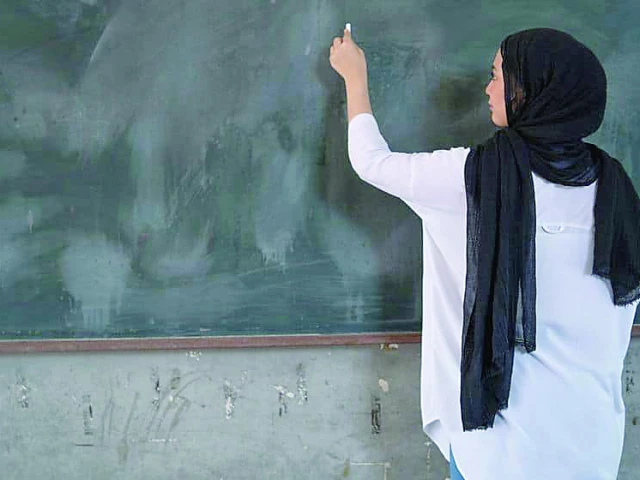
Despite the provincial government's decision to raise the minimum monthly wage to Rs43,000 in the current fiscal year's budget, thousands of teachers working at Sindh Education Foundation-funded schools continue to earn less than one-third of that amount, even as the foundation receives billions of rupees annually from the provincial exchequer.
According to details gathered by the Express Tribune, Sindh Education Foundation (SEF), which promotes education through a public-private partnership model, was allocated Rs10.89 billion in the previous fiscal year. The allocation has increased to Rs13.5 billion in the current budget.
Official data obtained for this report shows that SEF supports around 3,000 schools across the province, including 378 non-formal education centres. Together, these institutions employ nearly 30,000 male and female teachers. However, the majority receive monthly salaries ranging from just Rs10,000 to Rs15,000, well below the provincial minimum wage announced by the government.
The foundation finances partner schools through a monthly per-student subsidy. The amount varies by grade level, ranging from Rs800 for a primary school student to Rs2,300 for a higher secondary student. According to SEF records, more than 100,000 students are enrolled in schools operating under its support.
Official records show that Khairpur Mir's has the largest number of SEF-supported schools, with 385 registered institutions. Sanghar has 225 schools, Dadu 196, Badin 163, Qambar-Shahdadkot 157, Mirpurkhas 149, Malir in Karachi 127, Umerkot 109 and Tharparkar 103.
SEF's written agreements with partner schools require operators to pay employees market-based salaries through bank transfers. The contracts explicitly state that school staff should be paid according to prevailing market rates, making compliance with fair wage standards a contractual obligation rather than a recommendation. In practice, however, that provision appears to receive little oversight.
School operators say SEF inspectors primarily focus on verifying student attendance and assessing basic facilities during routine visits. They rarely examine salary records or whether teachers are being paid in accordance with the agreements. Operators also claim that subsidy payments are linked to the number of students present on the day of inspection rather than total enrolment, creating pressure to maximise attendance during visits.
Amir Haider, who operates an SEF-supported primary school in Mirpurkhas, acknowledged that teachers are paid low salaries. He argued that school operators are constrained by rising operational costs and inadequate government subsidies. According to Haider, increasing the per-student subsidy is essential if schools are expected to offer teachers salaries that meet the government's own minimum wage standard while continuing to operate in underserved communities. The Express Tribune contacted a senior Sindh Education Foundation official for comment. The official declined to speak on the record and requested anonymity.










This material may not be published, broadcast, rewritten, redistributed or derived from. Unless otherwise stated, all content is copyrighted © 2026 The Express Tribune.











COMMENTS
Comments are moderated and generally will be posted if they are on-topic and not abusive.
For more information, please see our Comments FAQ