Sharjeel Memon accuses K-P CM of 'sabotaging' govt-PTI talks
Updated 1 hour ago

JI protests at over 500 locations across country as Hafiz Naeem vows to intensify the anti-inflation campaign
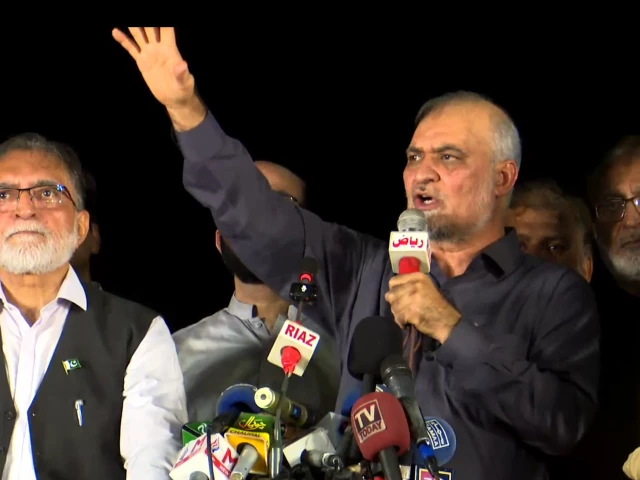
Jamaat-e-Islami (JI) Emir Hafiz Naeemur Rehman on Friday announced the next phase of the party's nationwide protest campaign, calling for sit-ins outside the Punjab Chief Minister's House in Lahore and Governor Houses in Karachi, Peshawar and Quetta on Sunday, August 9, against higher petroleum prices, petroleum levy and expensive electricity.
The JI had announced nationwide protests against the petroleum levy, rising fuel prices and inflation, with demonstrations planned on 510 major roads and highways in 170 districts.
The party protested at over 500 locations across the country, including major cities such as Karachi, Lahore, Peshawar, Quetta, Islamabad, Rawalpindi and Abbottabad, where protesters blocked main arteries as they demonstrated against the increase in the petroleum levy, inflation and the growing economic burden on the public.
Addressing participants of a protest sit-in at Qurtaba Chowk in Lahore, Hafiz Naeem directed party workers to launch a door-to-door mobilisation campaign on Saturday, followed by nationwide demonstrations on Sunday.
He said around 500 peaceful protests and sit-ins were held across the country on Friday. According to him, large numbers of people took to the streets from Karachi to Lahore and other cities, while protests were organised at 21 locations in Balochistan despite an initial plan for 18. He also claimed that party workers in Tharparkar had reached protest sites ahead of the scheduled time.
Describing Friday's demonstrations as the beginning of the movement, Hafiz Naeem said they were only a "trailer" and a rehearsal, adding that the main phase of the campaign was yet to begin. He warned that the sit-ins could be prolonged if necessary, saying the party would continue its struggle for what it described as the public's rights.
The JI chief said the country's governance system had failed to provide relief to the people and instead benefited influential groups. He alleged that the existing political structure had its roots in a colonial-era model under which feudal elites were empowered, adding that the same political class continued to dominate by switching parties while ordinary citizens bore the consequences.
He said the government had failed to manage the economy and should acknowledge its shortcomings, arguing that the public was struggling under inflation, unemployment, high electricity bills and an increasing tax burden.
Hafiz Naeem demanded the abolition of the petroleum levy, a reduction in taxes and lower electricity tariffs. He said international oil prices had declined but consumers in Pakistan had not received the full benefit, alleging that the government had instead increased the levy.
He claimed that more than Rs8 trillion had been collected through the petroleum levy but alleged that none of the amount had been spent on upgrading oil refineries. He further alleged that successive governments had relied on the levy to compensate for weak tax collection by the Federal Board of Revenue (FBR).
The JI emir also urged the government to stop citing the International Monetary Fund (IMF) as a justification for economic decisions. He claimed that if the government could continue what he described as extravagant spending, it could also provide relief to the public. He added that labourers, farmers, students and rickshaw drivers were paying the levy while many households were receiving electricity bills higher than their monthly incomes.
He demanded that petrol prices be reduced to Rs225 per litre, the petroleum levy be abolished, taxes be cut and electricity prices be lowered to provide immediate relief to consumers.
Hafiz Naeem said JI workers had maintained discipline during Friday's demonstrations and had not blocked ambulances or emergency services. He added that the party would continue its protest movement peacefully.
During the protest, traffic was partially disrupted around Qurtaba Chowk as sections of Bahawalpur Road, Ferozepur Road, Queens Road, Jail Road and Lytton Road were partially closed.
Protest swarms Pindi
Protests also overran Rawalpindi and neighbouring districts as political leaders and citizens spilled onto the streets with slogans, demanding relief.
Nationwide protest sit-ins and blockades across the Karakoram Highway were implemented as JI Punjab chief Dr Tariq Saleem led the protest.
Addressing the protest at Liaquat Bagh on Murree Road, Rawalpindi, Saleem noted that the increase in petrol prices has had the greatest impact on the working class, students and motorcyclists. “If we were to make a call against inflation taxes, the nation will surround the houses of governors, chief ministers and others. Pakistan was not achieved for a few families, landlords and the elite, but for the people,” he said.
The JI leader added that people were worried about how to arrange bread for their family during the period of inflation and unemployment, while the rulers were busy with spending lavishly.
Protesters demanded that rulers should solve the public’s problems; otherwise, they will face public backlash, rejecting the petroleum levy and taxes. “There has been no significant increase in crude oil prices in the global market, but petrol and diesel are being continuously made expensive in Pakistan, said Dr Tariq Saleem.
The protest leaders also spoke out against the arrest of students and party workers who had joined the protest to speak up for their rights.
Protest in other districts
A massive protest was staged in the Hazara division as well. Sit-ins were held at various locations across the city, while the Karakoram Highway was completely blocked at five different locations.
The Karakoram Highway remained completely closed in Haripur, at Siddique Akbar Chowk, in Abbottabad at Fawara Chowk, in Mansehra at Ghazi Kot Township Chowk, in Battagram at Kuss Bridge and in Kohistan at Pattan. Jamaat-e-Islami workers and a large number of citizens participated in the sit-ins and staged a strong protest in support of their demands against the government.
Addressing the protest sit-in at Fawara Chowk Abbottabad, Jamaat-e-Islami leader Hazara Abdul Razzaq Abbasi responded to and challenged Rana Sanaullah over a statement he made on a TV programme the previous day, in which he claimed that Jamaat-e-Islami does not have the capability to block the country's highways.
سکھر- امیر جماعت اسلامی پاکستان حافظ نعیم الرحمٰن کی اپیل پر پٹرولیم مصنوعات کی قیمتوں میں اضافے اور عوامی مسائل کے خلاف جماعت اسلامی کا قافلہ ببرلو بائی پاس بند کرنے روانہ
— Jamaat e Islami Pakistan (@JIPOfficial) August 7, 2026
Hafiz Naeem
Jamaat e Islami
Bhatta Levy NaManzoor #JIProtestAgainstBhattaLevy pic.twitter.com/W6wyIRzcks
Abdul Razzaq Abbasi said, "Rana Sanaullah, see what Jamaat-e-Islami can do?”
“Today he can see with his own eyes that the people are on the streets in Hazara and protest sit-ins are ongoing on all major highways of Hazara,” he added.
Karachi grinds to a halt
Like other cities, major arteries of Karachi were also brought to a standstill after citywide protest call by Jamaat-e-Islami, with demonstrators blocking Shara-e-Faisal and staging sit-ins across key roads.
Rallies converged from different parts of the city at Mazar-e-Quaid before proceeding towards Shahrah-e-Quaideen and eventually Shara- e-Faisal, where protesters occupied both tracks of the road, disrupting traffic for hours.
Simultaneous demonstrations were reported on major roads including the National Highway, Superhighway, Hub River Road, Shahrah-e-Orangi, Shahrah-e-Korangi, and Shahrah-e-Pakistan, as participants from various districts staged sit-ins and chanted slogans against the government’s economic policies.
Protesters, many of whom arrived on motorcycles, cars, vans, and trucks, carried party flags and placards bearing messages such as “End petroleum levy tax,” “Reduce fuel prices,” “Control IPP mafia,” and “Stop burdening the poor.”
Addressing the main sit-in on Sharae Faisal, JI Karachi Ameer Monem Zafar Khan said the scale of protests — claiming demonstrations on over 500 major roads countrywide — reflected public rejection of what he termed “economic oppression” by the ruling elite.
“The people of Karachi and across Pakistan have shown they will not accept unjust policies,” he said. “This is a clear message to the rulers that their extravagant spending and anti-people decisions must end.”
He added that citizens had symbolically switched off their vehicles to register protest, calling it evidence of widespread frustration among the public. “The writing is on the wall for those in power,” he said.
Khan demanded the immediate abolition of the petroleum levy, reduction in fuel prices, and an end to what he described as excessive payments to independent power producers (IPPs). He also called for tangible relief measures for low-income segments of society.
The protests caused significant traffic disruptions across Karachi, with commuters facing long delays and diversions as key thoroughfares remained blocked for extended periods.



This material may not be published, broadcast, rewritten, redistributed or derived from. Unless otherwise stated, all content is copyrighted © 2026 The Express Tribune.




COMMENTS
Comments are moderated and generally will be posted if they are on-topic and not abusive.
For more information, please see our Comments FAQ