Pakistan, seven nations call Israeli actions in Gaza grave violations of international law
Updated 1 hour ago

Says removal, not compulsory retirement, justified where public confidence is lost
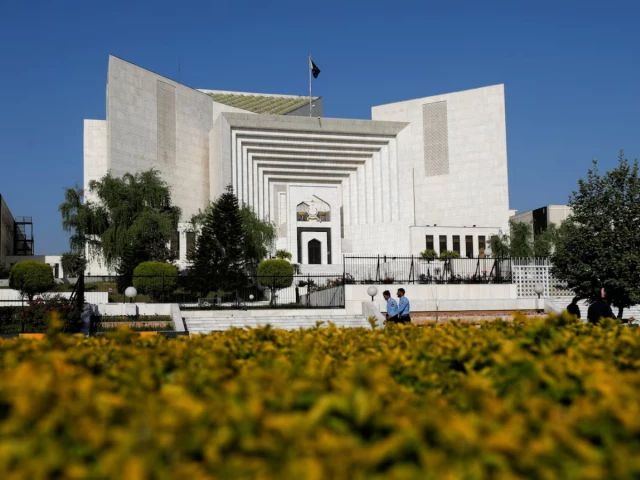
Emphasising that public confidence is the cornerstone of the judiciary, the Supreme Court has ruled that a judge whose reputation is found to be bad cannot continue to hold judicial office, even if a specific act of corruption has not been conclusively proved.
The ruling came in an eight-page judgment authored by Justice Shahid Waheed while restoring a notification for the removal of a judicial officer from service.
A three-member bench headed by Justice Waheed examined whether a judicial officer found to be of bad repute, though not proven guilty of a specific act of corruption, could be retained in service and whether compulsory retirement could serve as a legally sustainable alternative to removal.
Answering those questions in the negative, the court held that integrity occupies a central place in judicial service and that the continuation of a judge becomes impossible once public confidence in his character is lost.
"For a judge, integrity is binary because the confidence of the people in the judiciary is the cornerstone of an Islamic welfare state," the judgment stated.
The court observed that judges are bound by a "code of chivalry" requiring essential qualities beyond legal knowledge and professional competence.
"Legal knowledge and skill are, of course, their fundamental attributes. But this intellectual equipment alone is not sufficient for the proper discharge of their duties. They must also be endowed with the moral virtue of impartiality, which is, in fact, the very breath of their judicial life," the judgment said.
The court stressed that judges serve as the point where the abstract principles of law become a lived reality for citizens.
"The judge is the point at which the abstraction of law becomes a lived reality. Parties come not to argue with statutes, but to hear from a human conscience clothed in judicial office. If that conscience is doubted, the law itself becomes suspect," the judgment noted.
The bench further observed that the judiciary derives its authority not from force but from legitimacy, which rests on two fundamental pillars: competence and integrity.
"Competence can be tested in judgments. Integrity is tested in reputation," the court said.
The judgment warned that even a legally sound decision could lose credibility if delivered by a judge whose reputation has been tarnished.
"A judge may render sound law, and yet, if his name carries a stain in the public mind, the judgment will be received with suspicion," it stated. The court maintained that the ethical standards expected of judges go beyond merely avoiding wrongdoing.
"Ethically, the judicial office demands more than the absence of wrongdoing. It demands the presence of an unblemished character. The standard for a judge is not 'not guilty' but 'beyond reproach'."
The judgment explained that unlike elected officials, judges exercise power without political accountability and often without immediate review, making public trust in their integrity indispensable.
"The only check is the confidence of the people. Therefore, retention of any judge becomes impossible once his reputation is found to be bad," the court held. It further observed that judicial institutions require not only actual integrity but also the appearance of integrity.
"The judicial institution demands not only integrity, but also the appearance of integrity," the judgment added.
Referring to Islamic principles governing public office, the court noted that authority is regarded as a trust (am?na) that must be exercised with justice and fairness.
The bench then turned to the question of punishment, examining whether compulsory retirement was an appropriate penalty for a judicial officer whose reputation had been found to be tarnished.
According to the judgment, the guiding principle in determining punishment is proportionality, requiring that the penalty correspond to the gravity of the misconduct and the harm caused.
The court held that the real mischief in such cases is the loss of public confidence in the judiciary. "The judicial officer in the present case, by compromising his impartiality, not only lost public confidence but also strangled his judicial career," the judgment stated.
It observed that once public confidence in a judicial officer's integrity is fractured, the damage extends beyond the individual concerned and affects the rule of law itself.
"The moment public confidence in the integrity of the judicial officer was fractured, the fracture ran through the entire structure of the rule of law, undermining the integrity of the judicial institution itself. His continuation in office had become incompatible with the interests of the institution," the court said.
The judgment drew a clear distinction between compulsory retirement and removal from service, describing the difference as substantive rather than merely semantic.
"Compulsory retirement may, in appropriate circumstances, be imposed where the aim is to weed out deadwood or where retention is no longer administratively feasible," it observed.
However, the court ruled that compulsory retirement cannot be used in cases involving judges of poor reputation because such an outcome would allow them to leave office with benefits despite the damage caused to public confidence.
"It, in any case, cannot be imposed on a judge of poor reputation, as allowing him to retire with benefits would suggest that reputation is negotiable, which would defeat the very purpose of the penalty," the judgment stated.
The bench concluded that removal from service is justified where a judge's conduct affects both personal integrity and the moral standing of the institution, thereby undermining public confidence in the judiciary.
"As a result, removal from service becomes justified when the conduct affects the integrity of a judge and the institution's morality and damages public confidence," the court held.
Criticising the approach adopted by the tribunal in the case, the Supreme Court observed that it had failed to appreciate the distinction between compulsory retirement and removal.
"It appears that the Tribunal overlooked this distinction: that when an ill-reputed or corrupt judge is removed, the judicial institution begins to heal because a specific tumour has been excised," the judgment concluded.















This material may not be published, broadcast, rewritten, redistributed or derived from. Unless otherwise stated, all content is copyrighted © 2026 The Express Tribune.






COMMENTS
Comments are moderated and generally will be posted if they are on-topic and not abusive.
For more information, please see our Comments FAQ