UN chief praises Pakistan's peace efforts on regional conflicts in meeting with CDF Munir
Updated 3 hours ago

Says Sindh Assembly not once, but many times unanimously opposed the creation of any new province in Sindh
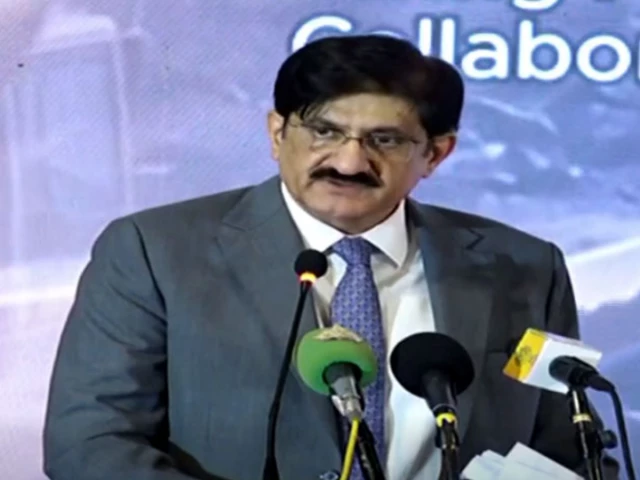
Sindh Chief Minister Murad Ali Shah on Thursday rejected claims that the governance system had collapsed, saying no bloodshed would be allowed over the issue of creating new provinces.
“The people of Sindh say that the provinces will be built on our dead bodies. My brother, we will not let anyone's dead bodies fall. Don't dramatise it so much. There is a way in the constitution to build provinces. And in that constitution, it is written that if an assembly of a province passes a resolution with a two-thirds majority to divide the province, then it is possible,” said Shah while speaking to reporters after addressing the Mining Technical Conference 2026.
The remarks came after Interior Minister Mohsin Naqvi reignited the debate by saying Pakistan's existing governance system had collapsed and was no longer capable of addressing the country's challenges, calling for administrative reforms, including the creation of new administrative units.
Shah, during the conversation with the reporter, said the Sindh Assembly had repeatedly opposed the creation of new provinces.
“The Sindh Assembly not once, many times. I don't remember the number, but many times, unanimously opposed the creation of any new province in Sindh,” he added.
The chief minister said that there was no objection to debating the issue and urged the media not to make it taboo, adding that people had trust in the process.
"So, if there is ever a change in this, which I am not seeing, then we can talk about it. So, there is no harm in debating anything," he said.
Responding to a question, he said protests were a right but should be held according to an established procedure, urging demonstrators to obtain permission from the administration before staging protests.
Shah said the provincial government had made provision to procure one million tonnes of wheat, adding that its primary objective was to protect local farmers.
Referring to Tharparkar, he said those who believed the system had collapsed should visit the district to see its progress.
During the conference, CM Sindh said electricity generation capacity from Thar Coal would be increased from the current 2,640 megawatts to 3,000 megawatts in the coming days.
Shah said more than 15 million tonnes of coal were being produced annually from Thar blocks, adding that the use of local coal was saving the country more than $1.5 billion in foreign exchange annually.
The Sindh chief minister expressed his government's commitment to fully explore the potential of the mining sector.
If reset is needed for good governance, then it should happen, says DG ISPR
On July 31, Inter-Services Public Relations (ISPR) Director General Lt Gen Ahmed Sharif Chaudhry said an administrative reset, if required, should be undertaken to ensure good governance, stressing that any such change must be carried out through constitutional and legal means and in accordance with the will of the people.
"The will of the people of Pakistan is superior. If good governance requires an administrative reset, then it has to be done through constitutional methods, legal procedures and political representatives,” he said.
MQM-P steps up 'new province' push
On July 25, Federal Minister and Muttahida Qaumi Movement-Pakistan (MQM-P) leader Mustafa Kamal announced that his party had decided to launch street demonstrations against the Sindh government's "systematic injustice" towards Karachi and other urban centres, while renewing his demand for the creation of new provinces and greater devolution of powers.
Fazl warns against creating new provinces without public consent
On Tuesday, Jamiat Ulema-e-Islam-Fazl (JUI-F) chief Maulana Fazlur Rehman launched a scathing attack on the government, declaring that the writ of the state has practically collapsed in Khyber-Pakhtunkhwa (K-P) and Balochistan, leaving citizens unable to travel safely even within their own home regions.
Addressing a press conference in Quetta, the veteran political leader warned that relying on raw force rather than political wisdom will never resolve Pakistan's deepening crises. He insisted that those steering the nation are well aware of the ground reality, stressing that the only way forward is to govern strictly according to the Constitution.
Lawyers, politicians divided on constitutional procedure
On July 31, Former additional attorney general Waqar Rana said the Constitution of Pakistan contains no express provision for creating new provinces.
"The Constitution of India, on the other hand, specifically provides for establishing new states under Articles 2 and 3. Article 239(4) of the Constitution of Pakistan caters only to the limited issue of altering the limits of a province," Rana said.
He explained that Section 2 of the Indian Independence Act, 1947, stipulated that Pakistan comprised certain provinces and areas, expressly referring to the existing provinces.
According to Rana, the proper legal course would be to amend the Constitution by first inserting an express provision for creating new provinces and then proceeding accordingly.
Read more: Legal debate intensifies over new provinces
"For such an amendment, resolutions passed by a two-thirds majority of every provincial assembly would be required. Some legal experts have wrongly suggested relying on Article 1, which has nothing to do with creating new provinces," he said.
Rana said the federal government could seek an advisory opinion by filing a presidential reference before the Federal Constitutional Court (FCC), but cautioned against relying on such a mechanism.
"A question of such great importance and far-reaching consequences must not hinge on an advisory opinion of the FCC," he said, adding that the issue was fundamentally political and the courts should avoid entering the political arena.
He also argued that concentrating political power could only be addressed by empowering people through education and economic development.
"Uttar Pradesh has a larger population than Punjab, so population alone cannot justify creating new provinces. Pakistan's economic problems have nothing to do with the number of provinces; they stem from the misuse of public funds," he added.
Pakistan Bar Council member Barrister Salahuddin Ahmed said the proposal appeared politically unfeasible given the strong public sentiments surrounding it.
He said, under Article 239 of the Constitution, creating new provinces would necessarily alter the boundaries of existing provinces. Therefore, it would require a two-thirds majority in the relevant provincial assembly as well as two-thirds majorities in both the Senate and the National Assembly.
"Those pushing this proposal may instead seek to amend Article 239 itself through Parliament and remove the requirement of approval from the provincial assembly altogether," he said.
Ahmed further pointed out that following the 27th Constitutional Amendment, Article 239(5) now states that, notwithstanding anything contained in the Constitution or any judgment of any court, no court shall have jurisdiction to question a constitutional amendment on any ground whatsoever.










This material may not be published, broadcast, rewritten, redistributed or derived from. Unless otherwise stated, all content is copyrighted © 2026 The Express Tribune.






COMMENTS
Comments are moderated and generally will be posted if they are on-topic and not abusive.
For more information, please see our Comments FAQ