PTI backs referendum to determine public opinion on creation of new provinces
Updated 1 hour ago

Spokesperson outlines country’s recent diplomatic engagements in weekly media briefing
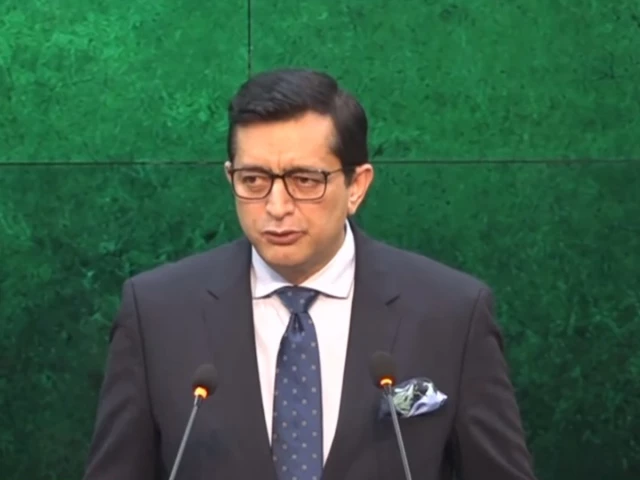
Pakistan remained committed to the “peaceful resolution of disputes” as a central pillar of its foreign policy, alongside national security, economic prosperity and regional cooperation, Foreign Office (FO) spokesperson Sajjad Haider Khan said on Friday, outlining the country’s recent diplomatic engagements with regional and international partners.
At a weekly press briefing, Khan said, “Pakistan will continue to pursue a foreign policy centred on national security, economic prosperity, constructive engagement, regional cooperation and the peaceful resolution of disputes."
Khan highlighted Pakistan’s participation in the COP31 climate summit in Turkey, its hosting of the Economic Cooperation Organisation (ECO) Council of Ministers meeting and efforts to strengthen ties with countries across Europe, Central Asia and Southeast Asia.
He began by recalling Prime Minister Shehbaz’s November 10-12 visit to Antalya for the 31st Conference of the Parties to the United Nations Framework Convention on Climate Change.
On the sidelines, PM Shehbaz met Turkish President Recep Tayyip Erdogan, with the two leaders reaffirming their “fraternal” ties and discussing bilateral cooperation, regional developments and efforts to promote peace and stability.
Khan noted that PM Shehbaz had highlighted regional efforts, particularly by members of the Makkah Accord, to promote “de-escalation and dialogue”. Erdogan, in turn, appreciated Pakistan’s “constructive role” and mediation efforts leading to the signing of the Islamabad memorandum of understanding.
At the summit, the prime minister also highlighted Pakistan’s efforts towards rapid solarisation, expanding renewable energy capacity, disaster preparedness and early warning systems. He stressed the need for “predictable, adequate and accessible climate finance” for developing countries, Khan added.
🔴LIVE: Spokesperson's Weekly Press Briefing 20-11-2026 at Ministry of Foreign Affairs, Islamabad https://t.co/sV4uY4KErw
— Ministry of Foreign Affairs - Pakistan (@ForeignOfficePk) November 20, 2026
Turning to regional economic cooperation, the spokesperson said Pakistan had hosted the 30th ECO Council of Ministers meeting in Islamabad on November 15 and 16 under the theme “Reviving Regionalism for a Resilient ECO”.
As the organisation’s chair for 2026-27, Pakistan brought together foreign ministers and heads of delegations from member states. Khan described the meeting as an opportunity to deepen bilateral engagement and cooperation with regional organisations.
FM Dar held bilateral meetings with foreign ministers and senior officials from Iran, Tajikistan, Turkey and Kyrgyzstan on the sidelines, discussing bilateral ties, regional cooperation, economic connectivity and coordination at multilateral forums.
He also met the secretaries-general of the ECO, the Organisation of Islamic Cooperation and the Conference on Interaction and Confidence-Building Measures in Asia, reaffirming Pakistan’s commitment to strengthening cooperation through these platforms.
Khan also recalled the preparatory work led by Foreign Secretary Ambassador Asim Iftikhar Ahmed, who chaired a senior officials’ meeting to finalise the agenda and draft Islamabad Communiqué.
On Pakistan’s bilateral engagements with European partners, Khan said Iftikhar had held the seventh round of political consultations with Italy, led by Italian Secretary General Ambassador Riccardo Guariglia. The discussions covered trade, investment, defence, education, technology and culture.
Read: Pakistan has ‘not given up’ on US-Iran peace efforts, Dar says
The 20th round of Pakistan-Sweden political consultations was also held in Islamabad on November 19. Both sides reviewed bilateral relations and discussed trade, investment, education, technology and healthcare, while exchanging views on regional and global developments.
Khan further highlighted FM Dar’s November 17 meeting with Turkmenistan’s Deputy Chairman of the Cabinet of Ministers and Foreign Minister Rashid Meredov, during which the two sides co-chaired the sixth Pakistan-Turkmenistan Joint Intergovernmental Commission.
The discussions covered trade and investment, energy, transport and connectivity, agriculture, industry and tourism. The two countries agreed to strengthen economic engagement and institutional cooperation, signing a protocol and a programme of cooperation between their foreign ministries for 2026-30. They also exchanged a memorandum of understanding on tourism cooperation.
On Pakistan’s engagement with Southeast Asia, Khan said FM Dar had held delegation-level talks with ASEAN Secretary-General Dr Kao Kim Hourn at the FO on November 19.
The two sides reviewed progress under the Pakistan-ASEAN Sectoral Dialogue Partnership and discussed cooperation in trade, investment, regional connectivity, agriculture, food security, climate resilience and digital innovation. Dar also stressed the importance of business links and people-to-people exchanges.
The spokesperson also announced that Climate Change Minister Musadik Malik had been nominated to represent Pakistan at the Shanghai Cooperation Organisation’s Civilisation Dialogue Forum in New Delhi from November 20 to 22.
“Pakistan’s participation reflects its commitment to dialogue among civilisations, cultural exchanges and people-to-people contact,” Khan said.
Read more: Pakistan calls Houthi attack on Riyadh tower ‘grave violation’ of Saudi sovereignty
He also recalled the FO’s hosting of the Gandhara Strategic Dialogue, titled “Towards a Shared Future”, on November 18. The event brought together senior Buddhist monastics from eight countries, international experts, diplomats, parliamentarians and senior government officials.
Foreign Secretary Iftikhar highlighted Gandhara’s significance as a “shared heritage of humanity” and a bridge between civilisations, while National Heritage and Culture Minister Aurangzeb Khan Khichi delivered a special address.
Khan said the dialogue provided a platform for cultural diplomacy, interfaith harmony and international cooperation to preserve and promote Pakistan’s Gandhara heritage.
Iftikhar also received a high-level Turkish delegation led by Deputy Head of the Directorate of Communications Farhat Pirinçci on November 18. The delegation included former Turkish defence minister Fikri Isik and members of the Turkish parliament. Discussions focused on strategic communications, countering disinformation and institutional cooperation.
On Pakistan’s engagement with the United States, Khan said FM Dar met former US Assistant Secretary of State for South Asian Affairs Robin Raphel on November 10. Dar appreciated the “positive trajectory” of Pakistan-US relations, while both sides agreed to promote closer exchanges between think tanks and academic institutions.
FM Dar also held telephone conversations with the foreign ministers of Uzbekistan and Kyrgyzstan on November 11 and 13, respectively, discussing bilateral cooperation through the Shanghai Cooperation Organisation and ECO.
On November 15, he spoke by telephone with Egyptian Foreign Minister Badr Abdelatty about regional and international developments and coordination at forthcoming R4 and R4-plus-E4 meetings. Abdelatty also renewed his invitation to PM Shehbaz to visit Cairo, which Dar “positively received”, Khan said.
Also read: Pakistan takes pride in safeguarding its invaluable Gandhara heritage: culture minister
The spokesperson also highlighted Pakistan’s engagement with Bangladesh, saying FM Dar had addressed 35 senior Bangladeshi civil servants participating in an Executive Leadership Training Programme in Pakistan.
FM Dar highlighted the longstanding friendship and shared cultural affinities between the two countries, as well as opportunities for cooperation through knowledge exchanges in governance and public administration.
On economic diplomacy, Khan recalled Dar’s address at the opening session of the Minerals Investment Forum 2026 on November 12, where he inaugurated its international exhibition in Islamabad.
DPM Dar had described economic diplomacy as a “central pillar” of Pakistan’s foreign policy and highlighted the Special Investment Facilitation Council’s role in facilitating international investment partnerships.
The foreign minister also addressed the Margalla Dialogue on November 10, emphasising effective multilateralism, adherence to international law and the UN Charter, and the importance of dialogue and diplomacy in resolving conflicts.
Khan further mentioned FM Dar’s separate meetings on Tuesday with Lana Nusseibeh, a candidate for the position of United Nations secretary-general, and David Miliband, president and chief executive of the International Rescue Committee.
In his meeting with Nusseibeh, FM Dar reaffirmed Pakistan’s support for the United Nations and effective multilateralism, including respect for international law and relevant UN Security Council resolutions. With Miliband, he discussed humanitarian activities, relief and recovery efforts, community resilience and challenges arising from humanitarian crises and climate change.
On the broader regional situation, Khan reiterated Pakistan’s condemnation of the Houthi militia’s attack on a tower in Riyadh’s King Abdullah Financial District, calling it a “grave violation” of Saudi Arabia’s sovereignty and a threat to regional peace and security.
The spokesperson also recalled Pakistan’s condemnation of an attempted Houthi attack on a Saudi Aramco administrative building in Riyadh on November 9. No casualties were reported. Pakistan had called for an “immediate and unconditional cessation” of attacks against Saudi Arabia and reaffirmed its support for measures to safeguard the Kingdom’s security and territorial integrity.
On Palestine, Khan said Pakistan had joined other foreign ministers in condemning an Israeli airstrike on the Nasr Medical Complex in Khan Younis and continued attacks against Palestinian civilians. The joint statement called for the protection of civilians and medical facilities, unhindered humanitarian assistance and the implementation of relevant ceasefire arrangements.
He added that Pakistan and 14 other countries had welcomed UK and Australian sanctions against Israeli settlement activities in occupied Palestinian territory, condemned continued settlement expansion, particularly the E1 plan, and reaffirmed support for a two-state solution based on the June 4, 1967 lines, with East Jerusalem as Palestine’s capital.







This material may not be published, broadcast, rewritten, redistributed or derived from. Unless otherwise stated, all content is copyrighted © 2026 The Express Tribune.



COMMENTS
Comments are moderated and generally will be posted if they are on-topic and not abusive.
For more information, please see our Comments FAQ