PTI backs referendum to determine public opinion on creation of new provinces
Updated 54 minutes ago

Chief Whip Aamir Dogar says decisions on new provinces must reflect public will and follow constitutional procedures
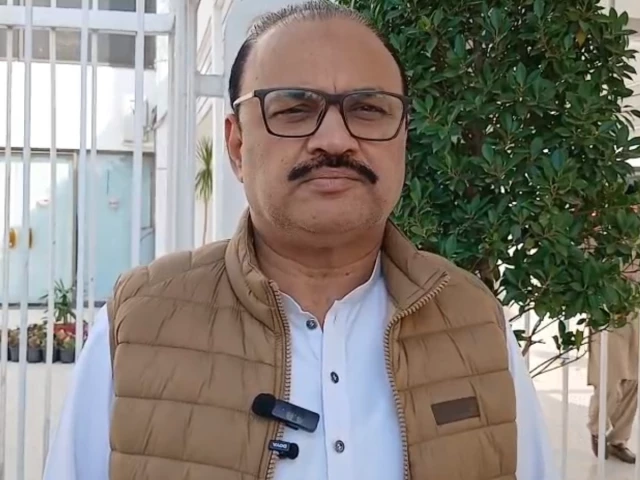
Pakistan Tehreek-e-Insaf (PTI) senior leader and Opposition Chief Whip in the National Assembly Aamir Dogar on Friday backed a referendum to determine public opinion on the creation of new provinces, saying any decision on the matter should reflect the people's will and be made in accordance with the law.
Speaking to reporters outside Parliament House, Dogar described a referendum as an effective way to establish public opinion on the issue. "Whether it comes through a referendum or another means, the people's opinion is a great solution. The will and opinion of the people should prevail," he said.
Dogar said PTI founder Imran Khan had consistently advocated the creation of smaller provinces, adding that a separate South Punjab province had been included in the party's 2018 election manifesto.
"I am from Multan, South Punjab. In 2018, we made the creation of a South Punjab province part of our agenda. Not only did we include it in our agenda, but when our government came to power, we also worked towards it," he said.
He added that the proposal for a separate province had given an identity to the Saraiki-speaking population of South Punjab.
Dogar said any move to create new provinces should have public approval and follow constitutional and legal procedures, adding that PTI's final position would be determined by Imran Khan.
He also said discussions surrounding the proposed 28th Constitutional Amendment and the creation of new provinces remained confined to the media and social media. PTI would not take a position until a draft was formally presented in parliament, he added.
Asked whether the party's support for a South Punjab province also extended to a separate province for Karachi, Dogar said the matter would first be discussed within the party's internal forums.
"We have a parliamentary forum, a political committee and a core committee. The recommendations of all three forums will be presented to Imran Khan, and the final decision will be his," he said.
Read: Govt moves to break deadlock over new provinces through political dialogue
Dogar said divisions within the ruling coalition made it premature for the opposition to decide its position on the proposed constitutional amendment.
"There are cracks within the government itself. You have seen the statements made by Bilawal Bhutto-Zardari, the biggest partner in the coalition, and even the government's own ministers do not know what will happen," he said.
He added that the opposition would formulate its position after assessing the situation, once the government reached a consensus on the matter.
Turning to the proposed All Parties Conference (APC) in Islamabad, Dogar said its date would be finalised through consensus within the next one or two days.
He said political representatives from across the country, PTI leadership, Tehreek Tahafuz-e-Ayin Pakistan (TTAP) and the joint opposition would be invited to attend the conference.
"The all-parties conference is expected, and the venue has been decided. It will be held in Islamabad and will take place soon," he said.
On the proposed parliamentary committee on electoral reforms, Dogar said government Chief Whip Tariq Fazal Chaudhry had asked the opposition to nominate its members.
Dogar said he had informed Chaudhry that a parliamentary session was expected during the week, although it now appeared unlikely. The joint parliamentary committee would meet after the session, he added.
"My job as chief whip is to send the nominations, coordinate, prepare the agenda and present it to my parliamentary party. There will be a debate and a decision, and that is when we will conclude," he said.
Dogar also dismissed speculation that PPP Chairman Bilawal Bhutto-Zardari would join the opposition, saying it was too early to draw conclusions from his recent statements.
Read more: Bilawal calls for 'political reset', says system 'deliberately destroyed'
Pointing to the PPP's share in the current power-sharing arrangement, Dogar noted that the party held positions in the presidency, provincial governments, governorships, the Senate and the National Assembly.
"Right now, the PPP has the biggest share in the power-sharing arrangement, so it is very premature to say that Bilawal will join the opposition," he said.
Dogar also said President Asif Ali Zardari's policies over the past five years had harmed the PPP and its voters, adding that the party faced considerable resentment in Punjab. "Bilawal is a young leader and has a future, but he must be thinking and consulting the party. That is a decision he has to make," he said.
He added that Bilawal's recent statements had received a positive response both in Pakistan and internationally. "I am talking about the people — they have really liked his stance," Dogar said.
Bilawal’s speech at the Karachi Press Club stirred controversy after he warned that a bloodbath was imminent if Sindh was administratively divided. He also hinted that the government was considering a 28th Constitutional Amendment for the purpose, while claiming that the 27th Amendment had been forced on PPP lawmakers.
The meeting between the president and the prime minister yesterday was among several recent engagements focusing on issues dominating the political landscape.
The PML-N leadership decided to reach out to parliamentary parties, including the PPP and MQM-P, to discuss the creation of new provinces and administrative units, as well as other political and constitutional matters. Well-placed party sources told The Express Tribune on Thursday that a political coordination committee comprising senior leaders would be formed to hold consultations and develop a joint strategy on key national issues.
The proposed consultations followed a meeting between President Asif Ali Zardari, Prime Minister Shehbaz Sharif and Interior Minister Mohsin Naqvi, where they agreed to resolve outstanding issues through dialogue amid tensions sparked by PPP Chairman Bilawal Bhutto-Zardari’s remarks and criticism from federal government representatives.
Also read: Bilawal's contention
Sources said the discussions could also cover the constitutional and legal implications of creating new provinces, the possibility of a public referendum, counter-terrorism efforts, economic challenges and local government reforms. The government may convene a national political conference to discuss the issues, with proposals potentially brought before parliament if consensus emerges.
On November 14, President Zardari met PM Shehbaz at his Model Town residence after Naqvi proposed holding a referendum on the issue of new provinces.
The debate on carving new provinces for broader governance reforms gained momentum on July 31, when Naqvi called for additional administrative units or provinces to overhaul what he described as the country's outdated governance system. Addressing the Pakistan Economic Summit 2026 in Islamabad, he argued that the existing governance model had effectively “collapsed” after decades of failing to deliver.
His remarks drew a mixed response, with several political leaders also calling for a debate on the issue in parliament instead of public fora.
The proposal drew the interest of the MQM-P, which has repeatedly advocated carving out new provinces from Sindh. Even before Naqvi's July 31 remarks, Health Minister Mustafa Kamal had floated the idea of dividing Sindh.
On September 4, the Sindh Assembly passed a resolution rejecting attempts to divide the province or create new administrative units. Chief Minister Syed Murad Ali Shah declared that there would be no compromise on Sindh's geographical unity.






This material may not be published, broadcast, rewritten, redistributed or derived from. Unless otherwise stated, all content is copyrighted © 2026 The Express Tribune.


COMMENTS
Comments are moderated and generally will be posted if they are on-topic and not abusive.
For more information, please see our Comments FAQ