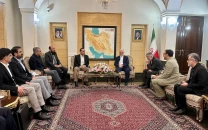
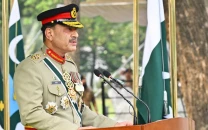
CDF Munir, Mohsin Naqvi depart for Iran amid efforts to promote regional peace: ISPR
Updated 2 hours ago

Argue economy does not flourish when constitutional supremacy is contested, political uncertainty prevails
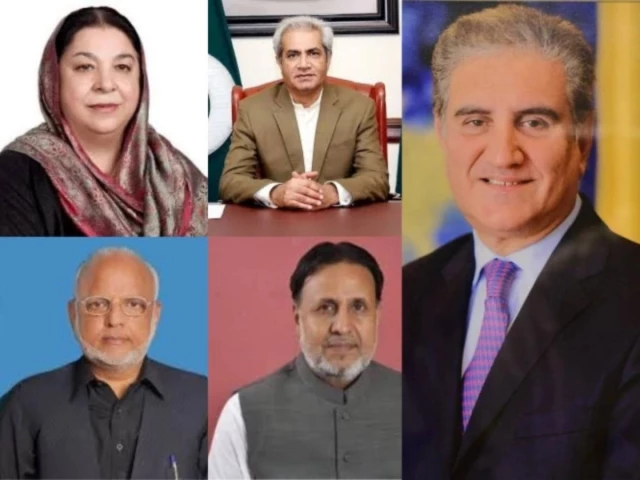
Five incarcerated senior Pakistan Tehreek-e-Insaf (PTI) leaders have called on the opposition leadership to engage Prime Minister Shehbaz Sharif in talks on a "Charter of Pakistan", it emerged on Thursday.
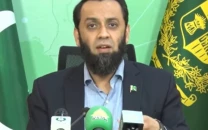
On June 14, Federal Information Minister Attaullah Tarar had invited the opposition to sign a Charter of Economy while defending the federal budget in the National Assembly (NA).
In a letter to opposition leaders Mahmood Achakzai, Allama Raja Nasir Abbas and PTI Chairman Barrister Gohar Ali Khan — dated June 17 — PTI leaders Shah Mehmood Qureshi, Dr Yasmin Rashid, Omar Sarfraz Cheema, Ejaz Chaudhry, and Mian Mahmoodur Rasheed — currently incarcerated in Kot Lakhpat Jail — proposed a framework aimed at ensuring constitutional supremacy, political stability, respect for electoral mandate and institutional balance beyond the government's proposed Charter of Economy.
The letter stated that Pakistan stood at “critical crossroads”, pointing to the government's offer of an economic charter to address the country's challenges.
“While economic reform and policy continuity are undoubtedly essential, it is important to ask a more fundamental question, can economic stability be achieved in the absence of political stability and constitutional certainty?” the letter asked, adding that "history, experience and common sense suggest otherwise."
It noted that the economy did not flourish when constitutional supremacy was contested, political uncertainty prevailed and public confidence in institutions was weakened.
The senior PTI leaders highlighted that investment, growth and prosperity were ultimately products of trust in the rule of law, respect for democratic mandate and predictable governance.
The signatories maintained that Pakistan’s challenges were fundamentally constitutional and political in nature, rather than solely economic. They argued that efforts to resolve economic issues without addressing these “foundational” concerns would fall short in bringing about the desired outcome.
The leaders, therefore, called on the opposition to encourage the prime minister to broaden the national dialogue beyond the Charter of Economy and work towards a comprehensive Charter of Pakistan.
According to the letter, the proposed charter should seek consensus among political parties, state institutions, and other stakeholders on key principles, including: unconditional supremacy of the Constitution, respect for the electoral mandate and the will of the people, an end to political engineering in all its forms, strict adherence by all institutions to their constitutional roles and boundaries, across-the-board accountability without discrimination and protection of core national policies, including implementation of the National Action Plan and long-term economic frameworks, regardless of changes in government.
The quintet, citing international examples, argued that political stability preceded economic well-being and not the other way around.
“If the prime minister is genuinely committed to placing Pakistan on a path of national recovery, this is an opportunity to demonstrate statesmanship by initiating an inclusive national dialogue on a Charter of Pakistan,” the letter stressed, adding, “Such an initiative would address the root causes of instability rather than merely its symptoms.”
The letter concluded with a call for a serious, transparent, and result-oriented discussion on the proposal between the government and the opposition.
“Pakistan deserves a consensus that transcends governments,” the PTI leaders wrote, adding that the country required “not another temporary arrangement but a durable national covenant”.




This material may not be published, broadcast, rewritten, redistributed or derived from. Unless otherwise stated, all content is copyrighted © 2026 The Express Tribune.

COMMENTS
Comments are moderated and generally will be posted if they are on-topic and not abusive.
For more information, please see our Comments FAQ