Lifestyle changes driving diabetes spike
Updated 3 hours ago

.
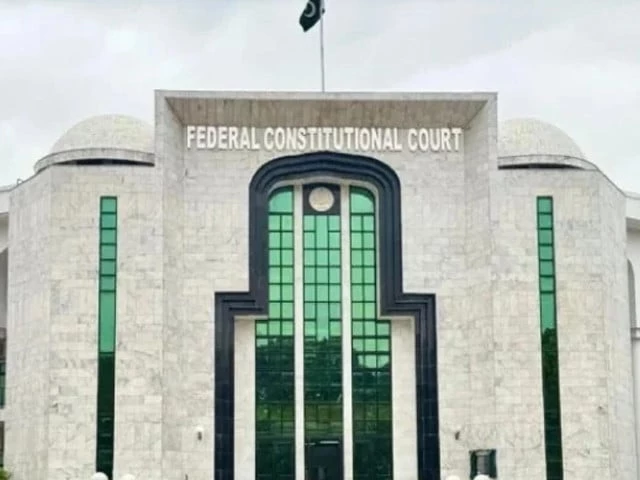
The Federal Constitutional Court (FCC) emphasized that revenue authorities must undertake a comparative evaluation for the appointment to the office of lambardar, setting aside an earlier appointment and directing adherence to statutory requirements.
"The competent revenue authorities are, therefore, required to undertake a comparative evaluation under Rule 17 for the purpose of identifying the most suitable candidate who is best equipped, in terms of character, capacity, and local acceptability, to discharge the duties attached to the office, including those contemplated under Rule 22 ibid.
"The entire selection process is thus oriented towards the appointment of a person in whom the State can repose confidence for the effective performance of public functions relating to the collection of land revenue, abiana, and other government dues, as well as for maintaining effective coordination between the administration and the local inhabitants," said a 17-page judgment.
FCC Chief Justice Amin-ud-Din Khan authored the verdict. He led a division that set aside the appointment of a lambardar after accepting the petition filed by Shoukat Ali. The court declared that the petitioner is entitled to appointment as lambardar of Chak No4/WB, Tehsil and District Vehari.
The judgment noted that the jurisdiction of superior courts in matters relating to the appointment of a lambardar is essentially supervisory in nature and is exercisable within well-defined constitutional and legal parameters.
"Interference is warranted only where the impugned order suffers from illegality, arbitrariness, misreading or non-reading of material evidence, violation of the governing statutory provisions, or perversity in the assessment of comparative merit and suitability."
It stated that ordinarily, reappraisal of evidence or substitution of judicial view in matters involving comparative evaluation of candidates is impermissible unless the conclusions recorded are demonstrably unsustainable in law or facts.
However, it said, such restraint does not operate in derogation of the constitutional mandate enshrined under Article 4 of the Constitution which guarantees individuals the right to be dealt with in accordance with law and to enjoy equal protection of law.
"Thereby obligating all state functionaries, including revenue authorities, to act strictly within the confines of lawful authority and in a fair, non-arbitrary, and reasoned manner," the judgment stated.















This material may not be published, broadcast, rewritten, redistributed or derived from. Unless otherwise stated, all content is copyrighted © 2026 The Express Tribune.




1727268465-0/Untitled-design-(42)1727268465-0-208x130.webp "independence 2 0")



COMMENTS
Comments are moderated and generally will be posted if they are on-topic and not abusive.
For more information, please see our Comments FAQ