Juice industry urges excise duty cut to 10%
Updated 1 hour ago

Govt commits to achieving primary budget surplus target of 2% of GDP
The budget discussions between Pakistan and the International Monetary Fund (IMF) have remained inconclusive, though both sides covered significant ground except for convergence over the cost of tax relief and estimates of new policy measures for the primary budget surplus target of Rs2.8 trillion.
The government sought relief for the salaried class and for exporters by abolishing the 1% extra tax. However, the IMF had issues with the estimates of revenue measures needed to offset the relief impact, said government sources. The lender also found the impact of the proposed new policy measures lower than what the tax authorities had projected.
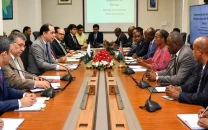
The IMF mission led by Iva Petrova concluded its staff visit to Islamabad between May 13 and 20, according to a statement issued by the lender on Thursday. "Discussions on the FY2027 budget will continue in the coming days," said Petrova after eight days of talks.
The IMF stated that the staff visit focused on recent economic developments, reform implementation, and the budget strategy for fiscal year 2027. Petrova said Pakistan remained committed to achieving the primary budget surplus target of 2% of GDP, or just over Rs2.8 trillion, for the next fiscal year. "The authorities reaffirmed their commitment to a primary surplus target of 2% of GDP in FY2027, which will support fiscal sustainability and continue to build resilience," she said.
She added that the envisaged gradual fiscal consolidation would be supported by efforts to broaden the tax base, improve tax administration, and enhance spending efficiency and public financial management at both federal and provincial levels.
Some budget numbers were also opened for discussion, and Pakistani authorities are now required to share their final estimates this week. The government plans to unveil the new budget on June 5.
The sources said a few issues remained outstanding, including the reliability of the revenue measures needed to achieve next fiscal year's tax collection target of Rs15.264 trillion for the Federal Board of Revenue (FBR). The government proposed reducing income tax rates for the salaried class and a 1% cut in the minimum income tax rate. The FBR assessed the estimated impact of these two measures at around Rs200 billion, which the IMF did not accept.
The secretary of finance, the director general of the tax policy office and the member (reforms) of the FBR did not respond to questions about whether there was disagreement between Pakistan and the IMF over these numbers.
The sources said the IMF also believed that the measures proposed to collect an additional Rs430 billion in taxes were insufficient and required review. Pakistani authorities suggested to the IMF that the test case for the reliability of these measures should be the first?quarter tax collection target of Rs3.05 trillion. They offered that if the July?September target was missed, the government would take additional revenue measures.
Another issue is how large a shortfall the FBR will sustain in this fiscal year, which will then affect the new year's target. The FBR has already recorded a Rs683 billion shortfall during the first ten months of this year against the downward?revised target.
The FBR this week suspended the sales tax registration of K?Electric, the country's largest utility company, and the Hyderabad Electricity Supply Company (Hesco) over issues with their tax payments. This will deny industrial and commercial consumers input tax adjustments.A K?Electric spokesperson said, "We have already engaged with the FBR on this matter, and we have been assured that the system will be restored to normal."
Petrova said the IMF had constructive discussions with the authorities on recent economic developments, including the impact of ongoing disruptions from the Middle East conflict, the new budget formulation, and progress on the reform agenda. She also said the State Bank of Pakistan (SBP) reiterated its commitment to maintaining an appropriately tight monetary policy stance to anchor inflation expectations and will continue to monitor potential second?round effects from energy price increases.
The IMF again emphasised exchange rate flexibility as a key shock absorber and said efforts should continue to build a deeper foreign exchange interbank market.
Petrova said discussions also covered ongoing structural reforms, including in the energy sector and state?owned enterprises, product market liberalisation, and financial sector reforms aimed at supporting durable growth and attracting high?quality private investment.
However, despite successive bailout packages, neither the government nor the IMF has succeeded in ending the inefficiencies of the power sector and other SOEs. For the next fiscal year, the government is budgeting nearly Rs1 trillion in subsidies, including Rs830 billion for the power sector. Pakistan Railways expenses are borne by taxpayers, both for salaries and pensions, and the management is reluctant to bring its law in line with the State?Owned Enterprises Act to improve efficiency and governance.
Petrova said the IMF would send its next mission to Pakistan later this year to review progress on implementation of the programme and hold Article IV consultations.
Amid the poor performance of the FBR, tax payments by salaried persons are growing every month. According to provisional FBR data, salaried individuals paid nearly Rs470 billion in income tax during the July?April period of the current fiscal year. Non?corporate sector employees paid the highest amount of Rs209 billion, corporate sector employees paid Rs150 billion, provincial government employees paid Rs63 billion, and federal government employees contributed Rs45 billion.
The IMF regards the primary budget surplus – revenues after interest payments – as sacrosanct. However, the FBR remains the weakest link. The lender has now further hardened the condition by linking a waiver for missing the target to IMF Executive Board approval.












This material may not be published, broadcast, rewritten, redistributed or derived from. Unless otherwise stated, all content is copyrighted © 2026 The Express Tribune.







COMMENTS
Comments are moderated and generally will be posted if they are on-topic and not abusive.
For more information, please see our Comments FAQ