Security forces kill TTP commander in Balochistan's Pishin
Updated 1 hour ago

Jonathan Powell calls on PM Shehbaz to discuss security, trade and diplomacy
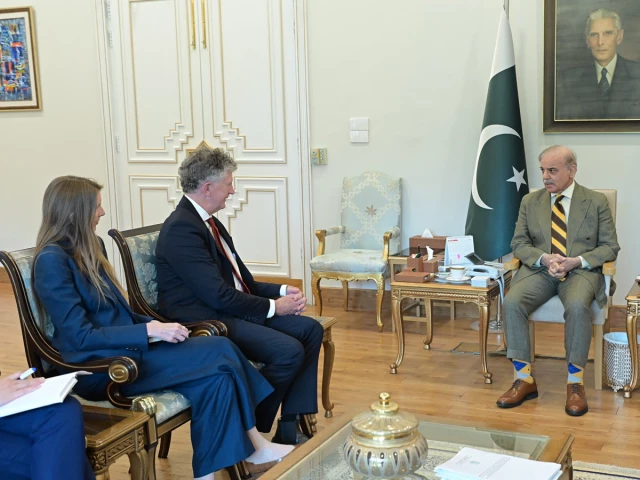
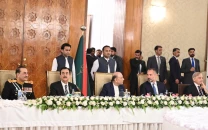
The United Kingdom’s National Security Adviser (NSA) Jonathan Powell on Wednesday conveyed the appreciation of the British government for Pakistan’s “constructive role in regional diplomacy” to Prime Minister Shehbaz Sharif amid efforts to yield a solution to the conflict between the United States and Iran.
According to a statement issued by the Prime Minister’s Office, Powell called on the premier at the Prime Minister's House.
“Powell conveyed the appreciation of His Majesty’s Government for Pakistan’s constructive role in regional diplomacy, including its ongoing efforts to facilitate dialogue and de-escalation in the broader region,” the statement said.
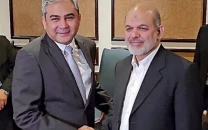
Read: Mohsin Naqvi meets IRGC chief in Tehran during second visit in less than a week
During the meeting, PM Shehbaz reaffirmed Pakistan’s commitment to maintaining “robust and forward-looking engagement” with the UK, which he described as a longstanding strategic partner.
Mr. Jonathan Powell, the UK’s National Security Adviser, called on Prime Minister Muhammad Shehbaz Sharif. Islamabad, 20 May 2026. pic.twitter.com/M5kK7pQwor
— Prime Minister's Office (@PakPMO) May 20, 2026
While conveying his best wishes to his British counterpart, Sir Keir Starmer, the prime minister recalled the warm and cordial telephone conversation between the two leaders last month, during which they expressed a shared desire to further strengthen Pakistan-UK ties.
The British NSA also congratulated the prime minister on the government’s economic reform efforts and expressed Britain’s interest in further expanding bilateral cooperation in the areas of security, trade, investment, and development.
On February 28, the US and Israel launched a joint offensive against Iran. Tehran retaliated with strikes on Israel and other Gulf countries hosting US assets.
Pakistan subsequently positioned itself as a key mediator for peace, brokering a two-week ceasefire and hosting the highest-level US-Iran talks since the 1979 Islamic Revolution. Although the "Islamabad Talks" ended without agreement, the ceasefire was held and later extended upon Islamabad's request.
Since the talks in Islamabad failed to yield any result, exchanges have continued between the sides, with Pakistan effectively playing its mediation role.
Also Read: Pakistan urges dialogue, diplomacy as only viable path to de-escalation and peace in Middle East
The fragile talks between Washington and Tehran have entered a sensitive stage after the two sides exchanged fresh proposals this week, the sources said.
“Currently, Pakistan's top priority is to further strengthen the ceasefire and persuade the two sides to hold another round of direct talks,” the sources said.
The latest US proposal offers “slightly better incentives” to Iran than previous offers, the sources said, without providing further details.
According to the sources, the proposal addresses Iran’s frozen assets and international sanctions imposed on Tehran.
However, they said Washington offered “no new concession” regarding Iran’s nuclear programme, which remains the central obstacle to reaching an agreement.
Under a 14-point Iranian proposal previously reported by Anadolu, Tehran seeks separate negotiations on its nuclear programme, including enriched uranium issues, within 30 days after a permanent ceasefire is reached.
Washington, however, wants the nuclear issue to be “discussed and resolved” before any permanent ceasefire agreement.









This material may not be published, broadcast, rewritten, redistributed or derived from. Unless otherwise stated, all content is copyrighted © 2026 The Express Tribune.






COMMENTS
Comments are moderated and generally will be posted if they are on-topic and not abusive.
For more information, please see our Comments FAQ