Trump's face could appear on US $250 bill
Updated 2 hours ago

Trump says good news on talks possible soon as Pakistan accelerates efforts to return US, Iran to negotiating table
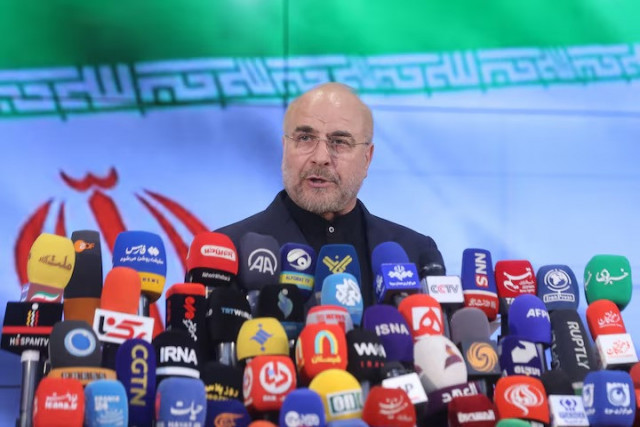
Iran’s Parliament Speaker and lead negotiator Mohammad Bagher Ghalibaf said on Wednesday that a "complete ceasefire" with the United States was only possible if the country stopped its naval blockade of the Strait of Hormuz.
In a post on X, Ghalibaf said: "A complete ceasefire only makes sense if it is not violated by the maritime blockade and the hostage-taking of the world’s economy, and if the Zionist warmongering across all fronts is halted; reopening the Strait of Hormuz is impossible with such a flagrant breach of the ceasefire.
"They did not achieve their goals through military aggression, nor will they through bullying. The only way forward is to recognise the rights of the Iranian nation."
آتشبس کامل وقتی معنا دارد که با محاصره دریایی و گروگانگیری اقتصاد دنیا نقض نشود و جنگ افروزی صهیونیستها در همه جبههها متوقف باشد؛ بازگشایی تنگه هرمز با نقض فاحش آتشبس ممکن نیست.
— محمدباقر قالیباف | MB Ghalibaf (@mb_ghalibaf) April 22, 2026
با تجاوز نظامی به اهداف خود نرسیدند،با قلدری هم نخواهند رسید. تنها راه، پذیرش حقوق ملت ایران است.
The comments came as multiple Pakistani sources familiar with the developments told Anadolu that Pakistan had accelerated its diplomatic efforts to seek a "breakthrough” to bring the US and Iran back to the negotiating table
"Renewed efforts are on to persuade Trump to end the blockade of Iranian ports, which is its (Tehran) prime condition for resumption of talks," a source said, adding Pakistan’s top leadership was involved in the diplomatic efforts.
However, sources insisted that “no definitive timeframe” could be given on when the next round of talks would take place and said that “both sides are testing each other's nerves."
Sources admitted the process to unfold the logjam is “tougher” than the first time when Islamabad brokered the ceasefire and brought the two sides face-to-face on April 11 and 12.
They added that Pakistan was in "constant" contact with regional nations seeking their "influence" to persuade Iran to come back to the table.
Islamabad was prepared for a second round of talks this week, but Tehran demanded the US lift the blockade of Iranian ports despite the US deciding to send Vice President JD Vance to Pakistan.
Another Pakistani government official confirmed to Anadolu that the "advanced" US team that landed in Islamabad on Sunday ahead of the possible second round of talks was still in the capital.
The talks have not taken place, and yet "there is no order for them from Washington to return", officials said.
Several US planes loaded with officials and equipment landed in Islamabad over the weekend, but officials from Iran failed to return to Islamabad.
Pakistani authorities have, however, continued high-level security measures in the capital as roads leading to the Red Zone remain closed to general traffic.
All the educational institutions and hostels in Islamabad and Rawalpindi have also remained closed since last week. Public transport, including metro bus services, also remains suspended.
Trump, according to the sources, believes that he can "twist Iran's arm" through a naval blockade of Tehran's port to hold the second round of talks from a "commanding position".
"Despite the highly complex nature of the issue, Pakistan is highly hopeful for a breakthrough as both sides acknowledge that war is not a solution to the conflict," the sources maintained.
Sardar Masood Khan, Pakistan's former ambassador to the US and the UN, reckons that some "confidence-building measures" from both sides, including easing blockades and ensuring freedom of navigation in the Strait of Hormuz, could help create a "conducive" environment for meaningful dialogue.
"If the US releases recently seized Iranian ships, and lifts the blockade of Tehran's ports while maintaining its military presence around the Strait of Hormuz, whereas, the Islamic Republic [of Iran], in return, fully opens the strait allowing all kinds of commercial traffic, it can be a common ground to bring the two sides to the table," Khan told Anadolu.
Meanwhile, Iranian President Masood Pezeshkian posted a similar comment as Ghalibaf on X.
"The Islamic Republic of Iran has welcomed dialogue and agreement and continues to do so. Breach of commitments, blockade and threats are main obstacles to genuine negotiations. World sees your endless hypocritical rhetoric and contradiction between claims and actions."
The Islamic Republic of Iran has welcomed dialogue and agreement and continues to do so. Breach of commitments, blockade and threats are main obstacles to genuine negotiations. World sees your endless hypocritical rhetoric and contradiction between claims and actions.
— Masoud Pezeshkian (@drpezeshkian) April 22, 2026
'Good news' of peace talks possible as soon as Friday, Trump tells NY Post
American media outlet The New York Post earlier reported that "good news" about the second round of scheduled talks between the United States and Iran in Islamabad could be possible as soon as Friday, according to President Donald Trump and Pakistani sources.
"Sources in Islamabad touted positive mediation efforts with Tehran, renewing the possibility of more peace talks within the next '36 to 72 hours'. Asked about this possible breakthrough by The Post, Trump, in a text message, said: 'It’s possible! President DJT'," the outlet reported.
It further said that in the time since last night's extension of the ceasefire between the warring countries, Pakistan had "continued working its diplomatic channels with Iran", and the time period was based on an assessment of that work, according to a source.
“The ceasefire is holding despite heightened rhetoric, indicating positive intent on both sides,” the source was quoted by the outlet as saying.
“No military escalation from either side. Pakistan remains the key mediator,” the person added.
Meanwhile, Axios reported, citing unnamed officials, that Trump’s negotiators are worried that there may not be anyone in Tehran to approve a deal with Washington.
The report said that Trump’s negotiators believe a deal to end the war and address “what's left of Iran's nuclear programme” is still achievable, but they are concerned that there may be no one in Tehran “empowered to say yes”.
It further claimed that Iran’s Supreme Leader Mojtaba Khamenei is “barely communicating”, adding that Islamic Revolutionary Guard Corps (IRGC) generals and Iran's civilian negotiators are “openly at odds over strategy”.
The interior "fracture" is partly a consequence of Israel's March assassination of Ali Larijani, the previous secretary of Iran's Supreme National Security Council, the report said, noting that his replacement, Mohammad Bagher Zolghadr, is “not effective” at coordinating between the IRGC, civilian leadership and the supreme leader.
According to the report, on Monday evening, Iran seemed to signal through Pakistani intermediaries that it was open to negotiations. By Tuesday morning, however, that openness vanished, replaced with a demand that the US end its naval blockade.
Trump reportedly believes the US has already achieved everything it can through military action and is looking to exit the increasingly unpopular conflict. He is unwilling to restart operations until all other avenues have been fully explored.
However, if Pakistani mediators fail to bring Iran to the table within the timeframe Trump has in mind, military action will once again be considered.
🇺🇸🇮🇷President Trump is giving Iran's warring factions a short window of several days to unify behind a coherent counter-offer — or the ceasefire he extended Tuesday ends, three U.S. officials tell me. My story on @axios https://t.co/AZRyt8nK8M
— Barak Ravid (@BarakRavid) April 22, 2026
Separately, Trump expressed his gratitude to Iranian leaders for cancelling the alleged executions of eight female protesters.
“I very much appreciate that Iran, and its leaders, respected my request, as President of the United States, and terminated the planned execution,” Trump wrote on Truth Social.
He characterised the development as “very good news”, adding that four of the women will be released immediately while the others will serve one month in prison.
https://t.co/GGwbAtAWmZ pic.twitter.com/3suq6gUw6s
— Rapid Response 47 (@RapidResponse47) April 22, 2026
The US president had appealed to Tehran on Tuesday to spare the women, framing their release as a "great start" to negotiations.
However, Iran’s judiciary-affiliated news agency, Mizan, earlier dismissed the claims of imminent hangings as “fake news”, asserting that none of the individuals involved faced a death penalty verdict.
According to Mizan, a detailed review of the cases shows that some of the individuals cited by Trump have already been released, while others face charges that, if confirmed by courts, could result in prison sentences.
Iran seizes two vessels in Strait of Hormuz as Trump continues naval blockade
Earlier, Iran’s Islamic Revolutionary Guard Corps (IRGC) said its naval forces intercepted two vessels in the Strait of Hormuz over alleged violations.
In a statement, the IRGC Navy said the vessels, identified as MSC Francesca, which it described as “linked to Israel”, and Epaminodes, were stopped for repeated violations, including operating without authorisation and allegedly tampering with navigation systems.
The force said the vessels were attempting to exit the strait “covertly” and were intercepted based on intelligence monitoring.
According to the statement, both vessels have been transferred to Iranian territorial waters for inspection of their cargo and documentation.
The IRGC Navy said it continues to monitor maritime traffic in the waterway and warned that any actions violating Iran’s navigation rules or threatening maritime security would be met with “decisive and legal action.”
The UK Maritime Trade Operations (UKMTO) said early on Wednesday a cargo ship came under gunfire near Iran’s coast in the Strait of Hormuz, marking the second such reported incident that day.
The agency said a vessel was fired upon approximately 8 nautical miles west of Iran’s coast and later stopped, though no damage or casualties were reported.
In another incident, a container ship reported being approached by a gunboat linked to the IRGC near the strait.
UKMTO said it has received dozens of reports of attacks and suspicious activities affecting vessels in the region since late February.
Another ship targeted in Iranian waters
— Mehr News Agency (@MehrnewsCom) April 22, 2026
🔺A Greek ship named Euphoria was targeted by the IRGC and is now stranded off the coast of Iran.
Earlier, the IRGC said it is prepared to deliver new achievements and “surprises”, warning of responses to any renewed act of aggression, according to Iran's semi-official Tasnim News Agency. In a statement released on Wednesday, the IRGC described itself as a force ready to deploy new capabilities on the battlefield against an aggressive and untrustworthy enemy.
The statement said the Iranian nation takes pride in the IRGC’s comprehensive strategic capabilities, alongside other branches of the Armed Forces, noting that their missile and drone strikes have left the Israeli and US forces strained and weakened.
According to Tasnim, referring to the current phase described as a “silence in military confrontation,” the IRGC stressed the need for vigilance and monitoring of the enemy’s behaviour during negotiations and the ceasefire" period.
Iran’s military said early on Wednesday that it would immediately strike pre-designated targets if the US launches any new attack on the country, according to state television.
The warning came in remarks by Ebrahim Zolfaghari, the spokesperson for Iran’s Khatam al-Anbiya Central Headquarters, following what he described as repeated threats by US President Donald Trump and American military commanders.
“Our capable and powerful forces have long been in a state of 100% readiness and are ready and on the trigger,” Zolfaghari said. He added that in the event of “aggression and any action against the Islamic Republic of Iran,” Iranian forces would “immediately and powerfully attack pre-determined targets.”
Iran says no talks with US until blockade lifted despite ceasefire extension
Iranian Ambassador to the United Nations Amir-Saeid Iravani responded to Trump's ceasefire extension, stating that there will be no talks with the US until the blockade is lifted.
Iran’s UN Ambassador Amir-Saeid Iravani has responded to US President Donald Trump’s announcement of an extension to the ceasefire, saying Tehran will not enter negotiations with the US unless the naval blockade is lifted. pic.twitter.com/xwgSyEZEoU
— Al Jazeera Breaking News (@AJENews) April 22, 2026
“The United States must halt its ‘violation of the ceasefire’ before any new round of negotiations,” the ambassador told Iranian media outlet Shargh, according to Al Jazeera.
“As soon as they lift the blockade, the next round of negotiations will be held in Islamabad,” the ambassador said, adding, “Iran is prepared for any scenario.” “We have not been the initiator of military aggression. If they seek a political solution, we are ready. If they seek war, Iran is ready for that as well,” he added.
Iranian spokesperson criticises US 'lack of good faith'
In an interview with the BBC, Spokesperson for the Iranian Foreign Ministry Esmaeil Baghaei said Iran entered the first round of talks with seriousness and goodwill, but lashed out at Washington for repeatedly shifting positions, maintaining its naval blockade, and taking hostile actions that undermine the diplomatic process, reported Iran's semi-official Tasnim News Agency.
He said Iran's delegation to the first round of Pakistani-mediated talks with the US had gone to Islamabad "with good faith and sense of seriousness, but you have a negotiating party that has shown its lack of seriousness, lack of good faith".
"They're changing their position frequently," he said.
According to Tasnim, he pointed to "flip flops, threats of war crimes," referencing Trump's social media posts and recent interviews where he threatened to "knock out every single power plant, and every single bridge" if Iran did not accept what he called the US's offer of a "very fair and reasonable deal".
Asked whether Iran had agreed to attend a new round of talks in Islamabad and then changed its decision, Baghaei said, "We never said we were going and then reneged our commitments - as is the habit of the United States."
UN chief welcomes US ceasefire extension with Iran
UN Secretary-General Antonio Guterres has welcomed an announcement by the US to extend the ceasefire with Iran, his spokesman said on Tuesday.
"This is an important step toward de-escalation and creating critical space for diplomacy and confidence-building between Iran and the United States," Stephane Dujarric said in a statement.
The statement came after Trump said that Washington would extend its ceasefire with Iran to allow time for Tehran to prepare a "unified proposal" following a request by Pakistani officials.
Dujarric said the UN encourages all parties to refrain from actions that could undermine the ceasefire and engage constructively in negotiations to reach "a sustainable and lasting" resolution.
Noting that Guterres fully supports Pakistan’s efforts to facilitate continued dialogue, Dujarric expressed hope that these diplomatic efforts would help establish the conditions necessary for a “comprehensive and durable resolution” to the conflict.
Trump's announcement came as a US delegation led by Vice President JD Vance was expected Tuesday to travel to Islamabad for a second round of face-to-face talks with Iran, though the trip was delayed.
The negotiations would have followed an initial round of high-level engagement in Pakistan earlier this month, which ended without a breakthrough.
The ceasefire, initially announced earlier this month, had been set to expire on Wednesday.
Arab foreign ministers demand Iran pay compensation for attacks, closure of Strait of Hormuz
Arab foreign ministers on Tuesday demanded that Iran pay compensation for damage caused by what they described as Iranian attacks on Arab countries and its closure of the Strait of Hormuz.
The position came in a resolution passed during an emergency Arab League meeting held by video conference under Bahrain’s chairmanship.
The resolution said Iran bears “full international responsibility” for attacks targeting Jordan, the United Arab Emirates, Bahrain, Saudi Arabia, Oman, Qatar, Kuwait, and Iraq, and is obliged under international law to provide “full reparation” for all resulting losses and damages.
It also condemned Iran’s closure of the Strait of Hormuz and threats to shut the Bab el-Mandeb Strait, saying such actions violate international law and the principle of freedom of navigation.
Abdullatif Al Zayani, Bahrain’s foreign minister, said Iran’s actions disrupted maritime traffic, threatened energy security, food and medicine supplies, and harmed global trade and the world economy.
He said Tehran must also be held accountable for the consequences of closing the Strait of Hormuz to international navigation.
Earlier this month, Iran demanded compensation from Saudi Arabia, Qatar, the UAE, Bahrain, and Jordan, claiming the countries had taken part in the war against Tehran.
Hostilities in the region escalated after the US and Israel launched joint strikes on Iran on Feb. 28. In response, Tehran carried out retaliatory strikes on Israel and other regional countries hosting US assets.
Trump declares Iran ceasefire extension with peace talks in doubt
Trump said he would indefinitely extend the ceasefire with Iran to allow for further peace talks, although it was not clear on Wednesday if Iran or Israel, the US ally in the two-month war, would agree.
Trump said in a statement on social media that "Upon the request of Field Marshal Asim Munir, and Prime Minister Shehbaz Sharif, of Pakistan, we have been asked to hold our attack on the Country of Iran until their leaders and representatives can come up with a unified proposal."
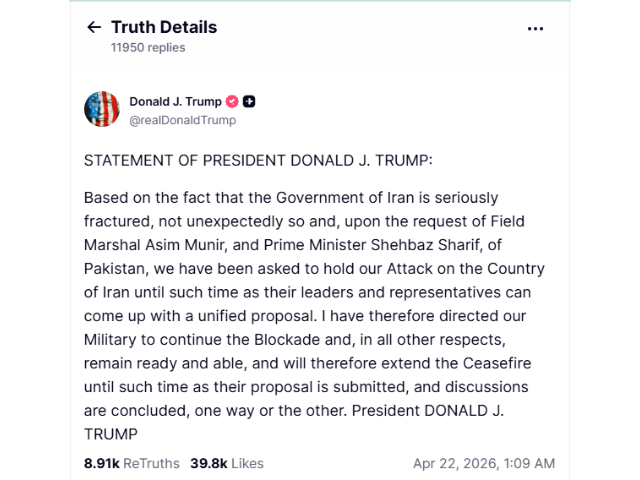
Pakistan's leaders have hosted peace talks in Islamabad to end a war that has killed thousands of people and shaken the global economy.
But even as he announced what appeared to be a unilateral ceasefire extension, Trump also said he would continue the US Navy's blockade of Iran's trade by sea, considered an act of war by Iran.
There was no response from senior Iranian officials early on Wednesday to Trump's announcement, although some initial reactions from Tehran suggested Trump's comments were being treated sceptically.
Read: Trump heeds CDF Munir, PM's truce call
Tasnim News Agency, affiliated with the Islamic Revolutionary Guards Corps, said Iran had not asked for a ceasefire extension and repeated threats to break the US blockade by force. An adviser to Iran's lead negotiator, the speaker of parliament, Mohammad Bagher Ghalibaf, said Trump's announcement carried little weight and may be a ploy.
Trump's wartime rhetoric has veered between extremes. In an expletive-filled threat against Iran only two weeks ago, he promised that a "whole civilisation will die tonight", while at other times he has appeared keen to end the violence and market uncertainty.
With his announcement, Trump again pulled back at the last moment from his threats to bomb Iran's power plants and bridges. United Nations Secretary General António Guterres and others have condemned those threats, noting international humanitarian law forbids attacks targeting civilians and civilian infrastructure.
In a separate Truth Social post, Trump has claimed that Iran is "collapsing financially" and "wants the Strait of Hormuz open immediately" as they are "starving for cash!" He has also claimed that the military and the police are "complaining that they are not being paid."
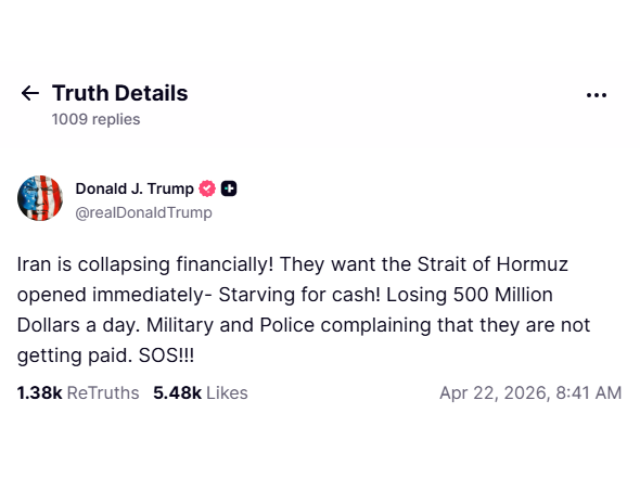
In a separate post, Trump stated that by opening the Strait, Iran could make "$500 million dollars a day," claiming that they "only say they want it closed because I have it totally BLOCKADED (CLOSED!), so they merely want to 'save face'."
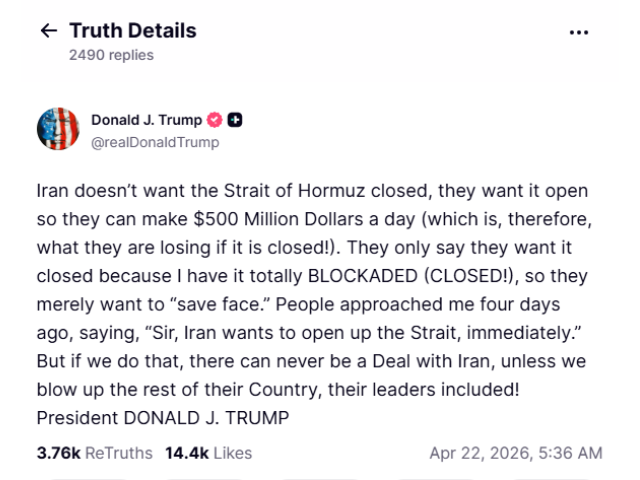
He added that there can "never be a deal with Iran" unless the US "blow(s) up the rest of their Country, their leaders included!"
Trump slams Wall Street Journal Op-Ed
Trump slammed Elliot Kaufman, a Wall Street Journal Editorial Board member, for his editorial piece titled "The Iranians Take Trump for a Sucker."
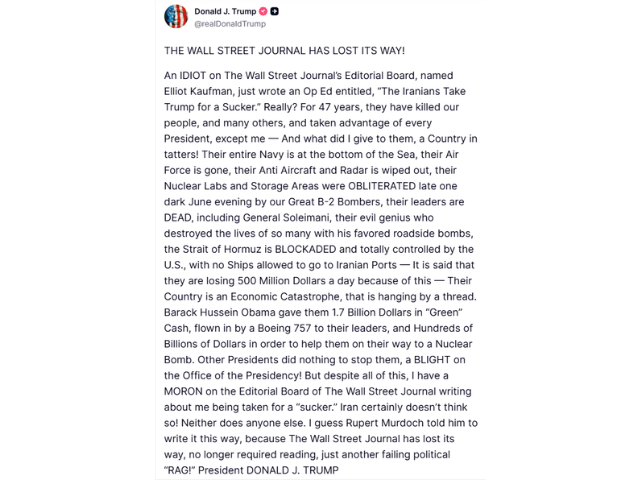
In response to the Op-Ed, Trump claimed that he gave the Iranians a "Country in tatters", saying that the US had destroyed their navy, air force, anti aircraft, radar systems and their nuclear laboratories and storage facilities, referring to the June 2025 attacks during Operation Midnight Hammer.
He went on to criticise former US president Barack Obama for giving Iran "$1.7 Billion Dollars in 'Green' Cash," and "Hundreds of Billions of Dollars in order to help them on their way to a Nuclear Bomb."
Next peace talks uncertain
The US and Israel began the war on February 28 with aerial bombardments of Iran, and one of the first strikes in Iran killed over 170 people, many of whom were children. The conflict quickly spread to Gulf states that host US military bases and to Lebanon after Hezbollah launched retaliatory strikes against the Israeli attacks on its territory.
Read more: US positive on Iran deal but talks still uncertain as ceasefire end nears
Israeli Prime Minister Benjamin Netanyahu has for decades sought to oust Iran's leadership, but Trump has given shifting and sometimes contradictory rationales for joining Israel to launch the war and how he foresees it ending, stirring confusion in global markets.
US stock futures rose, the dollar wavered, and oil prices turned lower on Wednesday after Trump's announcement.
More than 5,000 civilians have been killed across the region and hundreds of thousands displaced so far, mostly in Iran and Lebanon due to US-Israeli strikes on civilian infrastructure, and the war has led to the virtual closure of the Strait of Hormuz, a vital chokepoint in global energy markets between Iran and Oman, sending oil prices soaring and fears that the global economy could enter a recession.
Iran has repeatedly exploited its ability to control the passage of oil tankers and other ships in the strait in response to US and Israeli attacks.
Trump said in his statement he was willing to extend the ceasefire because "the Government of Iran is seriously fractured, not unexpectedly so," a reference to US-Israeli assassinations of some of the country's leaders in the war's first weeks, including the late Supreme Leader Ayatollah Ali Khamenei, who has been succeeded by his son.
A few hours before his announcement, Trump had told the CNBC news channel that he was not inclined to continue the temporary truce and the US military was "raring to go."
Those comments came as tentatively scheduled peace talks in Islamabad seemed on the verge of falling apart: US Vice President JD Vance, whose presence has been requested by the Iranians, had planned to return to Pakistan on Tuesday, but a White House official said he had not yet departed Washington and was taking part in additional policy meetings.
Before Trump's latest announcement, a senior Iranian official told Reuters that Iran's negotiators had been willing to attend another round of talks if the US abandoned a policy of pressure and threats, and rejected negotiations aimed at surrender.
Iran has condemned the US Navy intercepting and seizing two commercial Iranian ships at sea as part of its blockade, the second earlier on Tuesday, with its foreign ministry accusing the US of "piracy at sea and state terrorism." The US, joined by multiple other countries, has condemned Iran for impeding freedom of navigation in the Strait of Hormuz.
Hours after extending the ceasefire, Trump doubled down on the US blockade, saying in a social media post that lifting it would undermine any chance of a peace deal "unless we blow up the rest of their Country, their leaders included."
A first session of talks 10 days ago produced no agreement, with much of the focus on Iran's stockpiles of highly enriched uranium.
Trump claims he wants to take the uranium out of Iran to prevent the country from enriching it further to the point where it could develop a nuclear weapon. Iran says it has only a peaceful civilian nuclear program and a sovereign right to continue that as a signatory of the nuclear weapons non-proliferation treaty.






This material may not be published, broadcast, rewritten, redistributed or derived from. Unless otherwise stated, all content is copyrighted © 2026 The Express Tribune.






COMMENTS (2)
Comments are moderated and generally will be posted if they are on-topic and not abusive.
For more information, please see our Comments FAQ