Afghan Taliban mark five years in power
Updated 1 hour ago

European foreign ministers meet as Kyiv pushes for stronger role in ending the four-year war
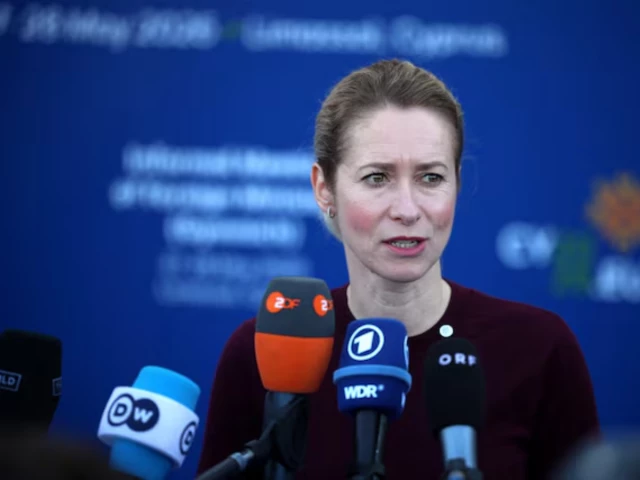
Russia will not get to choose who represents Europe in any potential talks with Moscow over Ukraine and the bloc will present a united front, European Union foreign ministers meeting in Cyprus said on Thursday.
The foreign ministers are gathering informally to discuss their strategy as Kyiv pushes for more European involvement to help end the more-than-four-year war, with the United States focused on its conflict with Iran.
Earlier this month, President Vladimir Putin suggested that former German chancellor Gerhard Schroeder, who has described the Russian leader as a personal friend, could represent Europe in possible talks.
European governments rejected that proposal, with European foreign policy chief Kaja Kallas restating that position on Thursday.
"I find that it's a trap that Russia wants us to walk into, that we discuss who talks to them, and they're already picking who is suitable or who is not," Kallas said.
"Let's not walk into that trap. Negotiation is always a team effort," she said. "That's why the substance is much more important than who".
"It is really the place to discuss with the foreign ministers the core interests, the core requests that we also have for Russia, because once we go to the table, then it should be also very clear what we are doing there," Kallas said.
The Kremlin said on Wednesday that Russian President Vladimir Putin was open to negotiations with Europe, the RIA news agency reported.
"Europe will decide the name of the negotiator, not Mr Putin," Italian Foreign Minister Antonio Tajani said when arriving for the ministerial gathering.
"It is not a Putin decision, it is our decision," he added.
Defining a common approach to Russia
Despite a flurry of speculation about whether the EU would designate an envoy for any talks, some ministers have said the discussion is premature.
"This is not the time when we are discussing who is going to have the negotiations," Lithuanian Foreign Minister Kestutis Budrys told reporters in Cyprus.
"But we have to discuss what we are doing to put additional pressure on Russia and also give more systems to Ukraine, for Ukraine to sustain these attacks and lead it to victory," he added.
Diplomats told Reuters ahead of Thursday's meeting that no decisions were expected in Cyprus, and that there was no consensus on European preconditions or demands for Moscow. Some officials also said they felt it was too early to discuss the question of an envoy.
Many ministers stressed the need for Europe to find a common position on how to approach possible future talks.
"What's important more than talking about the special envoy (...) is that it has to be one voice," Spain's Foreign Minister Jose Manuel Albares told reporters.
Carrying the European message
Some ministers signaled openness to Europe designating an envoy in the future.
"Europe needs to be at the table in any case, it can't be with 27 member states, and Europe is larger than the EU alone, but I am confident that together we can not only agree about a mandate, but perhaps also on some people that could take on this role," Finnish Foreign Minister Elina Valtonen told reporters.
Belgium's Foreign Minister Maxime Prevot said, "I think that we have to discuss about the contents of the potential negotiation process, what kind of project the EU can propose at the table of negotiation. And we also have to define someone to embody also the European message".
Asked if she would like the role of European negotiator, Kallas said her job is to represent the bloc.
"I'm the High Representative of the European Union, and you can read my job description in the treaties - and of course, that is also representing Europe. But for that, we need to be united".



This material may not be published, broadcast, rewritten, redistributed or derived from. Unless otherwise stated, all content is copyrighted © 2026 The Express Tribune.

1727268465-0/Untitled-design-(42)1727268465-0-208x130.webp "independence 2 0")
COMMENTS
Comments are moderated and generally will be posted if they are on-topic and not abusive.
For more information, please see our Comments FAQ