China visit: growing anarchy and despotism
Updated 2 hours ago

.
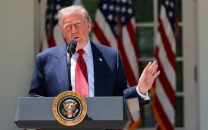
The much-awaited President Donald Trump's visit to China, which was delayed due to the Iran War, finally materialised. The visit was a global event of immense significance, and a political and strategic analysis of the visit is already underway. Political analysts are examining what future trajectory this most important geopolitical relationship in the world is likely to take and how the future balance of power in international politics is likely to be shaped by these states.
This meeting took place in an international environment locked in a great power rivalry, unending global security and strategic competition, one that divides the world into pro-China and anti-China blocs. Yet, the visit managed to convey subtle messages of the underlying intentions of these two great powers. The message in the direct leader-to-leader diplomacy during this visit was simple: use such contact more frequently to create stability and prevent the great power rivalry from taking an upward trajectory of conflict. To further this intention, President Trump has already invited President Xi Jinping to visit the USA in September this year. The visit conducted during the ongoing Iran War also sends a broad message that the current de facto China-US bipolarity is more engaging, suitable and meaningful than the emerging multipolarity in finding solutions to the ongoing global crises. It is also, unlike the earlier US-Soviet Union bipolarity, not just about threats, risks, pre-emption, deterrence and strategic containment but about responsibility as well.
Specifically, in the case of the Iran War, it means bipolar engagement by the two great powers to de-escalate, stabilise and prevent broader expansion of the regional conflict. Unlike the bipolarity in the Cold War, which saw the spread of communism by the Soviet Union being globally contained, the current US grand strategy against China is both about containment and engagement. Given this emerging geopolitical reality, the international system is likely to experience change. In the absence of any central authority, it will remain anarchic but engagement of the two great powers to coexist and cooperate is likely to strengthen and reinforce the element of despotism at the regional and global levels.
Thomas Hobbes viewed anarchy as humanity's most immediate danger, describing life without authority - or central authority in the case of the international system - as solitary, nasty, brutish and short. The consequence of such an anarchic international system in the recent past has been the insecurity experienced by weak states like Afghanistan, Libya, Iraq, Lebanon and Syria. When the US projected too much power in the unipolar moment, it maximised the growth of international anarchy and disorder, with weak states paying a price as the life of their governing administrations became solitary, nasty, brutish and short. If the US and China agree to increasingly cooperate and engage, then the US will have to accept China as a hegemon in Asia - one that, like the US, uses pressure, intimidation, coercion and force to manage its sphere of influence. Other countries in the region cannot contain China and if the US air and naval assets remain deployed in the Middle East and the US cannot pivot towards the East Pacific, China will be free to impose a despotic and free-from-international-law control and authority over ordinary powers. Such an international system showcasing both anarchy and despotism will resemble an empire or hegemonic order rather than a system of equal sovereign states that the current world order of liberal internationalism represents.
China will actually be following the US lead, which often presents itself as defending a rules-based international order, but in practice, it also exercises forms of despotic power. The US responds to uncertainty by maintaining military alliances like NATO, strengthening Indo-Pacific partnerships like QUAD, and utilising maximum pressure and deterrence strategies to achieve strategic objectives against its rivals. The US support of Israel in the Gaza war and the US war against Iran represent a clear violation of international law and an expression of international despotism, where a dominant power can get away with violating international law to shape a regional future of its liking.
Other examples of the American display of despotism in the international system include USD dominance in global finance, which gives Washington coercive leverage through sanctions; the sanctions on Iran and Russia affect other countries as well. The American influence in institutions like the International Monetary Fund and World Bank is also a despotic attempt to shape global economic behaviour. The US manages anarchy, but by preserving a system of despotic hierarchy together with its allies and partners, it wishes to turn the world into an American kingdom in which states remain dependent and insecure.
What the US and China may have agreed to in Beijing is strategic coexistence. Under the concept of great powers engagement, both great powers are likely to accept the dominance and control of their respective spheres of influence and, in doing so, promote despotism in an international system that fundamentally would remain anarchic but in which authority will remain concentrated in the dominant power.
Chinese promotion of international despotism will be through its Belt and Road Initiative, which it is already utilising to create long-term dependency through infrastructure financing. In the South China Sea, China will continue to impose its preferred regional order despite objections by other countries. China will also use Institutions like the Asian Infrastructure Investment Bank to provide alternatives to Western-led institutions.
Both the US and China will continue to compete in three dimensions of global competition: security, trade and developing high-end technologies, but within their spheres of influence: the Western Hemisphere in the case of the US and the South China Sea and Eastern Pacific in the case of China. Both great powers will bend the rules, shape dependencies and create new loyalties in an international system that will now be not only anarchic but despotic. The international system will cede to their despotism because their powers will be unchallenged, arbitrary, without accountability and in disregard of international law. All this with little respect for the agency of smaller states.












This material may not be published, broadcast, rewritten, redistributed or derived from. Unless otherwise stated, all content is copyrighted © 2026 The Express Tribune.




COMMENTS
Comments are moderated and generally will be posted if they are on-topic and not abusive.
For more information, please see our Comments FAQ