Deadly drone strike on Kuwait tests shaky ceasefire
Updated 5 hours ago

Says he could accept a 20-year halt to Iran’s nuclear activity
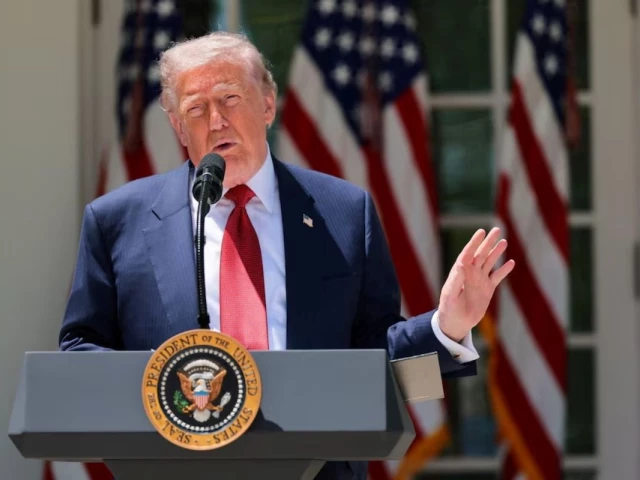
United States President Donald Trump said on Friday that the ceasefire with Iran was made as a "favour" to Pakistan and at the request of other countries.
"We really did the ceasefire at the request of other nations, I would not have been in favour of it. We did it as a favour to Pakistan, they are terrific people, the field marshal, the prime minister," he said while talking to reporters aboard Air Force One on his return trip from a state visit to China.
Trump on Iran:
— Clash Report (@clashreport) May 15, 2026
We really did the ceasefire at the request of other nations.
I wouldn't have really been in favor of it, but we did it as a favor to Pakistan — terrific people, the field marshal and the prime minister. pic.twitter.com/Bsa3AqpcNl
He also indicated that he could accept a 20-year halt to Iran’s nuclear activity while dismissing the latest proposal from Iran as "unacceptable".
BREAKING: Trump indicated he could accept a 20-year halt to Iran’s nuclear activity:
— Clash Report (@clashreport) May 15, 2026
20 years is enough. But the level of guarantee from them… it's got to be a real 20 years. pic.twitter.com/cic86rTAuC
Reporter: Have you rejected the latest proposal from Iran or where does that stand?
— Clash Report (@clashreport) May 15, 2026
Trump: Well, I looked at it and if I don't like the first sentence, I just throw it away.
Reporter: What was the first sentence?
Trump: An unacceptable sentence. If they have any nuclear in any… pic.twitter.com/K2Ptswdr1a
Pakistan’s mediation process facing difficulties but remains active: Iran's Araghchi
Iranian Foreign Minister Abbas Araghchi said Pakistan’s mediation efforts regarding regional tensions had “not failed” but were currently facing difficulties. He added that Tehran would welcome any constructive role played by China to help ease the situation and support diplomatic progress.
Speaking at the Iranian Embassy in New Delhi, Araghchi said Iran was attempting to preserve the current ceasefire in order to give diplomacy an opportunity to move forward. He added that Tehran has "no trust" in the US and is interested in negotiating with Washington only if it is serious. Iran is trying to keep the ceasefire to give diplomacy a chance, he told reporters during a press conference.
"The mediation process by Pakistan has not failed yet, but it is in a very difficult course, mostly because of the Americans' behaviour and the mistrust which exists between us," Araghchi said.
"Contradictory messages" have made us reluctant about the real intention of the Americans in negotiations, Araghchi added. He also acknowledged the impact of US sanctions on Tehran, saying Iran fully understood the consequences of the restrictions imposed by Washington.
In comments carried by Iran’s IRIB broadcaster, he said Iran is not to blame for disruptions in the Strait of Hormuz, and that Tehran did not initiate the war and is only defending itself. He reiterated Iran’s position that the strait is now open to vessels of “friendly countries”, as long as they coordinate with Iranian officials, and only closed to Iran’s “enemies”.
Also Read: Trump says he and China's Xi agree Iran cannot have nuclear weapons
Araghchi also confirmed he has spoken with Russian officials about Moscow’s offer to store Iran’s enriched uranium and expressed appreciation for the country’s “intention to help”. He said Iran plans to postpone the issue of its enriched uranium to later stages of negotiations with the US, but may consider Russia’s proposal at an appropriate time.
“When we come to that stage, obviously we will have more consultations with Russia and see if the Russian offer can help or not,” he said. “This is not something at the time being”.
Addressing concerns over maritime security, Araghchi described the situation around the Strait of Hormuz as “very complicated”, saying Iran was attempting to help maintain stability in the strategic waterway. He said all vessels would be allowed to pass through the strait except those belonging to countries “at war with Iran”, adding that ships seeking passage should coordinate with the Iranian navy.
Top diplomats from the BRICS bloc held fresh talks on the second day of meetings in New Delhi. The gathering comes amid the US-Israeli war with Iran, which began on February 28 but is currently paused under a fragile ceasefire.
India issued a chair's statement at the conclusion of the annual BRICS foreign ministers' meeting instead of a joint statement and said there were differing views among some members on the situation in the Middle East.
Araghchi also said he had "received messages" from the US saying it was willing to continue talks, and that he was open to any support, including from China.
"We received messages again from the Americans saying that they are willing to continue the talks and continue the interaction," Araghchi told reporters.
"We appreciate any country who has the ability to help, particularly China," Araghchi said.
"We have very good relations with China, we are strategic partners to each other, and we know that [the] Chinese have a good intention, so anything that can be done by them to help diplomacy would be welcomed by the Islamic republic," he added.
China said it had been working to help end the conflict since it began with US and Israeli strikes on Iran on February 28.
"There is no point in continuing this conflict, which should not have happened in the first place," China's foreign ministry told AFP.
"To find an early way to resolve the situation is in the interest of not only the US and Iran, but also regional countries and the rest of the world."
UAE to accelerate oil pipeline project to help bypass Hormuz
The United Arab Emirates will accelerate construction of a new oil pipeline to double its export capacity through Fujairah by 2027, the government's Abu Dhabi Media Office said on Friday, vastly expanding its ability to bypass the Strait of Hormuz.
Abu Dhabi Crown Prince Sheikh Khaled bin Mohamed bin Zayed directed the Abu Dhabi National Oil Company (ADNOC) to fast-track the West-East Pipeline project during an executive committee meeting, ADMO said, adding the pipeline is under construction and expected to start operating in 2027.
It did not disclose the original timeline for the project.
The UAE's existing Abu Dhabi Crude Oil Pipeline (ADCOP), also known as the Habshan-Fujairah pipeline, can carry up to 1.8 million barrels per day, and has proved crucial as the country seeks to maximise direct exports from the Gulf of Oman coast.
The UAE and Saudi Arabia are the only Gulf producers with pipelines that export crude outside the Strait of Hormuz, while Oman has a long coastline on the Gulf of Oman.
Read: Oil rises after Trump says he is losing patience with Iran
The narrow waterway between Iran and Oman was effectively shuttered by Iran in response to a US-Israeli air and naval campaign that began on February 28, choking off about a fifth of global oil supplies that normally flow to Asia and elsewhere.
Kuwait, Iraq, Qatar and Bahrain are almost wholly reliant on the strait for shipments.
Energy prices have surged due to the disruption to supplies, prompting governments to ration fuel and raising fears of an economic downturn as inflation builds.
Meanwhile, France’s aircraft carrier Charles de Gaulle will soon arrive near the Strait of Hormuz, France’s minister delegate for the armed forces said on Friday, amid heightened tensions in the Gulf.
The French aircraft carrier Charles de Gaulle is “advancing into the Arabian Sea” and is already “in the area,” Alice Rufo told the French news broadcaster BFMTV. “It is advancing into the Arabian Sea; it is in the area,” Rufo said, referring to the French aircraft carrier.
US State Department offers bounties for information on IRGC drone-production unit
The US State Department offered hefty rewards for information on six individuals it says are involved in the drone-production wing of Iran’s IRGC Quds Force, identified as the Kimia Part Sivan Company (KIPAS), according to Al Jazeera.
The individuals, the State Department says, “are involved in KIPAS’s testing, development and supply of drones”.
A post by the State Department’s national security rewards programme said people who submit tips about individuals, their associates, or financial networks may be eligible for an award of up to $15m.
“Help us put a dent in the IRGC’s revenue stream,” the post stated, according to Al Jazeera.
China says 'no point in continuing' Iran war
China said on Friday that there was "no point in continuing" the Iran war as Chinese President Xi Jinping hosted his Trump on the final day of their Beijing summit.
"There is no point in continuing this conflict, which should not have happened in the first place," said a Chinese Foreign Ministry spokesperson in response to a question on whether the two sides discussed Iran and about Beijing’s position on the war.
"To find an early way to resolve the situation is in the interest of not only the US and Iran, but also regional countries and the rest of the world," the spokesperson said.
Read: US House narrowly rejects bid to rein in Trump Iran war powers
As the door to dialogue has now been opened, "it should not be shut again," the spokesperson said, urging efforts to maintain momentum toward de-escalation and pursue a political settlement, as well as dialogue and consultation to reach an agreement on the Iranian nuclear issue and other concerns.
The spokesperson also stressed the importance of reopening shipping lanes "as soon as possible to respond to the call of the international community and jointly keep the global supply chains stable and unimpeded."
"It is important to reach a comprehensive and lasting ceasefire as soon as possible, enable peace and stability to return to the Middle East and Gulf region at an early date, and lay the foundation for building a sustainable security architecture for the region," the spokesperson added








This material may not be published, broadcast, rewritten, redistributed or derived from. Unless otherwise stated, all content is copyrighted © 2026 The Express Tribune.









COMMENTS (1)
Comments are moderated and generally will be posted if they are on-topic and not abusive.
For more information, please see our Comments FAQ