PSX down 670 points on profit-taking ahead of Eid
Updated 19 minutes ago

Fallout may halve exports, slash remittances by 40%, push inflation to 17%
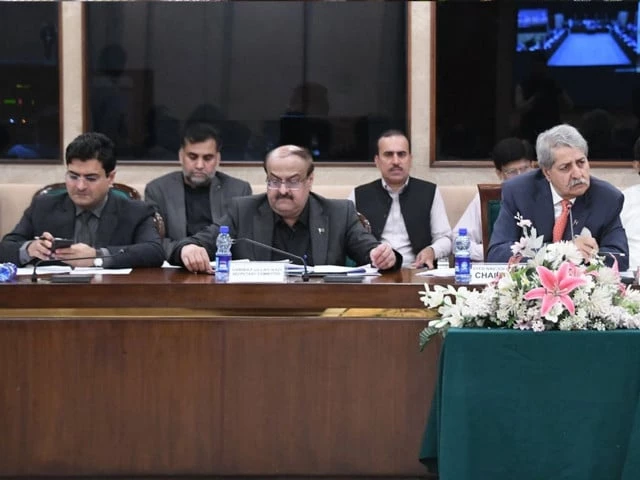
The Middle East conflict can cause $10 billion to $68 billion annual losses to Pakistan's economy, and inflation could hit 17% in an extreme oil price volatility situation, said an economist in a briefing to the National Assembly Standing Committee on Finance on Thursday.
The three different impact scenarios that Ali Salman, who is also head of the Policy Research Institute of Market Economy (PRIME), showed that in case of a severe shock, remittances can go down by 40% while exports may dip by almost 50% against their current monthly levels.
National Assembly Standing Committee on Finance Chairman Syed Naveed Qamar had arranged the briefing for the benefit of legislators.
There could be a minimum of $10 billion to a maximum of $50 billion in losses in three different scenarios of the war, said Salman. The estimated losses are far greater than Pakistan's current three-year $7 billion International Monetary Fund (IMF) programme, stated Qamar.
The war began on February 28. Although Israel and the US are not attacking Iran anymore, Iran has virtually closed the Strait of Hormuz while the US has enforced a naval blockade to disrupt Iranian oil shipments.
Inflation is a major challenge that will impact the entire macroeconomic framework of the country, said Salman.
Current scenario
While presenting three different shock scenarios, he briefed the committee that the annual impact of 51 days of war on Pakistan's economy was in the range of $10 billion to $14 billion. This includes $334 million additional per month impact of oil import, $333 million estimated reduction in monthly remittances, $400 million impact on exports and $100 million monthly increase in freight charges. Inflation is projected to stay in the range of 10% to 12%. Prime Minister Shehbaz Sharif said on Wednesday that the weekly oil import bill has already jumped from $300 million to $800 million.
Adverse scenario
In case of adverse impact where war continues for three months, Salman said that the annual impact will be in the range of $24 billion to $32 billion. His assessment was that the oil import bill can increase by $1 billion per month, remittances can go down by $700 million per month, exports could take a hit of $800 million a month and war risk impact is $150 million a month. Inflation can go up to 13% to 15%. Pakistan's normal monthly remittances range around $3.8 billion while its exports are roughly $2.5 billion a month.
Severe scenario
In case of severe shock where oil prices can go as high as $150 per barrel, Pakistan's economy may take an annual hit of $50 billion to $68 billion, said Salman. The monthly impact is $5.7 billion in this case. In the severe case scenario, the monthly oil import bill could increase by $2.8 billion, remittances can go down by $1.5 billion a month, and exports can take a hit of $1.2 billion.
The war risk surcharge can go as high as $5.7 billion a month and inflation may increase to 17%, he added. The estimates shared by the economist with the standing committee thus far are the highest and are equal to 17% of the size of Pakistan's economy.
Salman said that the oil price hike has already added approximately $4 billion to Pakistan's external payments by April 30 or in two months. He said that cabinet salary cuts for two months, coupled with a 25% reduction in salaries of legislators, would hardly save Rs85 million to Rs100 million. Despite the difficult economic times, for the Ministry of Finance it was business as usual. It moved a bill to amend the Fiscal Responsibility and Debt Limitation Act, which the standing committee also approved. The purpose of the amendments was not to control the public debt but to get powers to appoint as many directors in the Debt Office as the finance ministry deemed fit.
MNA Sharmila Faruqi objected to giving powers to appoint an unlimited number of directors, but Naveed Qamar said that he knew that appointing more directors would not change anything. This should not be used as an excuse for not managing the debt, he said.
MNA Jawad Hanif Khan questioned that the Ministry of Finance was showing eagerness to appoint more directors, but the post of director general had been vacant for months. Omar Khan, who is leading the Debt Office and is not an employee of the federal government, could not give a satisfactory response except for saying that the post has already been advertised.
MNA Hina Rabbani Khar asked why the Ministry of Finance was not able to observe the 56% debt-to-GDP limit. The debt-to-GDP ratio in the last fiscal year remained at 70.7%, admitted Omar Khan.
Jawed Hanif proposed that an amendment should be made to bind the finance ministry to report to parliament whenever the statutory debt limit is breached. However, Minister of State for Finance Bilal Azhar Kayani said that the debt limit was not a border "that you cross and report when you come back". His view was that the statutory debt limit was an aspirational clause, but Naveed Qamar did not agree with it.












This material may not be published, broadcast, rewritten, redistributed or derived from. Unless otherwise stated, all content is copyrighted © 2026 The Express Tribune.








COMMENTS
Comments are moderated and generally will be posted if they are on-topic and not abusive.
For more information, please see our Comments FAQ