CM Murad dismisses talk of 28th Amendment, says no move possible without PPP consent
Updated 3 hours ago

Notes preservation of such sites offers insight into forces that shaped modern China
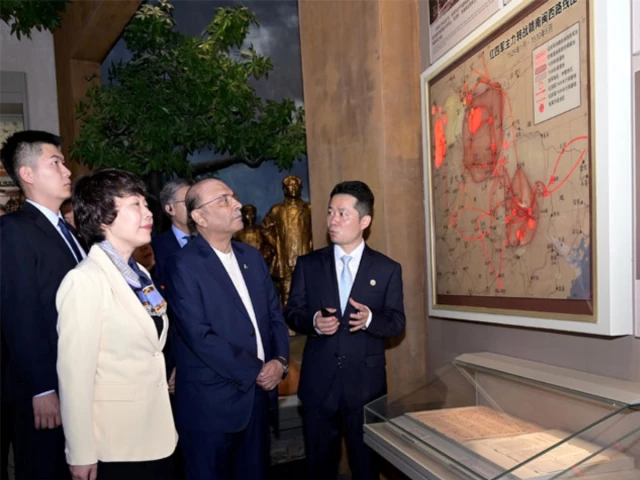
President Asif Ali Zardari on Tuesday visited Mao Zedong’s hometown in China's Shaoshan. He laid a wreath at the statue of Chairman Mao and paid tribute to China’s revolutionary leader, Radio Pakistan reported.
The president was received by senior party leader of the Xiangtan People’s Congress, Li Jiyang, and Director of the Shaoshan Administration Bureau of Hunan Province, Zhang Xihui, who briefed him on the life and struggle of Chairman Mao Zedong, highlighting his early years in Shaoshan and the influences that shaped his political thought.
The president was also briefed on the role of memorial institutions in preserving historical material and promoting public understanding of China’s revolutionary history.
Following the wreath-laying ceremony, the president visited the Mao Zedong Memorial Museum, where he was briefed on the life, thought and political legacy of the founding leader of the People’s Republic of China. He viewed historical artefacts, archival material and exhibits documenting key phases of China’s revolutionary history.
President Zardari paid tribute to Chairman Zedong’s role in China’s historical transformation and acknowledged his contribution to the country’s struggle, unity and development. He noted that the preservation of such sites offers insight into the forces that shaped modern China and underscores the importance of historical memory in national progress.
On Monday, Pakistan and China signed three memorandums of understanding (MoUs) aimed at strengthening bilateral cooperation in desalination, agricultural technology and the tea industry, in a move expected to boost investment, technology transfer and economic ties between the two countries.
The first MoU was concluded between the Government of Sindh and Lucion Environmental Technology Group for collaboration on a seawater desalination project in Karachi. The project aims to enhance the city's water supply by making seawater usable through modern technology.
The second MoU focused on cooperation in agricultural technology. Sharjeel Inam Memon signed it on behalf of the Sindh government and Chen Zhixin, chairman of Longping High-Tech Information Company, signed for the Chinese side.
The agreement is expected to introduce modern farming techniques, improved seeds, and advanced research to enhance agricultural productivity in Sindh.
The third MoU, relating to the tea sector, was signed between MESKAY & FEMTEE Trading Company, Hunan Tea Group and Jiaolong International Technology in Hainan.
Separately, the president conferred the Sitara-i-Pakistan on Professor Pan Xiangbin at a special investiture ceremony in recognition of his outstanding contributions to cardiac care and his services to patients in Pakistan.
Prof Xiangbin, an interventional cardiologist and cardiac surgeon, serves as vice president of Fuwai Hospital under the Chinese Academy of Medical Sciences and director of the National Interventional Quality Control Center for Structural Heart Disease.
An internationally recognised expert, he has pioneered advanced diagnostic and therapeutic technologies, including ultrasound-guided interventional techniques that allow treatment without surgery, radiation exposure or general anaesthesia.
President Zardari said these efforts had strengthened Pakistan's healthcare capacity and demonstrated the tangible benefits of Pakistan-China cooperation.





This material may not be published, broadcast, rewritten, redistributed or derived from. Unless otherwise stated, all content is copyrighted © 2026 The Express Tribune.





COMMENTS
Comments are moderated and generally will be posted if they are on-topic and not abusive.
For more information, please see our Comments FAQ