Trump intervenes as Nvidia reinstates Huang
Updated 24 minutes ago

Discussions focused primarily on the Strait of Hormuz and Iran's stockpile of highly enriched uranium
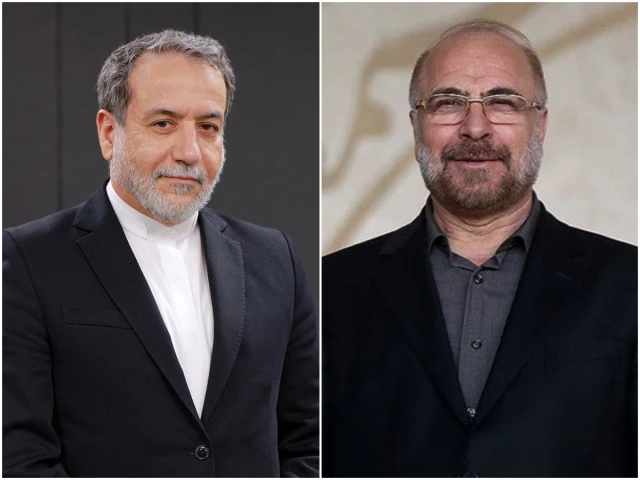
Iran's top negotiator and its foreign minister were in Doha for talks with Qatar's prime minister on a potential deal with the United States to end the three-month-old war, an official briefed on the visit said on Monday, after Washington and Tehran played down hopes for an imminent breakthrough.
US Secretary of State Marco Rubio told reporters in New Delhi earlier that the US would give diplomacy every chance to succeed before considering whether to deal with Iran in "another way".
There was a "pretty solid thing on the table in terms of their ability to open up the strait, get the Strait [of Hormuz] open, enter into a very real, significant, time-limited negotiation on the nuclear matter, and hopefully we can pull it off", Rubio said.
In a lengthy post on Truth Social on Monday, US President Donald Trump said talks with Iran were going "nicely", but warned of fresh attacks if they failed. It "will only be a great deal for all, or no deal at all", he wrote.
“The negotiations are proceeding in an orderly and constructive manner, and I have informed my representatives not to rush into a deal in that time is on our side… Both sides must take their time and get it right. There can be no mistakes!” - President Donald J. Trump 🇺🇸 pic.twitter.com/GfylPZdqBf
— The White House (@WhiteHouse) May 24, 2026
In his post, he urged more Arab and Muslim states to sign up to the Abraham Accords, which were brokered during Trump's first term in office and aim to normalise ties between Arab and other Muslim-majority states and Israel.
He said Saudi Arabia and Qatar should immediately sign up and everyone else should follow suit, calling his request mandatory.
Israeli Prime Minister Benjamin Netanyahu's office did not immediately respond to a request for comment on Trump's post.
Iran's foreign ministry spokesperson Esmaeil Baghaei said in a weekly briefing on Monday that a conclusion had been reached on many topics, but that does not mean that "we're close to signing an agreement".
The official briefed on the Iranians' Doha visit told Reuters the discussions were focused primarily on the Strait of Hormuz and Iran's stockpile of highly enriched uranium, while the country's central bank governor is also part of the delegation to discuss the potential release of frozen Iranian funds as part of a final deal.
Baghaei said the potential memorandum of understanding contains 14 points and is focused on ending the war and the US naval blockade of the Strait of Hormuz, in exchange for Iran taking steps to ensure safe transit through the strategic waterway.
He said the talks were not yet focusing on nuclear issues, however, which will be negotiated over a 60-day period if the framework accord is agreed.
Trump has said his key aim in the war is to prevent Iran from developing a nuclear weapon with its highly enriched uranium. Tehran has consistently denied it has any plans to do that.
As efforts to reach a deal continued, Iran said it had downed a "hostile" stealth drone using a new air defence system, Iranian news agencies reported, without saying where it had come from.
"This is a sign from us that no more stealth drones can penetrate the skies of the Persian Gulf," Fars quoted unnamed officials as saying.
Baghaei said the potential accord contained no specific details on management of the strait, through which about a fifth of the world's oil and liquefied gas usually flows.
Iran will not charge tolls for ships to pass through, Baghaei said. However, he added there would be a cost for services offered, such as navigation and steps to protect the environment, under a protocol to be agreed with Oman, which shares the opposite shore of the waterway.
The strait has been effectively closed since the US and Israel first launched strikes on Iran on February 28, with only a handful of vessels passing through compared with about 125 to 140 daily before the conflict.
Iran's state TV said on Monday that 32 vessels and five oil tankers passed through the Strait of Hormuz in the past 24 hours with the authorisation of Iran's Revolutionary Guards naval forces, and it reiterated that no vessel would be allowed to transit without coordination with the IRGC.
The energy crisis due to the Hormuz standoff has caused a spike in oil prices and driven up the costs of fuel, fertiliser and food.
Oil prices fell more than 4% to two-week lows on Monday on optimism that the US and Iran might be moving closer to a deal.
The two sides remain at odds on several difficult issues, however, such as Iran's nuclear ambitions, Israel's war in Lebanon with the Iranian-backed Hezbollah militia and Tehran's demands for the lifting of sanctions and the release of tens of billions of dollars of Iranian oil revenues frozen in foreign banks.
Trump, whose approval ratings have been hit by the war's impact on US energy prices, and who has faced congressional efforts to curb his war powers, has repeatedly played up the prospect of a deal to end the war.
Separately, two sources said Israeli Prime Minister Benjamin Netanyahu has told his confidants that Israel now has little ability to influence Trump's decision-making over the Iran conflict.
Iran will not submit to enemy's 'excessive demands': Pezeshkian
Iranian President Masoud Pezeshkian slammed the enemy’s insistence on imposing an economic war against Iran, saying the country will not submit to the enemy’s “excessive demands,” according to Iranian state broadcaster IRNA.
In a meeting with members of the Iran Chamber of Commerce, Industries, Mines, and Agriculture on Monday, Pezeshkian said that negotiations with the US were planned to ensure that Iran's rights as a nation are fully secured, and that the nation will not submit to pressures and demands.
🚨President Pezeshkian:
— IRIB (Islamic Republic of Iran Broadcasting) (@iribnews_irib) May 25, 2026
We will not give in to the excesses of the #enemy.
The rights of the Iranian nation must be fully enforced.
Although the adversaries shifted their focus to economic warfare after military failure, the government and the private sector will also successfully navigate this stage, he added.
On May 20, Pezeshkian said in an X post that “Iran has consistently honoured its commitments and explored every avenue to avert war; all paths remain open from our side.”
Iran has consistently honored its commitments and explored every avenue to avert war; all paths remain open from our side. Forcing Iran to surrender through coercion is nothing but an illusion. Mutual respect in diplomacy is far wiser, safer, and more sustainable than war.
— Masoud Pezeshkian (@drpezeshkian) May 20, 2026
“Forcing Iran to surrender through coercion is nothing but an illusion. Mutual respect in diplomacy is far wiser, safer, and more sustainable than war,” he added.
Xi says China commends Pakistan for its mediating role in restoring peace in Middle East
China commends Pakistan for taking the initiative to play a mediating role in restoring peace in the Middle East, Chinese President Xi Jinping said on Monday when meeting with Prime Minister Shehbaz Sharif.
Read: Pakistan, China sign agreements spanning agriculture, education, media and trade
PM Shehbaz said that Pakistan appreciated China's support for Pakistan in mediating the US-Iran negotiations, noting that President Xi's four propositions on the Middle East situation offer guidance for achieving peace
China urges US, Iran to maintain ‘momentum of de-escalation’
China on Monday urged the US and Iran to continue the “momentum of de-escalation” as potential signs emerged that the war between the two sides could wind down following recent diplomatic contacts.
“China’s position on the Iranian situation is very clear. This is a conflict that should never have happened and there is no need for it to continue,” Foreign Ministry spokeswoman Mao Ning told reporters in Beijing.
She was responding to questions about ongoing intense diplomatic efforts toward a potential pact between the US and Iran to permanently end the war, which began on February 28. “An earlier solution serves the interests of both the US and Iran, as well as regional countries and the world at large,” said Mao.
Read more: PM Shehbaz meets Chinese Premier Li Qiang in Beijing, reaffirms commitment to CPEC
The spokeswoman stressed it was “important to sustain the momentum of de-escalation, stay committed to the direction of political resolution, and seek a solution through dialogue and consultation that accommodates the concerns of all parties.”
Iran says framework reached in US talks but final deal not imminent
Iran’s Foreign Ministry spokesperson Esmaeil Baghaei said Tehran and Washington had reached a framework on several issues during ongoing negotiations, but cautioned that a final agreement between the two sides was not imminent.
Speaking during a press conference on Monday, Baghaei said, “We have reached a conclusion on a large portion of the discussion topics; this is correct, but this does not mean that the signing of an agreement is imminent.”
He added that the current focus of the negotiations was on ending the ongoing conflict rather than discussions surrounding Iran’s nuclear programme.
“At this stage, we are not talking about the nuclear issue and our focus is on ending the war,” he stated, adding that Tehran was working to safeguard its national interests through diplomacy and other measures.
The spokesperson reiterated that Iran had no guarantees the United States would honour its commitments under any future agreement and stressed that Tehran would not be influenced by threats or political pressure. “Threats, pressures, depictions, and publishing caricatures are well part of politics in that part of the world. We pursue our work in the field of action,” he said.
Baghaei also acknowledged mediation efforts by Pakistan and other regional countries, saying recent progress in negotiations had been facilitated through indirect diplomatic channels. “The changes in recent weeks have been caused by mediation from Pakistan and other countries,” he said, adding that discussions also included provisions aimed at ending the conflict in Lebanon.
Commenting on the Strait of Hormuz, Baghaei said management of the strategic waterway was the responsibility of the countries bordering it. “We are in contact with the countries bordering the Strait of Hormuz to provide security there and to protect their interests,” he said. “While Tehran will not take any tolls, it is normal that services that will be provided would require a price,” he added.
Baghaei further warned that Iran would respond to its adversaries at a time and in a manner of its own choosing. “As a civilised, stylish, and powerful nation, wherever we deem necessary, in whatever way is appropriate, we will respond to the enemy, as we have already done so,” he said.
US, Iran could finalise deal 'maybe today,' says Rubio
US Secretary of State Marco Rubio said on Monday that there might be news “maybe today” in the talks between Iran and the US to end the war.
“Work still in progress. We thought we might have some news last night, maybe today…,” Rubio told reporters in the Indian capital New Delhi, as he flew to the Indian city of Agra to visit the landmark, Taj Mahal.
The US diplomat said there is "a pretty solid thing on the table in terms of their ability to open up the straits, get the straits open, enter into a very real, significant, time-limited negotiation on the nuclear matters.”
“Hopefully we can pull it off,” he said.
Rubio, who is on a four-day visit to India, said US President Donald Trump is not “going to make a bad deal," and the US is going to give "diplomacy every chance to succeed."
“As the President (Trump) said, he's not in a hurry; he's not going to make a bad deal. I mean, the President is not going to make a bad agreement. So let's see what happens. We're going to give diplomacy every chance to succeed before we explore the alternative,” he said.
During military conflict Iran's tactic was "an eye for an eye," and in diplomatic conflict, it is "action for action", Ebrahim Rezaei, the spokesperson of the Iranian parliament, said on Monday.
در دوره جنگ نظامی تاکتیک ما چشم در مقابل چشم بود، در جنگ دیپلماتیک اقدام در مقابل اقدام است.
— ابراهیم رضایی (@EbrahimRezaei14) May 25, 2026
بلوف رییسجمهور شکستخورده را باور نکنید، زمان به ضرر آمریکاییهاست.
اگر توافق میخواهند مذاکره کنند، اگر بنزین ۶ دلاری میخواهند بایستند و بلوف بزنند تا علف زیر پایشان سبز شود.
ایران زیر…
Iran would not yield to pressure or threats, and if the United States wanted an agreement, it should negotiate, but if it wanted $6-gasoline it could continue bluffing, he added on X.
Iran's top negotiator in talks with the United States, Mohammad Bagher Ghalibaf, has been reelected as the country's parliamentary speaker, semi-official Fars news agency reported on Monday.
Trump says there is no rush for Iran deal, US blockade stays
Trump said on Sunday he had told his representatives not to rush into any deal with Iran, as his administration played down hopes of an imminent breakthrough in the three-month-old war that had been raised a day earlier.
The US blockade on Iranian ships in the Strait of Hormuz would "remain in full force and effect until an agreement is reached, certified, and signed," Trump wrote on Truth Social. "Both sides must take their time and get it right," he added.
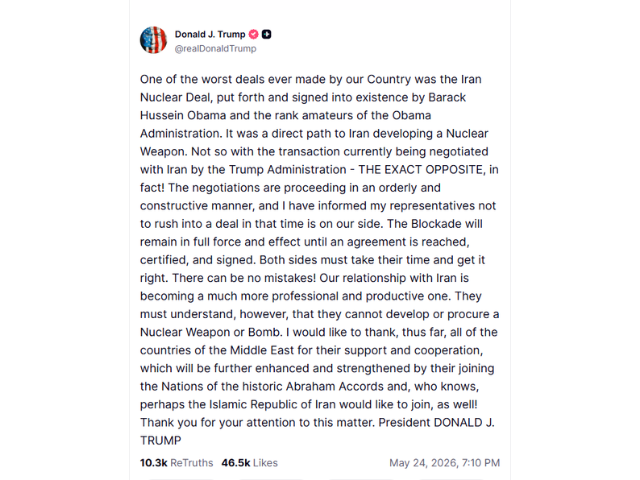
There was no immediate response from Iran's government. But Tasnim news agency, which is linked to Iran's Revolutionary Guards, said the US was still obstructing parts of a potential deal, including Tehran's demand for the release of frozen funds.
A day earlier, Trump said Washington and Iran had "largely negotiated" a memorandum of understanding on a peace deal that would reopen the Strait of Hormuz, which before the conflict carried one-fifth of global oil and liquefied natural gas shipments.
The two sides remain at odds on several difficult issues, such as Iran's pursuit of peaceful nuclear endeavours, Israel's war in Lebanon with the Iranian-backed Hezbollah militia and Tehran's demands for the lifting of sanctions and the release of tens of billions of dollars of Iranian oil revenues frozen in foreign banks.
Working out deal's details
A senior Trump administration official told reporters an agreement would not be signed on Sunday, saying that the Iranian system did not move fast enough. But he outlined what he said were the latest contours of what was being negotiated.
Also read: US official says Washington, Tehran reach preliminary deal to reopen Strait of Hormuz: reports
The official, speaking on the condition of anonymity, said Iran had agreed "in principle" to open the Strait of Hormuz, in exchange for the United States lifting its naval blockade, and to dispose of Tehran's highly enriched uranium.
He said the US understood Iran's Supreme Leader Ayatollah Mojtaba Khamenei had endorsed the broad template of the deal.
There was no immediate confirmation from Iran or elaboration on what an "in principle" agreement meant.
The US official said Washington envisioned first reopening the strait and lifting the US naval blockade. Negotiating the details of the nuclear measures would take more time, he said.
He pushed back on suggestions that Iran has not accepted disposing of its stockpiled enriched uranium. "It's a question about how," the official said.
A second senior administration official said on Sunday that the proposed framework would give negotiators 60 days to reach a final deal.
Iranian sources had told Reuters that in future stages, "feasible formulas" could be found to resolve the dispute over its highly enriched uranium stockpile, including diluting the material under the supervision of the UN nuclear watchdog.
Iran has long denied US and Israeli accusations that it is pursuing nuclear weapons and says it has a right to enrich uranium for civilian purposes, although the purity it has achieved far exceeds that needed for power generation.
LNG tankers clear Strait of Hormuz, bound for Pakistan and China: Report
Two liquefied natural gas tankers are exiting the Strait of Hormuz on Monday, heading to Pakistan and China, while a supertanker with Iraqi crude for China left the Gulf on Saturday after being stranded for nearly three months, shipping data showed.
The US-Israeli war on Iran that began on February 28 has severely curtailed shipping through the Strait of Hormuz, through which around one-fifth of the world's supply of oil and LNG normally flows.
The vessels are among a handful of supertankers exiting the Gulf this month via a transit route that Iran has ordered ships to use. Last week, three Very Large Crude Carriers (VLCCs) made their way to China and South Korea with 6 million barrels of crude.
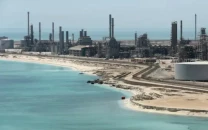
LNG tanker Fuwairit is crossing the Strait of Hormuz on Monday and is expected to discharge its cargo in Pakistan on Tuesday, shipping data on LSEG and Kpler showed. The vessel, sailing under the Bahamas flag, loaded LNG at Qatar's Ras Laffan port around March 28.
Deal draws out US critics
Trump, whose approval ratings have been hit by the war's impact on US energy prices and who has faced congressional efforts to curb his war powers, has repeatedly played up the prospect of an agreement to end the conflict that the US and Israel started on February 28. A tenuous ceasefire has been in place since early April.
Oil prices hit two-week lows to kickstart the week with Brent crude futures down over 4% to $98.83 a barrel — the first time it has dipped below $100 in intraday trading since early May — while US West Texas Intermediate was at $92.03 a barrel, also down over 4%.
As details of the possible agreement emerged over the weekend, critics, including former Secretary of State Mike Pompeo and Democratic lawmakers argued that it offered little beyond the 2015 Iran nuclear deal negotiated by former President Barack Obama, from which Trump withdrew during his first term.
Chris Van Hollen, a Democratic member of the Senate Foreign Relations Committee, said the deal's reported outlines would amount to little more than "the pre-war status quo" with Iran.
"I think this was a blunder," Van Hollen said on the "Fox News Sunday" program. "When you're digging a hole, you should stop digging, and that sounds like maybe what we're doing finally."
Trump, who has also faced criticism from hawkish conservatives over his willingness to compromise with Iran, pushed back.
"If I make a deal with Iran, it will be a good and proper one ... So don’t listen to the losers, who are critical about something they know nothing about," Trump said in a Truth Social post on Sunday.
In another potential stumbling block, an Iranian military adviser to Khamenei said Tehran had the legal right to manage the Strait of Hormuz, though it was not clear if that meant continuing to decide which ships can go through.
Iran's Revolutionary Guards said 33 vessels had passed through the strait over the past 24 hours after getting permission from Tehran, still far short of the 140 on a typical day before the war.
Any deal reinforcing the current fragile ceasefire would bring relief to markets but not immediately quell a global energy crisis, which has driven up costs of fuel, fertiliser, and food.
Even if the war ends now, full flows through the strait will not return before the first or second quarter of 2027, the head of the Abu Dhabi National Oil Company said last week.
The US-Israeli bombing of Iran killed thousands of people in Iran before it was suspended in early April.
Israel has also killed thousands more and driven hundreds of thousands from their homes in Lebanon, which it invaded in pursuit of Hezbollah. Iranian strikes on Israel and neighbouring Gulf states have killed dozens.







This material may not be published, broadcast, rewritten, redistributed or derived from. Unless otherwise stated, all content is copyrighted © 2026 The Express Tribune.






COMMENTS
Comments are moderated and generally will be posted if they are on-topic and not abusive.
For more information, please see our Comments FAQ