Woman dies after alleging sexual assault by husband
Updated 12 hours ago

Historic city once linked to traditional trades witnesses fading artisanal culture
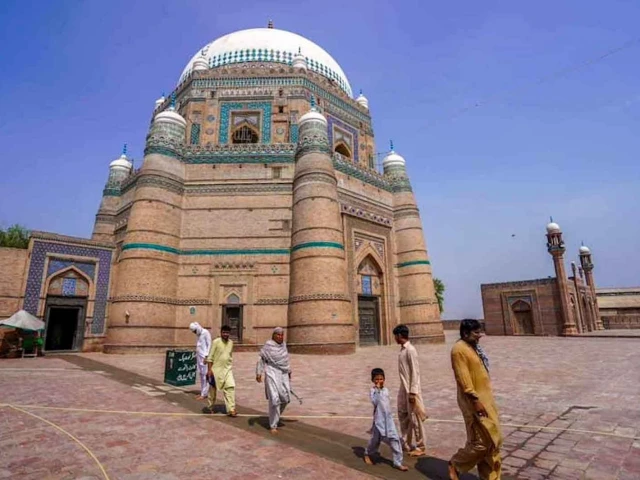
The ancient city of Multan, regarded as one of the oldest living cities in South Asia with a history spanning nearly 5,000 years, continues to preserve its cultural identity through its historic mohallas that once served as vibrant centres of specialised crafts and professions.
In the context of old Multan, a neighbourhood is more than a residential area; it represents a close-knit community often linked to a specific trade, skill or social group.
The nearly 12 interior-city mohallas once formed the backbone of Multan's economic and cultural life, where generations inherited and continued their ancestral professions. Walled City Authority guide Amir Bashir said that although many of the traditional crafts have nearly disappeared, the names and historical significance of these localities still reflect Multan's rich heritage.
He explained that "Mohalla Kaman Garaan" was once famous across the subcontinent for finely crafted bows decorated by skilled artisans, while Mohalla Dar-Khana Wala was known for its expert woodworkers, whose craftsmanship remains visible in old carved wooden structures.
Near Daulat Gate, Mohalla Kumharan Wala serv ed as a major pottery hub producing clay utensils, while Mohalla Neel Garaan was renowned for indigo dyeing, once in high demand across regional markets.
Amir noted that Mohalla Kapri Patolian was home to artisans who specialised in threading pearls into silk strings, a delicate craft popular across the subcontinent. Mohalla Kashi Garaan, located outside Daulat Gate, was associated with tile makers and ceramic artisans.
He added that Mohalla Kaghaz Katt was historically known for producing silver foil (varq), a nearly extinct craft today. Mohalla Qazi Wala was home to the city's judges. whose descendants still reside there.
Another notable area, Mohalla Hakeeman Wala, once served as a centre for traditional herbal medicine practitioners, while Mohalla Sootri Watt was known for rope-making used in charpoys, though it is now largely replaced by commercial activity. Mohalla Purana Awa functioned as a marketplace linked to brick kilns and pottery production. "Today, these crafts are nearly extinct as the younger generation is less inclined to adopt ancestral professions," Amir Bashir said. "However, the names of these areas continue to preserve the memory of those trades and reflect the diversity of Multan's past."
He emphasised that walking through the walled city offers a unique historical experience, where every street narrates stories of craftsmanship, community and cultural evolution. Despite modern changes, Multan's historic mohallas remain a living reminder of its glorious past, quietly preserving the skills, traditions, and identities that once defined this ancient city, he added.





This material may not be published, broadcast, rewritten, redistributed or derived from. Unless otherwise stated, all content is copyrighted © 2026 The Express Tribune.














COMMENTS
Comments are moderated and generally will be posted if they are on-topic and not abusive.
For more information, please see our Comments FAQ