Four invisible barriers to foreign investment
Updated 10 hours ago

Transshipment surges at Karachi Port, clean energy shift gains pace amid ME conflict
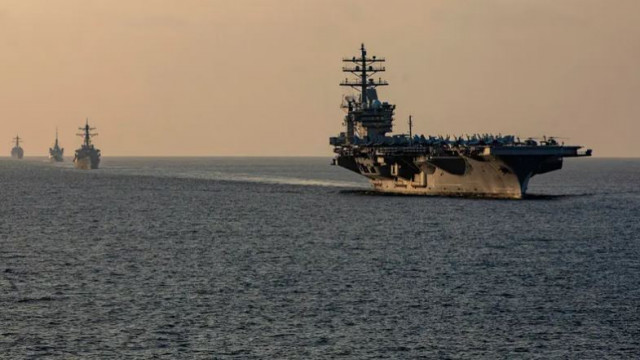
The US-Iran war and the consequential blocking of the Strait of Hormuz by both Iran and the US have provoked interest in economists and policymakers alike, as the dynamics involving geopolitics and economics in the region are likely to be reshaped. Pakistan has once again found itself in a situation where numerous challenges and opportunities have arisen as it takes centre stage in its efforts to defuse the crisis engulfing the Middle East.
A prolonged blockade of the Strait of Hormuz will lead to fuel and electricity shortages in the country, as significant sources of energy that power the economy pass through the strait. However, a continued blockade can increase maritime traffic into Pakistani ports if favourable terms, given Pakistan's importance as a mediating partner of both the US and Iran, are negotiated for transit for Pakistani vessels in the Strait of Hormuz.
First, the increasing oil prices in the global market have affected fuel prices in Pakistan. As the risk premium on transiting through the Strait of Hormuz increased and benchmark crude prices skyrocketed, the ex-refinery price of fuel products also increased in Pakistan. Petrol, diesel and kerosene registered their highest single price hikes in history, as the government was forced to manage the costs of rising crude oil prices and the risk premium. A prolonged oil shock will likely result in a higher import bill, which is likely to drain foreign exchange reserves and depreciate the Pakistani rupee, increasing the import bill further in rupee terms.
Before the price hike, the government had reported a surge in domestic demand for fuel products, which made the price increase ever more important in order to curtail consumption and reduce pressure on the balance of payments. The initial decision to absorb the price shock has resulted in limited fiscal space for the government to give concessions. However, the government may continue to support the most vulnerable segments of the population, such as motorbike owners, the trucking industry and farmers, by providing them with cash subsidies.
Second, the Pakistan Stock Exchange (PSX) has shown significant volatility in the last month, as it shows high levels of sensitivity to the geopolitical barometer in the region. For instance, the market surged more than 14,000 points on April 8 due to optimism about the ceasefire and possible talks, only to shed more than 6,000 points as talks broke down and the risks of war increased. The heightened tension in the region favours short-term survival tactics of investors rather than long-term productive investments in capital expenditures and expansion plans.
Further, as volatility increases, so does the risk premium. Investors require higher returns due to increased uncertainty, driving up the costs of acquiring new equity. Hence, this can lock out the equity market as a source for further investments. In addition, the cost of doing business also increases with uncertainty as the blockade in the Strait of Hormuz continues. As essential raw materials and intermediate goods used in the production of several fuel-intensive products are sourced from the Persian Gulf, firms begin to pile up inventory instead of relying on cost-saving "just-in-time" methods. Therefore, the cost of working capital increases, impacting the financing costs for firms.
There is a strong negative effect as market capitalisation faces a downward risk, increasing possibilities of rapid outward movements of foreign portfolio investment and currency depreciation. This risk is compounded if the value of collateral held by publicly listed firms shrinks, leading to a reduction in commercial loans by the financial sector and, in effect, risking an economic meltdown. A prolonged war in the region may thus amplify the negative impact on the economy.
Considering the positives from the conflict, maritime traffic into Pakistan has increased as transshipment has surged. Transshipment is the shipment of containers to an intermediate destination, where larger shipments are broken into smaller shipments, to avoid customs and duties checks as well as ensure more efficient transportation of goods. Port authorities in Pakistan have provided several incentives to shipping companies in the form of lower port charges and fees, handling of bulk cargoes, and provision of bonded facilities in northern Karachi to encourage transshipment, especially as uncertainty rages in the Persian Gulf. Karachi Port received more transshipment in the first 24 days of March 2026 than in the entire year of 2025, while transshipment activity in Port Qasim increased by more than 2,300%. This opportunity is set to place Pakistan as a major regional hub if maritime connectivity is improved along with the performance of the logistics sector.
Finally, the regional conflict has renewed discussion on the importance of investments in renewable energy, particularly solar power, and consequently the reduction in demand for imported fuel products. The latter can be achieved by replacing fuel-powered vehicles with electric vehicles. Increasing electricity tariffs coupled with volume-based pricing and grid unreliability have increased investments in rooftop solar systems across the country, while cheap Chinese imports of solar panels, tax exemptions on installation of solar panels, and now-retracted net metering policies increased the incentives for households to invest in solar panels.
Pakistan imported more than 22GW of solar panels in 2024, more than what Canada and the UK have installed in recent years. There is also a shift towards power generation from solar panels via commercial solar installations by various industrial sectors, while solar-powered tube wells have become important for irrigation in agriculture. With solar panel adoption primarily by richer households, electricity drawn from the national grid has become increasingly expensive for poorer households. However, the shift towards a more widespread use of electricity as a source of energy rather than fuel in industries and commercial ventures should lower average capacity costs and reduce the burden on poorer segments of society.
Hence, it is crucial to realise that while the costs of prolonged conflict can far exceed the benefits, the potential for creating a transshipment hub in Pakistan and investing in renewable sources of energy, especially solar, can provide long-term benefits even if the conflict itself is short-lived. Increased taxes and reduction in incentives for solar energy can adversely impact the long-term transition that results in lower dependency on imported fuel products, which can save the economy from future balance-of-payments crises.
THE WRITER IS AN ASSISTANT PROFESSOR OF ECONOMICS AND RESEARCH FELLOW AT CBER, IBA








This material may not be published, broadcast, rewritten, redistributed or derived from. Unless otherwise stated, all content is copyrighted © 2026 The Express Tribune.







COMMENTS
Comments are moderated and generally will be posted if they are on-topic and not abusive.
For more information, please see our Comments FAQ