Iran demands release of $12b in frozen assets in potential deal with US
Updated 1 hour ago

Rebuffing Trump, Iran rejects reported split between 'radicals and moderates'
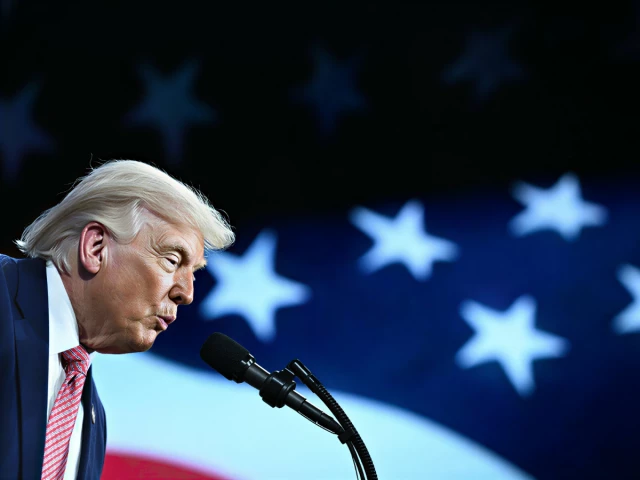
United States President Donald Trump said on Thursday that a deal with Iran would only be made when it was "appropriate and good" for the US, adding that the clock was ticking for Iran.
He said that with Iran's military capability destroyed, he had "all the time in the world", but the Islamic republic did not.
— Rapid Response 47 (@RapidResponse47) April 23, 2026
Meanwhile, Iranian leaders rebuffed Trump's assertion of a split in their leadership ranks between the "radicals" and the "moderates".
In a post on X, President Masoud Pezeshkian said: "In Iran, there are no radicals or moderates; we are all 'Iranian' and 'revolutionary', and with the iron unity of the nation and government, with complete obedience to the supreme leader of the revolution, we will make the aggressor criminal regret his actions. One God, one nation, one leader, and one path; that path being the path to the victory of our dear Iran, more precious than life."
در ایران ما تندرو و میانهرو وجود ندارد؛
— Masoud Pezeshkian (@drpezeshkian) April 23, 2026
همه ما "ایرانی" و "انقلابی" هستیم و با اتحاد آهنین ملت و دولت، با تبعیت کامل از رهبر معظم انقلاب متجاوز جنایتکار را پشیمان خواهیم کرد.
یک خدا، یک ملت، یک رهبر و یک راه؛ آنهم راه پیروزی ایران عزیزتر از جان.#ایران_ما
Iranian Parliament Speaker Mohammad-Bagher Ghalibaf posted the same message on X.
در ایران ما تندرو و میانهرو وجود ندارد؛
— محمدباقر قالیباف | MB Ghalibaf (@mb_ghalibaf) April 23, 2026
همه ما «ایرانی» و «انقلابی» هستیم و با اتحاد آهنین ملت و دولت، با تبعیت کامل از رهبر معظم انقلاب متجاوز جنایتکار را پشیمان خواهیم کرد.
یک خدا، یک رهبر، یک ملت، و یک راه؛ آن هم راه پیروزی ایرانِ عزیزتر از جان.
#ایران_ما
Iranian Foreign Minister Abbas Araghchi similarly said on X: "The failure of Israel's terrorist killings is reflected in how Iran's state institutions continue to act with unity, purpose and discipline. The battlefield and diplomacy are fully coordinated fronts in the same war. Iranians are all united, more than ever before."
The failure of Israel's terrorist killings is reflected in how Iran's state institutions continue to act with unity, purpose, and discipline.
— Seyed Abbas Araghchi (@araghchi) April 23, 2026
The battlefield and diplomacy are fully coordinated fronts in the same war.
Iranians are all united, more than ever before.
Trump earlier said on Truth Social that the US had "total control" over the Strait of Hormuz, without providing evidence.
"It is 'sealed up tight,' until such time as Iran is able to make a deal!" he wrote.
— Rapid Response 47 (@RapidResponse47) April 23, 2026
Trump said that Iran was "having a hard time figuring out who their leader is".
A number of senior leaders of the Islamic Republic have been killed in airstrikes since the US and Israel launched their joint assault on Iran on February 28, including the then supreme leader, Ayatollah Ali Khamenei, and influential powerbroker Ali Larijani.
Analysts say the killings have complicated decision-making in Tehran and narrowed Iran's options as the war grinds on.
"The infighting is between the 'hardliners', who have been losing badly on the battlefield, and the 'moderates', who are not very moderate at all (but gaining respect!), is crazy!" Trump said in his post.
Iran's negotiating posture has hardened sharply since the war began, with the hardline Revolutionary Guards exerting growing influence over decision-making, according to senior sources in Tehran.
His post came after Iran flaunted its own grip over the strategic waterway with video of its commandos storming a huge cargo ship.
State television broadcast footage of masked troops pulling up in a grey speedboat alongside the MSC Francesca, climbing a rope ladder to a shell door in the hull and jumping on board brandishing rifles.
Iran has effectively blocked the strait to ships apart from its own since the US and Israel launched the war.
Trump earlier ordered the US Navy to "shoot and kill" any small boats laying mines in the waters of the Strait of Hormuz, amid escalating tensions in the region.
“I have ordered the United States Navy to shoot and kill any boat, small boats though they may be, that is putting mines in the waters of the Strait of Hormuz,” Trump said in a post on Truth Social.
He added that there should be no hesitation, claiming that US mine “sweepers” were already clearing the strait.
“I am hereby ordering that activity to continue, but at a tripled-up level,” he said.
Separately, US forces intercepted and boarded a vessel transporting oil from Iran in the Indian Ocean, the US Department of War said.
“We will continue global maritime enforcement to disrupt illicit networks and interdict vessels providing material support to Iran, wherever they operate,” the department said in a statement posted on social media platform X.
Overnight, U.S. forces carried out a maritime interdiction and right-of-visit boarding of the sanctioned stateless vessel M/T Majestic X transporting oil from Iran, in the Indian Ocean within the INDOPACOM area of responsibility.
— Department of War 🇺🇸 (@DeptofWar) April 23, 2026
We will continue global maritime enforcement to… pic.twitter.com/SWF6Jt9Ci4
The department warned that international waters could not be used as a shield by sanctioned actors, adding that it would continue to deny illicit actors and their vessels freedom of manoeuvre in the maritime domain.
Earlier, reports said Iran had seized two container ships near the Strait of Hormuz on Wednesday, accusing them of operating without required permits and tampering with navigation systems.
Sources say the ships have now been taken to the Iranian port of Bandar Abbas.
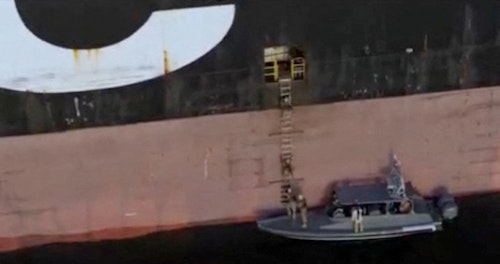
Still from video said to show the seizure of the container ships, released April 22, 2026. Photo: Reuters
"Some 20 Iranians armed to the teeth stormed the ship. Sailors are under Iranians' control, their movements on the ship are limited, but the Iranians are treating them well," a relative of one of the seafarers told Reuters.
One of the ships, Panama-flagged Francesca, is operated by MSC, the world's biggest container shipping group.
"Negotiations between MSC and Iran are ongoing, our sailors are fine," Montenegro's minister of maritime affairs, Filip Radulovic, told state broadcaster state RTCG.
Four sailors on the MSC Francesca including its captain are from Montenegro, he said.
Iran claims first Hormuz toll revenue collected
Meanwhile, Iran has collected its first revenue from tolls imposed on ships transiting the Strait of Hormuz, one of the world’s most important routes for global energy supplies, Parliament Deputy Speaker Hamidreza Haji Babaei said on Thursday.
“First revenues from transit fees in the Strait of Hormuz have been deposited into the Central Bank account,” he said in comments carried by the semi-official Tasnim News Agency.
Lawmaker Alireza Salimi also told Tasnim that Iran has begun collecting fees from vessels passing through the strait, citing what he described as “reliable sources.”
The amount charged varies depending on the type and volume of cargo and the level of risk posed by each vessel, the agency said, adding that Iran determines the rates and collection mechanisms.
The deputy speaker and lawmaker, however, did not give details about the number of ships that had paid.
Will a second round of US-Iran talks happen?
In an Al Jazeera interview, New York Post reporter Caitlin Doornbos, who had been in contact with US President Donald Trump, revealed that despite recent diplomatic hurdles, there is cautious hope for a breakthrough within the next 36 to 72 hours.
Caitlin Doornbos is a New York Post reporter in Islamabad who has a direct line to US President Donald Trump. We ask what she's heard about whether the US expects a second round of direct talks with Iran. pic.twitter.com/xgM6ySzqJg
— Al Jazeera English (@AJEnglish) April 23, 2026
She said that after the first round of the Islamabad Talks, she spoke with Trump on the possibility of further talks, to which he replied "wait about 48 hours...you'll have more news of whether or not a second round of talks happen."
"And it was about 48 hours after the President got back and said that there had been progress being made and that a second round of talks could happen soon", she said.
"So now, of course, we're a week later, and I don't want to be too optimistic about them actually happening. I never want to be too optimistic because these things are so complex."
When asked how to coherently report on Trump's constant messaging on Truth Social mixed in with the information from various sources, she said that anything that she reported could change. "This is a huge matter of diplomacy, the ending of a war. It's not going to be cut and dried, and it's not going to happen tomorrow."
US told Israel ceasefire with Iran will expire on Sunday: Israeli media
The United States told Israel that the recently extended ceasefire with Iran will expire on Sunday, according to Israeli media reports.
Israeli public broadcaster KAN said on Wednesday that US officials conveyed to Tel Aviv that the timeframe set by President Donald Trump for Tehran is due to end within days.
Citing an unnamed diplomatic source, the broadcaster said Trump is seeking to reach an understanding with Iran rather than engage in open-ended negotiations.
Israeli sources also said a breakthrough by Sunday appears unlikely.
They also described what they called “confusion” in US conduct, saying they have recently been learning about Trump’s moves through media reports and his posts on social media.
Earlier on Wednesday, a White House official told Fox News that the ceasefire could last between three and five days. At the same time, an Israeli source said the situation remains unclear and depends largely on Trump’s decisions, according to the broadcaster.
On Tuesday, Trump announced an extension of the ceasefire with Iran following a request from Pakistan, saying it would remain in place until Tehran presents what he described as a “unified proposal.”
Hostilities in the region have escalated since the US and Israel launched joint strikes on Iran on February 28. In response, Tehran retaliated with strikes on Israel and other regional countries hosting US assets.
Pakistan hosted talks between Washington and Tehran on April 11–12 after brokering the ceasefire on April 8. Efforts for another round of negotiations are underway, though uncertainty remains.
US intercepts three Iranian oil tankers in Asian waters
The US military has intercepted at least three Iranian-flagged tankers in Asian waters and is redirecting them away from their positions near India, Malaysia and Sri Lanka, shipping and security sources said on Wednesday.
Washington has imposed a blockade on Iran's trade by sea, while Iran has prevented ships from sailing through the Strait of Hormuz, the waterway at the entrance to the Middle East Gulf. Nearly two months after the US and Israel began their war on Iran, there is little sign of peace talks resuming during an uneasy ceasefire.
The closure of the strait has disrupted the supply of a fifth of the world's oil and gas supplies and caused a global energy crisis. US forces have seized an Iranian cargo ship and an oil tanker in recent days. Iran said it had captured two container ships seeking to exit the Gulf via the Strait of Hormuz on Wednesday after firing on them and another vessel, its first seizures since the war began.
The US has diverted at least three more Iranian-flagged oil tankers in recent days, according to two US and Indian shipping sources and two separate Western maritime security source who spoke to Reuters on Wednesday.
The US military did not immediately respond to a request for comment on the interceptions.
One of the vessels was the Iranian-flagged Deep Sea supertanker, which was part-loaded with crude and last seen on its public tracking transponder off Malaysia's coast a week ago, according to the sources and ship tracking data on the MarineTraffic platform.
The smaller Iranian-flagged Sevin, which had a maximum capacity of 1 million barrels and was carrying 65% of its load, was also intercepted. The vessel was last seen off Malaysia’s coast a month ago, ship tracking data showed.
The Iranian-flagged supertanker Dorena was also intercepted, fully loaded with 2 million barrels of crude, and last seen off the coast of southern India three days ago, according to the sources and ship tracking data on the MarineTraffic platform.
The US Central Command said on Wednesday in a post on X that the Dorena has been under the escort of a US Navy destroyer in the Indian Ocean after attempting to violate the blockade.
US forces may have intercepted the Iranian-flagged Derya tanker, shipping sources said. The vessel failed to discharge its cargo of Iranian oil in India before a US waiver on Iranian crude purchases expired on Sunday. That vessel was last seen off India’s western coast on Friday, according to MarineTraffic data.
US Central Command said on Wednesday that since the start of its blockade against ships entering or exiting Iranian ports, US forces had directed 29 vessels to turn around or return to port.
The US military has not listed all the ships it has intercepted, and did not immediately respond to requests for comment about the Derya and the Deep Sea.
A third maritime security source said the US military was looking to target Iranian ships away from the Strait of Hormuz and in open waters to avoid any risk of floating mines during operations.
Iran seized two ships in the Strait of Hormuz as it tightened its grip on the strategic waterway after US President Donald Trump announced he was indefinitely calling off attacks, with no sign of peace talks restarting.
The status of a two-week-old ceasefire, due to expire earlier this week, remained unclear. In a sharp about-face hours after threatening renewed violence, Trump made what appeared to be a unilateral announcement on Tuesday that the US would extend a ceasefire until it had discussed an Iranian proposal in peace talks to end the two-month-old war.
Read: Complete ceasefire only sensible if not violated by US maritime blockade: Iran's negotiating chief
But Iranian officials did not say they had agreed to any extension of the truce, and criticised Trump's decision to maintain the US Navy blockade of Iran's trade by sea, itself considered by Iran an act of war. Iran's parliament speaker and lead negotiator, Mohammad Bagher Ghalibaf, said a full ceasefire only made sense if the blockade was lifted.
Reopening the Strait of Hormuz, the slender chokepoint that carried a fifth of the world's oil trade before the war, was impossible with such a "flagrant breach of the ceasefire," Qalibaf said on social media.
"You did not achieve your goals through military aggression, and you will not achieve them by bullying either," he wrote in his first response to Trump's announcement. "The only way is recognising the Iranian people's rights."
Trump again backed away at the last moment from his repeated threats to bomb Iran's power plants and other civilian infrastructure, which the United Nations and others warn would violate international humanitarian law. But little progress has been made in ending the war that started with joint US-Israeli attacks on Iran on February 28.
That leaves the two sides in a holding pattern with the crucial Strait of Hormuz still effectively shut, straining economies across the world. Thousands of people have been killed across the Middle East, mostly in Iran and Lebanon, where Iran-allied Hezbollah fights against Israeli aggression and bombardment of civilian infrastructure.
The Islamic Revolutionary Guard Corps seized two vessels and escorted them to Iranian shores, according to statements by the shipping companies and Iran's semi-official Tasnim news agency.
IRGC released footage of the interception of two vessels, MSC-FRANCESCA and EPAMINODES, after maritime violations in the Strait of Hormuz.
— Press TV 🔻 (@PressTV) April 22, 2026
Follow: https://t.co/mLGcUTS2ei pic.twitter.com/ZUUBbzbA2N
The Revolutionary Guards accused the ships it had seized, the Liberia-flagged Epaminondas and Panama-flagged MSC Francesca, of operating without required permits and tampering with their navigation systems.
A third, Liberia-flagged container ship was fired upon in the same area but was not damaged and had resumed sailing, according to maritime security sources.
Leavitt said in an interview with Fox News that since the ships were not US or Israeli vessels, the seizure was not a violation of the ceasefire. She called it an act of "piracy". Iranian officials have called the US blockade of Iranian-bound vessels piracy as well.
The US military said on Wednesday it had so far directed more than 30 ships to turn around or return to port as part of the US blockade against Iran. Far beyond the Gulf, the US military has intercepted at least three Iranian-flagged tankers in Asian waters, sources said, redirecting them away from their positions near India, Malaysia and Sri Lanka.
Read more: Pezeshkian blames US 'blockade' for impasse
Brent, the international crude oil benchmark, remained above $100 a barrel in Asian trade on Thursday, having hit triple figures a day earlier for the first time in two weeks.
No new deadline for ceasefire
In his Tuesday announcement, Trump said that the US had agreed to a request by Pakistani mediators "to hold our Attack on the Country of Iran until their leaders and representatives can come up with a unified proposal ... and discussions are concluded, one way or the other."
He has not set any deadline for the proposal or discussions, White House press secretary Karoline Leavitt told reporters.
Pakistan, which has acted as a mediator, was still trying to bring the sides together after both failed to show up for tentatively scheduled talks in Islamabad on Tuesday before the two-week-old ceasefire was due to expire.
A first session of peace talks between Iran and the US in Islamabad 11 days ago produced no agreement.
Trump wants Iran to give up highly enriched uranium and forgo further enrichment to, allegedly, prevent it from building a nuclear weapon. Iran says it has only a peaceful civilian nuclear programme, and wants the lifting of sanctions, reparations for damage and recognition of its control over the strait.
Iran has also made a ceasefire between Israel and Hezbollah a condition of truce talks. On Wednesday, Israeli air strikes on Lebanon killed at least five people, including the Lebanese journalist Amal Khalil.
It was the deadliest day since a 10-day ceasefire was announced on April 16 between Israel and Lebanon, notwithstanding the thousand-plus Lebanese killed by Israeli attacks over the course of the war.





This material may not be published, broadcast, rewritten, redistributed or derived from. Unless otherwise stated, all content is copyrighted © 2026 The Express Tribune.









COMMENTS (5)
Comments are moderated and generally will be posted if they are on-topic and not abusive.
For more information, please see our Comments FAQ