Science, policy and society
Updated 11 minutes ago

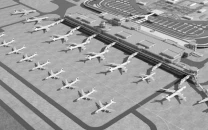
Traffic congestion has become one of the city's defining realities
Presently, I am travelling across the United Kingdom. Right from London to Nottingham, from Nottingham to Manchester, and from Manchester to Blackpool and Bradford, I have been observing not merely development, but a culture of civic discipline, urban order and respect for public spaces. Even small towns display remarkable planning and symmetry. Road signs are clearly visible and meticulously maintained. Vehicles move within their designated lanes, and during long journeys across cities and towns, one hardly hears the sound of horns.
What has impressed me even more is the pedestrian- and cycling-friendly environment. Separate tracks exist for walkers and cyclists. Drivers stop before pedestrian crossings and invariably give the right of way to pedestrians. In Redbridge, I walked up to a nearby park with jogging tracks, walking paths, and a serene lake. Litter bins are found everywhere. From the roads to the public parks, the environment is neat, green, dust-free and clean.
What has struck me most is that urban beauty here does not depend on expensive marble facades, decorative stones or extravagant beautification schemes. The authorities have not attempted to create artificial grandeur through costly structures. Instead, they have focused on cleanliness, greenery, proper road markings, pedestrian facilities, maintenance of public spaces and strict implementation of civic rules. There is simplicity, yet functionality; modesty, yet order.
As I walked through these streets and parks, I could not help comparing them with the condition of Peshawar, the heart of Khyber-Pakhtunkhwa. Once known as the 'City of Flowers', Peshawar today struggles with clogged drains, chaotic traffic, encroachments, shrinking public spaces, dust and unregulated urban expansion. Despite billions spent over the years in the name of uplift and beautification, the city often appears trapped between cosmetic projects and structural neglect.
The question therefore arises: why do cities in the United Kingdom remain functional and livable despite relatively simple urban designs, while our cities continue to struggle despite repeated beautification campaigns?
The answer lies in governance priorities.
In the United Kingdom, the emphasis appears to be on maintaining systems rather than merely announcing projects. Roads are not beautiful because they are covered with expensive stones; they are beautiful because they are clean, properly marked, dust-free and efficiently managed. Parks are not attractive because of decorative installations but because public spaces are protected, maintained and respected.
In contrast, our urban governance model frequently equates beautification with cosmetic construction. Greenbelts are decorated while drains remain choked. Pavements are rebuilt while encroachments continue unchecked. Roads are widened but parking regulation, pedestrian safety and traffic discipline remain neglected. Had the Redbridge Park existed in Peshawar, one fears that shops, kiosks, restaurants and even commercial plazas might eventually have emerged around it in the name of development or revenue generation, gradually suffocating the very spirit of the public space.
Peshawar's crisis is therefore not simply one of resources but of governance fragmentation, weak institutions and misplaced priorities. Multiple institutions - the Peshawar Development Authority (PDA), Water and Sanitation Services Peshawar (WSSP), Municipal Corporation, Tehsil Municipal Administrations, Public Health Engineering Department and others - operate with overlapping mandates and insufficient coordination. The result is duplication, inefficiency and weak accountability.
Traffic congestion has become one of the city's defining realities. University Road, GT Road, Kohat Road, Charsadda Road and Warsak Road frequently resemble immobilised corridors rather than functioning arteries of mobility. Encroachments continue to consume roadsides, footpaths and public spaces. Commercial plazas emerge in residential zones without adequate parking arrangements or planning compliance. Dust and unmanaged waste increasingly define the urban landscape.
However, while criticism of urban decline is necessary, fairness also demands acknowledgment of positive initiatives and administrative resolve where it exists. I fully admire the professional commitment and willingness to take up difficult challenges demonstrated by Riaz Khan Mehsud, the Commissioner Peshawar, under the dynamic and visionary leadership of Syed Shahab Ali Shah, the Chief Secretary of Khyber-Pakhtunkhwa. Both deserve appreciation for launching a drive against encroachments upon natural and man-made drains in and around Peshawar.
This initiative is particularly significant because encroachments upon drainage channels are not merely an issue of urban disorder; they directly contribute to flooding, environmental degradation, traffic disruption and public inconvenience. In many areas, natural drains have either narrowed due to illegal construction or become dumping grounds for waste and debris. During heavy rains, the consequences become visible in the form of urban flooding and collapse of civic systems.
The ongoing anti-encroachment drive demonstrates an important reality: with commitment, administrative courage and continuity of purpose, even difficult urban challenges can be confronted. I remain confident that if the same determination is sustained, Peshawar can still be transformed into one of the most livable and environmentally sustainable cities in Pakistan.
The real focus, however, must remain on cleanliness, greenery, proper urban management and, above all, protection of public spaces and natural drains. Urban reform should not be reduced to cosmetic beautification or short-term publicity campaigns. Sustainable cities are built through enforcement of rules, institutional coordination, environmental protection and civic discipline.
Peshawar still possesses immense strengths - its history, culture, resilience and strategic location. Yet unless governance fragmentation, weak enforcement and commercial encroachments are addressed decisively, the city will continue to lose both its functionality and its soul.
The real challenge is not merely to beautify Peshawar. It is to restore order, dignity, discipline and sustainability to a city that once stood as the cultural and historical gateway to the region.








This material may not be published, broadcast, rewritten, redistributed or derived from. Unless otherwise stated, all content is copyrighted © 2026 The Express Tribune.

COMMENTS (6)
Comments are moderated and generally will be posted if they are on-topic and not abusive.
For more information, please see our Comments FAQ