Tariff protection hurts consumers
Updated 1 hour ago

Iran war fallout triggers slump, AUMs shrink to Rs570b as investors exit stocks
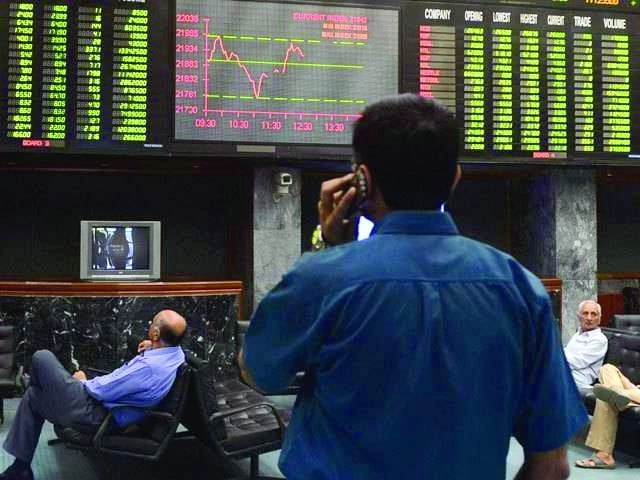
The Pakistan Stock Exchange (PSX), one of the best-performing markets just a few months ago, is now one of the worst. Thanks to the Israel-US war on Iran and Pakistan's heavy reliance on imported energy, the mutual fund industry has witnessed a sharp pullback in equity exposure in March 2026, with assets under management (AUMs) in equity funds plunging 13% month-on-month, as investors shifted aggressively towards low-risk instruments amid a steep deterioration in stock market performance.
Equity AUMs dropped to Rs570 billion in March, down from Rs655 billion in February, according to data compiled by Optimus Capital Management. The fall significantly outpaced the broader mutual fund industry decline, where total AUMs slipped 3% to Rs4.37 trillion. The sharp contraction also reduced equity's share in the overall mutual fund pool to 13%, compared with 14.5% in the previous month, underscoring a pronounced shift in investor preference towards capital preservation.
Market participants said the sell-off reflects a classic "risk-off" cycle, where investors exit equities in favour of safer, yield-generating instruments such as money market and income funds. The PSX correction has directly translated into equity fund outflows, said a senior fund manager. Rising oil prices, pressure on the rupee and external uncertainty have weakened investor confidence, prompting a move towards defensive assets.
The Overseas Investors Chamber of Commerce and Industry (OICCI), in a recent social media post, highlighted the extent of the reversal. It noted that while Pakistan's equity market delivered 51% returns in rupee terms last year, it ended the third quarter of FY26 as the third worst-performing market globally, posting a 14.6% loss in dollar terms. In contrast, energy-exporting markets such as Ghana and Oman recorded gains exceeding 43%, benefiting from higher oil prices.
This divergence underscores Pakistan's macroeconomic fragility. The country's heavy reliance on imported energy, coupled with a weakening currency, amplifies the impact of global shocks on financial markets. Every oil price spike widens Pakistan's external imbalance, pressures the rupee and erodes equity valuations, said a brokerage analyst. This time, the geopolitical shock has once again exposed those fault lines.
"Currency fragility, energy import dependence, and a thin foreign investor base inherited from the 2021 MSCI frontier downgrade mean that every external shock hits Pakistan harder and longer than it should," noted OICCI.
"Fixing that requires three things: cutting the energy import bill through domestic production and renewables, rebuilding forex reserves to give the rupee room to absorb pressure, and meeting MSCI's reclassification thresholds to bring mainstream emerging market capital back to PSX."
The structural weaknesses are further compounded by a relatively thin foreign investor base following Pakistan's downgrade to MSCI Frontier Markets in 2021. The absence of large, stable foreign inflows has made the PSX more susceptible to volatility and prolonged downturns.
Within the mutual fund industry, the shift away from equities was broad-based. Major asset managers reported double-digit declines in equity AUMs, reflecting both redemption pressure and market-driven valuation losses. MCB Funds saw equity AUMs fall by 19.1%, JS Investments by 21.9%, and Al Habib Asset Management by 24.3%. Other large players also recorded notable declines, with NBP Funds down 14%, UBL Funds 12.5%, and Alfalah Asset Management 15.1%. Even relatively defensive portfolios were not immune, as HBL Asset Management posted a 2.4% decline.
In contrast, low-risk categories continued to attract flows. Money market and income funds collectively accounted for a dominant share of industry assets, benefiting from elevated interest rates and abundant system liquidity. The continued erosion in equity participation poses long-term challenges for Pakistan's capital markets. With equity AUMs now comprising just 13% of total industry assets, the mutual fund sector remains heavily skewed towards debt-based investments, limiting the availability of risk capital for businesses.









This material may not be published, broadcast, rewritten, redistributed or derived from. Unless otherwise stated, all content is copyrighted © 2026 The Express Tribune.











COMMENTS
Comments are moderated and generally will be posted if they are on-topic and not abusive.
For more information, please see our Comments FAQ