Woman dies after alleging sexual assault by husband
Updated 12 hours ago

Settlements, public offices left below dual carriageway
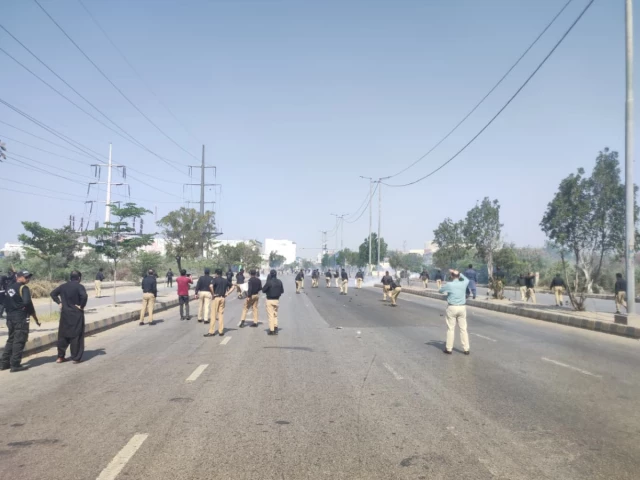
Dozens of government offices and private settlements along Sargodha Road have been left several feet below road level due to alleged faulty planning and design, causing drainage issues and financial strain.
According to local residents, the Communications and Works Department had approved an Rs11 billion project in the 202324 fiscal year to convert Sargodha Road into a dual carriageway from Chak No. 3 JB bypass to District Chiniot.
Of the total stretch, about 18 kilometres fall in Chiniot district, while around four and a half kilometres lie in Faisalabad.
The road, considered one of Punjab's busiest highways, carries over 16,500 vehicles daily, including heavy transport and dumper trucks transporting stone material from Sargodha to central Punjab.
Previously 24 feet wide, the road has now been expanded into a dual carriageway with three lanes on each side. The project was aimed at reducing accidents and improving travel safety for commuters, transporters, and pedestrians. It has also contributed to the socio-economic development of surrounding localities, including Kamalpur, Chak 2, 3, and 4 JB, Ram Diwali, Arfa, Karim Nagar, FDA City, Lundianwala Adda, Jhok Mor and Bhutto Colony.
However, concerns have emerged as engineers reportedly raised the road level by four to seven feet in various sections, leaving adjacent settlements and public offices at significantly lower levels.
Affected facilities include government schools, offices of the Agriculture and Livestock Departments, Local Government offices, Land Record Centres and NADRA offices.
Residents say the elevation has resulted in rainwater accumulation, causing repeated flooding and forcing both public institutions and private homeowners to spend additional funds on drainage and reconstruction.
Mudassar Farooq, a resident of Chak 4-JB, said the flawed planning has compelled residents to demolish and rebuild their homes at higher levels, incurring heavy expenses.
Syed Naveed Iqbal, Deputy Director of the District Government, said the matter falls under the jurisdiction of the Highway Department.
He added that the project's design and planning were carried out with the involvement of NESPAK.
However, NESPAK Resident Engineer Amjad Saeed denied the organisation's role in the design and planning phase, while acknowledging that a survey should have been conducted before raising the road level to avoid such issues.
Attempts were made to contact officials of the highway department but no response was received.
According to an urban planner, an Environmental Impact Assessment (EIA) is mandatory to evaluate potential impacts on the environment and local communities before project approval under the Pakistan Environmental Protection Act 1997.









This material may not be published, broadcast, rewritten, redistributed or derived from. Unless otherwise stated, all content is copyrighted © 2026 The Express Tribune.













COMMENTS
Comments are moderated and generally will be posted if they are on-topic and not abusive.
For more information, please see our Comments FAQ