Pakistan's consistent support for Palestine in a divided world
Updated 20 hours ago

Cinema operates precisely at this threshold, between perception and internalisation. It does not argue; it arranges
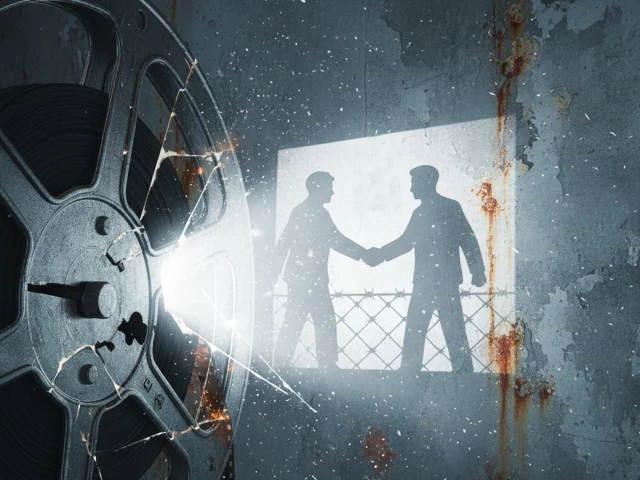
“The most effective propaganda is not that which is imposed, but that which is accepted as reality.” Adapted from Noam Chomsky.
There is a peculiar asymmetry in how violence is registered. A bomb must detonate to be believed. A narrative, by contrast, requires no such spectacle. It travels through dialogue, through framing, through the repetition of an idea so ordinary it evades scrutiny. By the time it is recognised, it is no longer encountered as persuasion, but as memory.
Cinema operates precisely at this threshold, between perception and internalisation. It does not argue; it arranges. It orients, does not instruct. And in doing so, it participates in what may be understood not as propaganda in its crude, twentieth-century form, but as a far more sophisticated process: the gradual construction of an epistemic environment in which certain conclusions feel inevitable.
To speak of Indian cinema in this context, therefore, is not to make the banal claim that films are “biased” or “political.” Such assertions are analytically thin. The more difficult and necessary question is this: how does a cultural industry, operating within specific political, economic, and ideological conditions, come to produce narratives that do not merely reflect reality, but delimit the boundaries of how reality itself is perceived?
This is where the language of warfare, often dismissed as rhetorical excess, becomes unexpectedly precise.
If narratives were merely incidental, sporadic distortions, isolated exaggerations, they would not merit this level of scrutiny. Their significance lies in their patterned recurrence, not in a single film. What appears, at first glance, as a creative coincidence begins, upon closer inspection, to resemble structure.
It is here that the analytical vocabulary of media theory becomes indispensable.
In Manufacturing Consent, Noam Chomsky and Edward S. Herman outline what they term the “propaganda model”, a framework designed not to expose overt censorship but to trace the subtler mechanisms through which media systems produce ideological alignment without centralised control.
The model’s enduring insight is this: bias does not require conspiracy; it emerges from systems, from ownership patterns, from political climates, from the anticipatory logic of what will be rewarded, funded, and amplified.
When transposed onto contemporary Indian cinema, this framework reveals something more complex than state-directed messaging. What emerges instead is a form of distributed narrative convergence where filmmakers, studios, and audiences, operating within the same ideological atmosphere, begin to reproduce similar representations without the need for explicit coordination.
This is not propaganda in its classical, declarative sense. It is something arguably more effective: the normalisation of a particular way of seeing.
Every narrative requires tension. And tension, more often than not, requires an antagonist. Across a range of mainstream productions, from overt war dramas to espionage thrillers, the figure of Pakistan increasingly appears not as a complex political entity, but as a narrative shorthand: a ready-made source of threat, instability, or moral opposition. In films such as Uri: The Surgical Strike, Raazi, and The Kashmir Files, the geopolitical is translated into the emotional, rendered legible through characters, plotlines, and affect.
More recent productions and forthcoming projects further illustrate the consolidation of this pattern. In Dhurandhar, even at the level of its promotional narrative and thematic anticipation, Pakistan is positioned less as a historically situated nation and more as a fixed adversarial construct.
It’s representation is pre-structured to align with an already familiar moral grammar. Similarly, the revivalist impulse embedded in projects such as Border 2 suggests not merely a return to earlier cinematic conflicts, but their re-inscription within a contemporary ideological moment, where memory itself becomes curated and selectively intensified. This translation is crucial.
Because once a political conflict is embedded within narrative form, it ceases to function as a matter of debate and instead becomes a matter of identification. The audience is not asked to evaluate; it is invited to feel. And feeling, unlike argument, resists interrogation.
Matthew Alford, in his work on cinematic propaganda, notes that the power of film lies less in its capacity to deceive outright and more in its ability to frame reality in advance, to establish the coordinates within which interpretation takes place.
In this sense, the repeated depiction of a nation through a narrow set of tropes preconditions perception. Over time, the distinction between fiction and inference begins to erode.
To understand why such representations persist, one must move beyond ideology and consider economics. Cinema is not only a cultural form; it is an industry. And industries respond to incentives.
Narratives that resonate, particularly those that align with prevailing nationalist sentiments, generate returns, both financial and symbolic. They attract audiences, secure distribution, and often receive tacit or explicit institutional support.
This creates what may be described as an affective economy, in which emotions themselves, patriotism, fear and pride circulate as commodities. Films that successfully mobilise these emotions do not merely entertain; they reinforce the conditions of their own success.
Each iteration makes the next more viable, more expected, more normalised. Within such a system, deviation becomes extremely risky and nuance, increasingly, becomes expendable. It is at this juncture that the language of hybrid warfare regains its analytical precision.
Traditionally, soft power, a term popularised by Joseph Nye, referred to a state’s ability to influence others through attraction rather than coercion. Culture, values, and media were its primary instruments. But in the contemporary landscape, where information flows are instantaneous, and boundaries between domestic and international audiences have blurred, soft power has evolved into something more diffuse: a means of shaping what might be called the cognitive terrain. Cinema plays a central role in this transformation.
Not because it dictates what audiences must think, but because it subtly constrains what they are able to imagine. It renders certain narratives familiar, others implausible, and still others invisible altogether. In doing so, it participates in a broader ecology of influence, one that extends beyond the screen into public discourse, policy justification, and even international perception.
For Pakistan, the implications are not merely reputational; they are epistemic. To be consistently represented through externally produced narratives is to risk being understood not on one’s own terms, but through the interpretive frameworks of another. Over time, this produces a form of discursive dependency, where even attempts at rebuttal remain trapped within the language and assumptions of the original narrative.
The challenge, therefore, is not limited to identifying bias or critiquing misrepresentation. It is far more fundamental: to construct counter-narratives that do not simply react, but redefine the terms of perception altogether.
Because in an era where wars are increasingly fought over meaning rather than territory, the decisive battleground is no longer geographic.
It is cognitive.
The writer is a Dean's Honour List student at the Beaconhouse National University, pursuing Media Studies.

1710998259-0/pti-(1)1710998259-0-208x130.webp "story")





This material may not be published, broadcast, rewritten, redistributed or derived from. Unless otherwise stated, all content is copyrighted © 2026 The Express Tribune.










COMMENTS (1)
Comments are moderated and generally will be posted if they are on-topic and not abusive.
For more information, please see our Comments FAQ