UAE says OPEC, OPEC+ exit was sovereign strategic decision, not political move
Updated 6 hours ago

KSE-100 index slips 0.9% WoW; struggles for direction on macro pressures
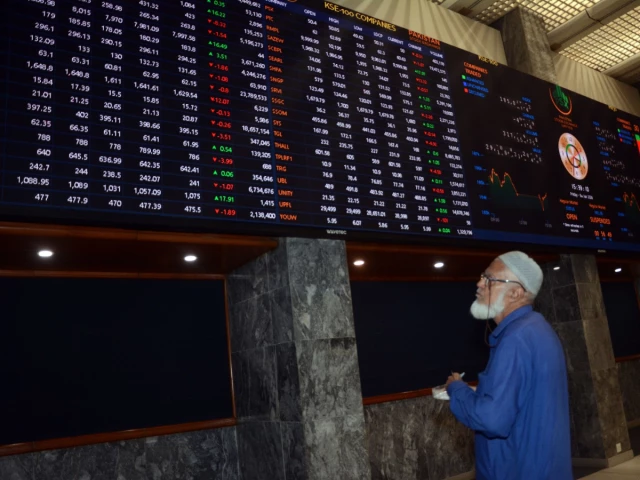
Pakistan's stock market remained under pressure during the outgoing week as persistent geopolitical tensions and surging global oil prices kept investor sentiment fragile, leading to continued volatility at the bourse. The benchmark KSE-100 index closed at 150,399, posting a decline of 1,309 points, or 0.9% week-on-week.
On a day-on-day basis, the Pakistan Stock Exchange (PSX) commenced the week with a negative session as the KSE-100 declined by 4,865 points (-3.21%), settling at 146,843. However, the PSX witnessed a positive session on Tuesday, gaining 1,900 points (+1.29%) at 148,743.
On Wednesday, the index surged 6,768 points (+4.55%) to 155,512, decisively reclaiming the key psychological threshold of 150k. Nevertheless, on Thursday, the market surrendered part of its previous session's gains, with the index falling 3,500 points (-2.25%) to close at 152,011. PSX continued its negative streak on Friday and lost a further 1,613 points (-1.06%) to settle at 150,399.
Arif Habib Limited (AHL), in its weekly commentary, stated that the KSE-100 index continued to experience volatility during the week amid geopolitical developments, resulting in persistent selling pressure. The index closed at 150,399, marking a modest decline of 0.9% WoW (1,309 points).
Among economic news, the Consumer Price Index (CPI) for Mar'26 rose 7.3% year-on-year (the highest since Aug'24), up from 7% in Feb'26. High-speed diesel (HSD) prices rose Rs184.9/litre to Rs520.35, while motor spirit went up Rs137.24/litre to Rs458.41. The price differential claim (PDC) on HSD (Rs203.88/litre) was removed and the petroleum levy was increased by Rs55.24. For 2QFY26, a GDP growth of 3.89% was reported, driven by industry (7.40%), agriculture (1.76%) and services (3.69%), AHL mentioned.
Trade deficit stood at $2.7 billion in Mar'26 as exports fell 14% YoY to $2.3 billion while imports declined 5.4% YoY to $5 billion. The T-bills' auction raised Rs776.9 billion vs the target of Rs750 billion, with demand concentrated in one-month and three-month papers. Yields were mixed, where one-month (-29 basis points) and six-month (-3 basis points) bills declined while three-month (+29 basis points) and 12-month (+25 basis points) bills increased.
Pakistan's public debt rose 1.1% to Rs81.4 trillion ($290.6 billion) in 1HFY26, with Rs55.4 trillion domestic (68%) and Rs26 trillion external (32%) debt. The Federal Board of Revenue (FBR) collected Rs1,185 billion (+8% YoY) in Mar'26, missing the target by Rs182 billion whereas 9MFY26 collection stood at Rs9,307 billion, short by Rs610 billion.
The State Bank-held reserves rose $6.2 million to $16.4 billion while commercial bank reserves increased by $47.8 million to $5.4 billion. Refinery offtake rose 13% YoY, led by HSD (+26.8%) and motor spirit (+25.1%) while production increased 13.9% YoY with utilisation at 58%.
Petroleum sales rose 19% YoY to 1.44 million tons in Mar'26 (ex-furnace oil +16.7%), with HSD +21%, motor spirit +16%, furnace oil +62% while 9MFY26 volumes grew 5% to 12.4 million tons. Cement dispatches increased 0.9% YoY to 3.74 million tons in Mar'26, driven by export growth despite weak local demand, while 9MFY26 dispatches grew 9.8% YoY, AHL added.
Syed Danyal Hussain of JS Global noted that the KSE-100 index remained volatile during the week, declining 1,309 points (0.9% WoW) amid escalating geopolitical tensions and persistently high Brent crude prices, which stayed above $100 per barrel throughout the week. On a positive note, Pakistan reached a staff-level agreement with the IMF on the third review under the Extended Fund Facility and the Resilience and Sustainability Facility, paving the way for a $1.2 billion tranche, subject to the IMF board approval.
Separately, the National Accounts Committee reported that Pakistan's economy grew 3.9% YoY in 2QFY26, driven by a recovery in industrial output (+7.4%). Meanwhile, inflation clocked in at 7.3% YoY in Mar'26, the highest reading since August 2024, taking the average 9MFY26 inflation to 5.7%.
The FBR collected Rs1.2 trillion in taxes during March, falling short of its target by Rs182 billion, while cumulative collection in 9MFY26 reached Rs9.9 trillion, missing the target by Rs610 billion. The government finally passed through higher international oil prices by raising petrol and diesel rates by Rs137/litre and Rs184/litre, respectively, effectively ending the subsidy regime, Hussain said.









This material may not be published, broadcast, rewritten, redistributed or derived from. Unless otherwise stated, all content is copyrighted © 2026 The Express Tribune.












COMMENTS
Comments are moderated and generally will be posted if they are on-topic and not abusive.
For more information, please see our Comments FAQ