State Bank receives $1.3b IMF disbursement
Updated 7 hours ago

Gives assurances to IMF to clear way for disbursement of $1b loan tranche
Pakistan has assured the International Monetary Fund (IMF) that to deal with the economic impact of the Middle East conflict, it stands ready to increase interest rates and devalue currency, as the lender has imposed yet another condition to end control over foreign currency movement.
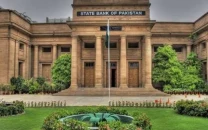
According to the Pakistani authorities, to cope with the increasing inflation and control imports in the aftermath of the Middle East war, they have assured the lender of increasing interest rates and easing control over the currency market. The assurances have been given to pave the way for a staff-level agreement for the disbursement of the fourth loan tranche of $1 billion out of the $7 billion package.
Central bank sources said that to deal with the adverse impact of choking supply lines and increasing fuel cost on the import bill and inflation, the bank informed the IMF that it would maintain an appropriately tight monetary policy and "stands ready to raise interest rates, if needed".
In its last monetary policy, the central bank had kept the rate unchanged after hostilities began in the region. Both the IMF and the SBP were of the view that with the increase in domestic oil prices due to the surge in global markets, inflation was expected to go up, which would require an increase in interest rates, currently standing at 10.5%.
In March, the inflation rate rose 7.3%, the highest level in the past 17 months but lower than expectations of the Ministry of Finance. The federal government had estimated that the country's energy import bill would rise in the range of $300 million to $500 million a month, if Brent crude prices ranged between $100 and $120 per barrel.
The Pakistan Bureau of Statistics (PBS) reported on Thursday that imports fell in March on an annual basis. According to the national data collecting agency, imports dipped 5.4% to $5 billion over the same month of last year.
During the July-March period of the current fiscal year, imports grew 6.6%, or $3.2 billion, to $50.5 billion. Compared to that, exports shrank 8% in nine months to a mere $22.7 billion, reflecting a huge trade deficit of $27.8 billion. The deficit widened 23% in the nine-month period.
However, Pakistani authorities have assured the IMF that they will relax restrictions on foreign exchange movement and will also use the currency as a shock absorber to discourage imports. The IMF has added a new condition in programme documents to make sure that these restrictions are lifted by March next year, sources said.
According to the new condition, the central bank will develop a roadmap for the gradual removal of foreign exchange restrictions. It will quantify the indicators and set timelines for complete liberalisation of the foreign exchange regime, the sources added.
They said that complete removal of the restrictions would depend on Pakistan's macroeconomic and financial stability. The IMF's stance was that such liberalisation would help the private sector and increase foreign investment.
But there have always been concerns about manipulation of the foreign currency market, given its very small size. In recent months, central bank authorities said that they removed various regulations that unduly burdened banks and their clients, including certain documentary requirements. The central bank was moving from general verification to risk-based verification to minimise the time and cost of these transactions, sources said.
Pakistan has already committed to implement a flexible exchange rate regime but the central bank is artificially keeping the price of the rupee low by massively purchasing dollars from the market. The country has failed to significantly enhance exports, which could help build the foreign exchange reserves.
The central bank assured the IMF that it would use the foreign exchange market as a buffer to absorb shocks and rebuild reserves. The SBP also said that it would take measures to arrange sufficient finances to ensure that Letters of Credit were opened for imports without bringing balance sheets of banks under stress, sources added.
They said that to address IMF concerns about subsidising foreign remittances, the government assured the lender that it would limit subsidies only to the extent of money allocation in the budget.
There had been disagreement between the Ministry of Finance and the SBP over financing the remittance subsidy scheme. The IMF has already included a condition in its loan package to determine the true cost of subsidies and the deadline to submit the report is May this year.
After developing an action plan, both the finance ministry and the SBP would finalise a mechanism to ensure that claims arising from the remittance subsidy scheme during any given fiscal year did not exceed budgetary allocations, sources said. Remittances are the only main non-debt creating source for Pakistan to remain afloat and are significantly higher than exports.







This material may not be published, broadcast, rewritten, redistributed or derived from. Unless otherwise stated, all content is copyrighted © 2026 The Express Tribune.














COMMENTS (2)
Comments are moderated and generally will be posted if they are on-topic and not abusive.
For more information, please see our Comments FAQ