State Bank receives $1.3b IMF disbursement
Updated 7 hours ago

Karachi handles 11,000 containers in March alone, up from 8,300 in all of 2025
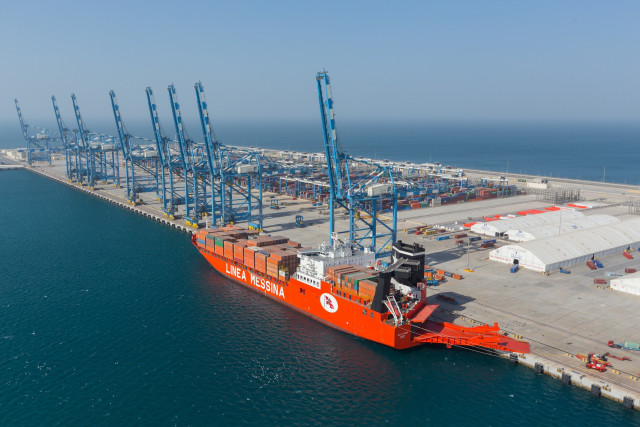
Gwadar Port has begun witnessing an uptick in transhipment activity as global shipping patterns shift amid disruptions in traditional routes through the Strait of Hormuz, with industry stakeholders calling for urgent policy action.
The port berthed M/V HMO LEADER, carrying 368 metric tonnes of transhipment cargo, according to the Gwadar Port media coordinator. The development reflects rising interest from shipping lines seeking safer routes amid Gulf tensions. Gwadar is attracting cargo due to its strategic location, modern infrastructure and free storage incentives, said Gwadar Port Chairman Noorul Haq Baloch.
According to Abdul Rahman Fudda, President of the Site Association of Industry, Gwadar's growing activity reflects a diversion of cargo flows triggered by geopolitical tensions involving Iran, Israel and the United States.
"Shipping lines are increasingly seeking safer alternatives, and Gwadar is beginning to benefit from that shift," said Fudda, noting that cargo volumes have also increased at Port Qasim despite operational challenges including heavy rains during Ramazan.
Fudda maintained security at Gwadar Port remains "tight and effective", while recent government relaxations have helped facilitate smoother cargo handling. However, he cautioned that Pakistan must act quickly to transform this temporary surge into a lasting advantage.
"Improving infrastructure, rationalising port charges and adopting research-based policy measures are essential if we want this momentum to continue beyond wartime conditions," he said. Shakeel Ahmed, former chairman of the Pakistan International Freight Forwarders Association, said Pakistan is experiencing an unprecedented increase in transhipment volumes, particularly at Karachi Port. He noted that approximately 11,000 transhipment containers (TEUs) were handled at Karachi Port in March 2026 alone, compared to around 8,300 containers processed during all of 2025.
"This extraordinary surge clearly reflects diversion of global cargo flows towards Pakistan," Ahmed said. At Port Qasim, container handling has also accelerated, with over 900 containers processed in a single day and cumulative volumes reaching around 4,000 TEUs.
Meanwhile, Gwadar Port has formally entered the transhipment network. A dedicated vessel recently berthed there, offloading approximately 1,900 metric tonnes of cargo destined for the UAE, while another vessel is expected soon.
"Although Gwadar's volumes are still building up, its strategic location gives it strong potential to emerge as Pakistan's primary transhipment hub," Ahmed said.
Stakeholders attributed the current surge in activity to a combination of geopolitical developments and policy measures introduced under Prime Minister Shehbaz Sharif, including customs amendments, expansion of temporary storage and expedited clearance systems, which have collectively enhanced Pakistan's competitiveness as a transhipment destination.
"These interventions have delivered timely results, but must now be institutionalised into a predictable and long-term framework," Ahmed emphasised. Separately, Salim Valimuhammad, Chairman of the Pakistan Chemicals & Dyes Merchants Association, described the surge as a "golden opportunity" for Pakistan's trade and logistics sector.
Recent official measures show the government has changed customs rules and port handling arrangements to speed transhipment, said Saquib Fayyaz Magoon, Senior Vice President of FPCCI.
A PM-led review on March 25 said off-dock terminals had been authorised to handle transhipment, with port transport charges reduced by up to 60 per cent and export desks activated. Separately, the FBR issued notifications revising transhipment procedures and authorising a 16.9-acre temporary storage area at Port Qasim, added Magoon. Valimuhammad attributed the increase not only to Gulf tensions but also to shipping disruptions in Dubai, which have compelled international lines to divert cargo to Pakistan.
"This indicates growing confidence among global operators in Pakistan's port infrastructure," he said, adding that Port Qasim is also benefiting from increased cargo movement.
Despite the positive trend, industry leaders stressed that sustaining momentum requires coordinated government-private sector efforts, including enhanced maritime security, safe cargo evacuation corridors, round-the-clock customs operations and greater digital facilitation.
Pakistan's duty-free transhipment regime was also highlighted as a key advantage, as such cargo is exempt from customs duties and taxes. Additionally, the Gwadar Free Zone offers long-term tax and duty exemptions.






This material may not be published, broadcast, rewritten, redistributed or derived from. Unless otherwise stated, all content is copyrighted © 2026 The Express Tribune.















COMMENTS
Comments are moderated and generally will be posted if they are on-topic and not abusive.
For more information, please see our Comments FAQ