Dar warns UNSC over Middle East tensions
Updated 10 hours ago

Jointly call for ceasefire, peace talks; urge civilian protection, safe shipping as Beijing eyes larger Middle East
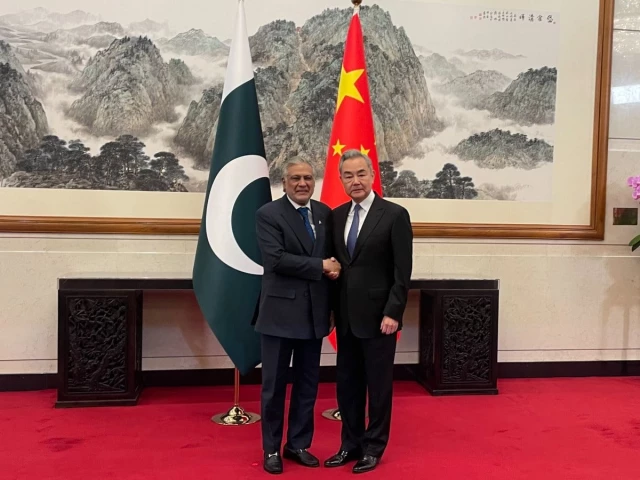
Pakistan and China on Tuesday jointly proposed a five-point initiative aimed at restoring peace and stability in the Gulf and the broader Middle East.
The plan calls for an immediate ceasefire, urgent diplomatic engagement to prevent further escalation, and the restoration of normal maritime traffic through the Strait of Hormuz.
The 'Five-Point Plan' was announced in a joint statement following a meeting in Beijing between China's Foreign Minister Wang Yi and Pakistan's Deputy Prime Minister and Foreign Minister, Senator Ishaq Dar.
Against the backdrop of escalating hostilities, #China and #Pakistan unveiled on Tuesday a five-point initiative for restoring peace and stability in the Gulf and Middle East region, with the immediate cessation of hostilities and an early start to peace talks at its core.… pic.twitter.com/siQZVqIxG3
— China Daily (@ChinaDaily) April 1, 2026
Dar travelled to China two days after hosting a meeting of foreign ministers from Saudi Arabia, Turkey, and Egypt as part of Pakistan's diplomatic efforts to end the conflict. China's endorsement of the plan highlights Beijing's increasingly proactive role in seeking a resolution to the crisis.
Chinese FM Wang Yi held talks with Pakistani Deputy PM and FM Mohammad Ishaq Dar in Beijing. The two sides put forward a five-point initiative for restoring peace and stability in the Gulf and Middle East Region.
— Lin Jian 林剑 (@SpoxCHN_LinJian) April 1, 2026
Wang noted #China supports and looks forward to #Pakistan playing… pic.twitter.com/gKK2Gs3swI
The plan
According to the joint statement, both sides stressed the need for an immediate cessation of hostilities, urging all parties to prevent the conflict from spreading and to ensure unhindered humanitarian access to war-affected areas.
They also called for the early resumption of peace talks, underlining that dialogue and diplomacy remain the only viable paths to resolving disputes. The statement emphasised the importance of safeguarding the sovereignty, territorial integrity, and security of Iran and the Gulf states, while urging all parties to refrain from the use or threat of force during negotiations.
Highlighting concerns over civilian safety, the two countries underscored the need to protect non-military targets. They called on all parties to strictly adhere to international humanitarian law and halt attacks on civilians and critical infrastructure, including energy facilities, desalination plants, and peaceful nuclear installations.
They also voiced concern over disruptions to global trade, stressing the need to ensure the security of shipping lanes, particularly in the Strait of Hormuz. They called for the safe passage of commercial vessels and the restoration of normal maritime traffic at the earliest opportunity.
Reaffirming their commitment to multilateralism, both countries emphasised the primacy of the United Nations Charter, urging the international community to support efforts aimed at achieving a comprehensive and lasting peace framework in line with international law.
PR No.86/2026
— Ministry of Foreign Affairs - Pakistan (@ForeignOfficePk) April 1, 2026
Deputy Prime Minister/Foreign Minister Senator Mohammad Ishaq Dar's Meeting with Chinese Foreign Minister Wang Yi, in Beijing on March 31st, 2026 pic.twitter.com/h50M3e1mFy
China's pivotal role
The Foreign Office in Islamabad stated that the initiative reflects a shared commitment by Islamabad and Beijing to promote de-escalation in a region facing heightened tensions. Diplomatic sources suggested that China could play a pivotal role in nudging Iran toward potential face-to-face talks with the US in Islamabad.
Dar's visit to Beijing gained significant traction among domestic and international commentators. Analysts noted that the joint statement proves Pakistan and China are "on the same page" regarding the crisis.
"The upshot of the China-Pakistan five-point statement on the war is that China's answer to being asked to get involved was definitely not 'no.' The statement is an opening for Beijing to step in," wrote Vali Nasr, Professor at Johns Hopkins and author of 'Iran's Grand Strategy', on X.
Geo-strategy expert Professor Dr Ishtiaq Ahmed noted that the statement aligns closely with the Gulf's interests. "By placing a ceasefire first, Beijing and Islamabad align with Gulf preferences and create a baseline that others can publicly support, even if not immediately implemented," he said.
Dr Ahmed added that the most "consequential point" involves the Strait of Hormuz: "By focusing on safe passage and normal shipping, the proposal links the conflict to global energy markets. It aligns with US, Chinese, and Gulf interests and creates a clear area where pressure for restraint can build quickly."
Former finance minister Asad Umar described the proposal on X as an "excellent development," noting it marks the first time China has taken a direct initiative to influence a global crisis of this magnitude. Quoting Allama Iqbal, he added: "See the sun rising from the East."
Michael Kugelman, a prominent American foreign policy expert, said the initiative signals Beijing's endorsement of the US-Iran peace process that Islamabad has sought to advance. However, he added, "It's also likely a reflection of Pakistan's view that China needs to be brought into the fold to get more buy-in from the Iranians."
Mushahid Hussain Syed, Chairman of the Pakistan-China Institute, termed the framework of "critical importance". He noted that it aligns closely with Iran's position while emphasising the supremacy of the UN and international law, indicating that China is now ready to act as a mediator.
Former information minister Fawad Chaudhry called the five-point initiative “a masterclass in diplomacy”.
“It beautifully & comprehensively converges the security concerns of the USA with the sovereignty of Iran. This document MUST be the basis for an immediate ceasefire and the end of Iran War. Pakistan and China’s 5-point initiative is a masterclass in diplomacy,” he wrote in a post on X.




This material may not be published, broadcast, rewritten, redistributed or derived from. Unless otherwise stated, all content is copyrighted © 2026 The Express Tribune.









COMMENTS (1)
Comments are moderated and generally will be posted if they are on-topic and not abusive.
For more information, please see our Comments FAQ