SBP opens formal banking to licensed virtual asset service providers
Updated 4 hours ago

Digital transition, omanisation policy to redefine jobs for unskilled Pakistanis
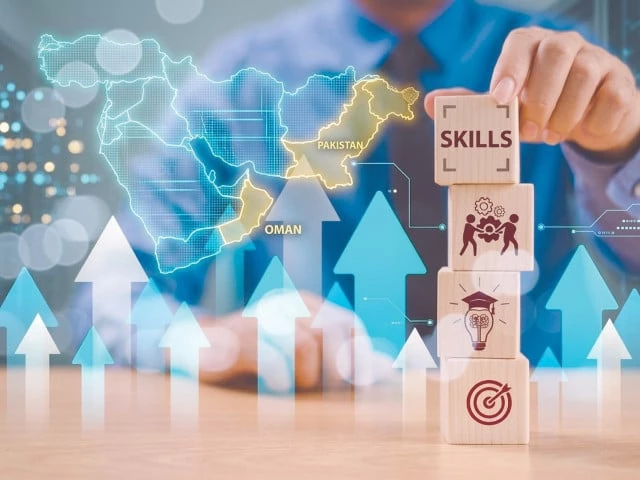
Pakistan's dependence on remittances is growing as it seeks to finance its expanding trade deficit. One of the countries contributing to these remittances is Oman, where many Pakistani workers send valuable foreign exchange back home. Meanwhile, Oman Vision 2040 aims for long-term economic transformation, which could significantly change employment opportunities for thousands of Pakistani expatriate workers.
As Oman gradually shifts toward a more digital and knowledge-based economy, it is also tightening labour market regulations through its omanisation policy. Remittances from the Gulf region continued to dominate Pakistan's inflows in February, reflecting the large concentration of Pakistani workers in Middle Eastern labour markets. From Oman alone, overseas Pakistanis sent $92.6 million during the month, slightly lower than the $105.6 million recorded in January, but still maintaining a steady contribution to overall inflows.
Alongside Oman, other Gulf Cooperation Council countries collectively contributed about $317.2 million, including Qatar with $102.8 million, Kuwait $77 million and Bahrain $44.8 million. Meanwhile, the two largest Gulf corridors, the United Arab Emirates and Saudi Arabia, remained the dominant sources, sending $696.2 million and $685.5 million respectively in February, underscoring the continued importance of Gulf economies for Pakistan's remittance inflows and external account stability. The transition reflects a broader structural shift in Oman's growth model. With non-oil activities now contributing more than 70% of the country's gross domestic product, economic expansion is increasingly driven by sectors such as logistics, digital infrastructure, advanced services and industrial operations. As these systems become more complex, demand is expected to move from basic operational labour toward workers capable of handling data, coordinating digital platforms and operating technologically advanced systems.
For Pakistani workers, many of whom have historically been employed in construction, maintenance, logistics and technical trades, this change could gradually redefine the types of skills required to remain competitive in the Omani labour market.
Industry observers say the challenge is not the availability of technology or infrastructure, but the availability of skilled workers able to operate and manage those systems efficiently. "At a certain stage, technology stops being the constraint. People become the limiting factor," said technology investor and infrastructure operator Matvii Diadkov, who has worked on ecosystem-level digital infrastructure deployments across logistics, e-commerce and real estate sectors in Oman and the wider region. "Systems only scale when there are enough skilled operators to run them, improve them and pass that knowledge forward," he noted through an email communication.
Oman already has strong digital infrastructure foundations, with internet penetration exceeding 95% and nationwide mobile coverage supporting advanced services. However, information and communication technology professionals still represent only about 2-3% of the country's workforce.
Regional benchmarks suggest that more than 40% of jobs now require at least some level of digital capability, highlighting a gap between infrastructure development and workforce readiness.
For expatriate workers, including Pakistanis, this gap may create both opportunities and risks. While specialists with strong technical or digital skills may find continued demand in areas such as engineering, healthcare and advanced system operations, mid-level operational roles could face increasing pressure as Oman prioritises employment opportunities for its own citizens. The tightening of labour market regulations is part of Oman's broader omanisation strategy, which seeks to increase the participation of Omani nationals in private-sector jobs. Under the country's updated labour law, companies can hire foreign workers only when suitable local candidates are unavailable, and firms may replace expatriate employees with Omani workers under localisation plans.
This policy shift is occurring alongside demographic dynamics that add further pressure to the labour market. More than half of Oman's population is under the age of 35, while youth unemployment remains structurally higher than the national average, estimated at around 10-12%. Analysts say the future trajectory of Pakistani workers in Oman will largely depend on how quickly they can upgrade their skills to match the evolving demands of a more technologically advanced economy.
While many Pakistani migrants already work in technical fields such as engineering, electrical maintenance and healthcare, experts note that the next phase of economic transformation will require stronger capabilities in digital system operations, data management, logistics coordination and industrial automation. "Another challenge is the absence of publicly available data on the exact digital skill levels among Pakistani expatriates working in Oman, making it difficult to measure how well their training aligns with the country's future workforce needs," Matvii Diadkov said.
Some analysts argue that closer cooperation between Pakistan and Oman on skills development could help address the mismatch.
Potential initiatives include joint certification programmes, pre-departure technical training, digital verification of professional qualifications and sector-specific training for industries such as logistics, energy infrastructure and industrial operations.
Education specialists note that talent development in digital sectors often takes eight to twelve years to mature, meaning early investments in training and institutional partnerships could play a crucial role in determining the long-term competitiveness of Pakistan's overseas workforce.















This material may not be published, broadcast, rewritten, redistributed or derived from. Unless otherwise stated, all content is copyrighted © 2026 The Express Tribune.






COMMENTS
Comments are moderated and generally will be posted if they are on-topic and not abusive.
For more information, please see our Comments FAQ