Pakistan begins preparations for 2nd round of US-Iran talks: sources
Updated 2 hours ago

With per-person iftar costs now at Rs300, low-income families and women rely on charitable meals
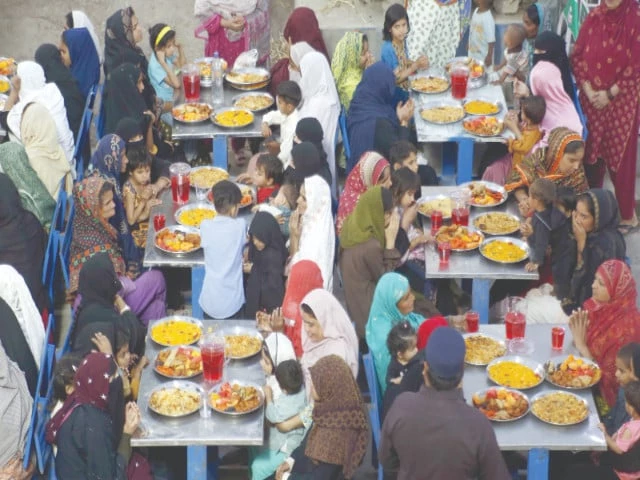
Rising inflation and shrinking household incomes have led to a surge in crowds at free iftar tables across the metropolis during the fasting month of Ramazan, with the cost of providing iftar and dinner per person now reaching Rs300.
Organisers say a growing number of women and low-income families are relying on these public meals as financial constraints prevent them from arranging iftar at home.
According to Imranul Haq, organiser of a welfare-run iftar table, Ramazan is a month of blessings during which philanthropists and charitable groups set up tables on major roads, intersections, and public spaces across the metropolitan city.
"This year, the number of iftar tables has increased by over 30 per cent, with more than 3,500 locations hosting meals where hundreds gather daily to break their fast," he said.
Haq added that low-income workers, drivers, delivery personnel, and labourers form the bulk of attendees, while many women and children also rely on these arrangements due to poverty.
Chaudhry Shahid Hussain, spokesperson for another welfare organisation, said people prefer iftar tables that provide both traditional iftar items and a full meal.
"Due to inflation, the cost of preparing iftar and dinner has risen by over 50 per cent. In 2024, per-person costs were around Rs180, which rose to Rs250 in 2025, and now stand at Rs300 in 2026," he added.
Typical iftar items include dates, samosas, dahi bhallay, fruit chaat, and seasonal fruits, while meals often consist of biryani or chicken or mutton qorma served with bread. Many organisers also provide food parcels for families to take home. Volunteer Asif Abbasi said several welfare organisationsincluding the Chhipa Welfare Association, Edhi Foundation, Saylani Welfare International Trust, Alamgir Welfare Trust, Al-Mustafa Welfare Society, and Jafaria Disaster Management Cell - organise both public iftar tables and takeaway iftar boxes.
He added that mosques, imambargahs, residents' associations, market bodies, philanthropists, and charitable women also contribute to the efforts. Larger venues provide separate arrangements for women, while roadsides and bus stops see distribution of iftar boxes, water, and juice for commuters.
Samina Bibi, a widow raising five children in the Lines Area, said: "No one likes coming to an iftar table like this, but because of poverty, these arrangements are a blessing for the poor."
Salim Ustad, an elderly rickshaw driver, said he earns around Rs1,000 daily and cannot afford to break his fast independently.
"If I break my fast on my own, it costs about Rs300. At these tables, we get both iftar items and a meal," he said, adding that many take food parcels home.
He urged the government to provide special relief packages so that low-income families can also share in the joy of Eidul Fitr.











This material may not be published, broadcast, rewritten, redistributed or derived from. Unless otherwise stated, all content is copyrighted © 2026 The Express Tribune.





COMMENTS
Comments are moderated and generally will be posted if they are on-topic and not abusive.
For more information, please see our Comments FAQ