Dar warns UNSC over Middle East tensions
Updated 3 hours ago

During his visit, the premier will hold talks with the Saudi crown prince to further strengthen bilateral relations
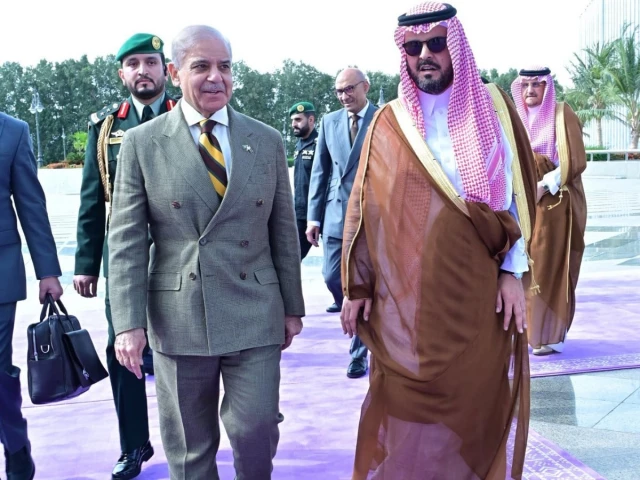
Prime Minister Shehbaz Sharif arrived in Saudi Arabia on Wednesday for the first part of his three-nation tour amid ongoing active negotiation efforts for peace in the Middle East.
The prime minister is on a three-nation tour till Friday, during which he will also visit Qatar and Turkiye. The Prime Minister’s Office said he is scheduled to hold a bilateral meeting with Saudi Crown Prince and Prime Minister Mohammed bin Salman. The meeting will involve discussions on further strengthening bilateral relations and an exchange of views on the regional situation.
Upon his arrival, the premier and his delegation were received by Makkah Deputy Governor Prince Saud bin Mishaal bin Abdulaziz, Saudi Arabia's Ambassador to Pakistan Nawaf bin Saeed Al-Malki, and Pakistan's Ambassador to Saudi Arabia Ahmad Farooq.
Jeddah: April 15, 2026.
— Prime Minister's Office (@PakPMO) April 15, 2026
Prime Minister Muhammad Shehbaz Sharif arrives in Jeddah for official visit to Saudi Arabia along with high-level delegation.
Upon arrival in Jeddah, the Prime Minister and the Pakistani delegation were warmly welcomed at the airport by Prince Saud bin… pic.twitter.com/OuTmd7DF8p
PM Shehbaz is accompanied by Deputy PM and Foreign Minister Ishaq Dar, Information Minister Attaullah Tarar, Special Assistant to the Prime Minister Syed Tariq Fatemi, and the prime minister’s spokesperson for foreign media.
The premier's visit came three days after the US and Iran were unable to reach an agreement to end their war despite marathon negotiations lasting around 21 hours. The prolonged talks, aimed at halting hostilities that have killed thousands and driven global oil prices higher over the past six weeks, ended with both sides blaming each other for the impasse.
On April 11, US and Iranian delegations arrived in Pakistan for conclusive talks following a two-week immediate ceasefire "everywhere, including Lebanon", announced by PM Shehbaz, who later invited delegations from both countries to Islamabad.
Prime Minister Muhammad Shehbaz Sharif departs Nur Khan Airbase Rawalpindi for an official visit to the Kingdom of Saudi Arabia. pic.twitter.com/s8HCixqvBG
— Government of Pakistan (@GovtofPakistan) April 15, 2026
Earlier today, the Ministry of Foreign Affairs (MoFA) said the visits to Saudi Arabia and Qatar would take place in a bilateral context, adding that the prime minister “will meet the leadership of Saudi Arabia and Qatar to discuss ongoing bilateral cooperation as well as regional peace and security”.
"During the tour, the prime minister will also travel to Turkiye to participate in the Antalya Diplomacy Forum, where he is scheduled to attend the Leaders’ Panel alongside other world leaders," the statement said.
It added that on the sidelines of the forum, the premier was expected to hold bilateral meetings with Turkish President Recep Tayyip Erdogan and other key leaders.
🔊PR No.1️⃣0️⃣2️⃣/2️⃣0️⃣2️⃣6️⃣
— Ministry of Foreign Affairs - Pakistan (@ForeignOfficePk) April 15, 2026
Curtain Raiser : Prime Minister’s Visit to Saudi Arabia, Qatar and Türkiye (15–18 April 2026)
🔗⬇️https://t.co/O80lliee7O pic.twitter.com/x1lhwHS5To
Highlighting the significance of the upcoming visit, the MoFA said Pakistan’s participation “reflects its continued commitment to constructive diplomacy, multilateral cooperation, and meaningful engagement with the international community on issues of global importance”.
Meetings of foreign ministers from Egypt, Saudi Arabia, Qatar, and Turkiye had first convened in Riyadh on March 19, at the height of tensions between Tehran and Washington. Just ten days later, they reconvened in Islamabad as part of a coordinated push by key Muslim countries to seek an end to the ongoing conflict in the Middle East.
Read More: FM Dar calls on US, Iran to uphold ceasefire commitment after talks end without agreement
The new development emerged as Pakistan, Turkiye, Egypt and Saudi Arabia were quietly but steadily moving towards formalising a new quadrilateral framework, as rapid developments in the Middle East push key regional players to coordinate more closely on diplomacy and security.
While officials stopped short of calling it an alliance, the pace and frequency of engagements suggest that the four-country forum is evolving into a structured grouping aimed at shaping outcomes in a volatile region.
The latest step came on Tuesday, when senior officials from the four countries met in Islamabad following up on earlier consultations between their foreign ministers. The meeting, hosted by MoFA, brought together top diplomats to firm up proposals that will now be presented at the upcoming foreign ministers' meeting in Antalya on April 17, on the sidelines of the Antalya Diplomacy Forum.
The US and Israel launched a joint offensive on Iran on February 28, killing thousands of people in Iran, including then-supreme leader Ayatollah Ali Khamenei and leaving tens of thousands injured, with civilian areas, including residential buildings and religious sites, among those hit.
The conflict also expanded geographically. Iran retaliated with drone and missile strikes targeting Israel as well as Jordan, Iraq, and Gulf countries hosting US military assets. It also restricted the movement of ships through the Strait of Hormuz.





This material may not be published, broadcast, rewritten, redistributed or derived from. Unless otherwise stated, all content is copyrighted © 2026 The Express Tribune.













COMMENTS (1)
Comments are moderated and generally will be posted if they are on-topic and not abusive.
For more information, please see our Comments FAQ