Cuba 'ready' for possible US attack: president
Updated 49 minutes ago

Bunker fuel prices surge over 40% as tanker transits through Strait of Hormuz down 90% from last week
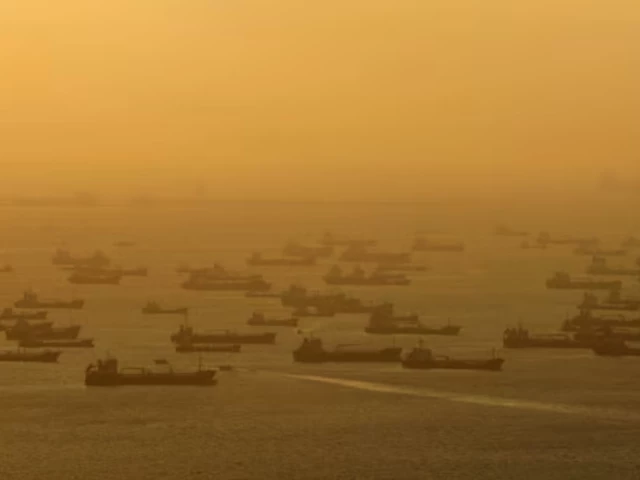
Fuel oil traders in Asia are struggling to secure alternative supply as the Iran war curtails shipments from key Middle Eastern suppliers through the Strait of Hormuz, prompting them to look to the West for replacement cargoes.
The shortage of Middle Eastern fuel oil volumes is set to dent the supply of bunker fuel for powering ships, with prices at key bunker ports such as Singapore set for further hikes in coming weeks, raising refuelling costs for vessel owners. Those higher costs will translate into increased prices for companies transporting goods.
Expectations for a growing shortage sparked a sharp rally in fuel oil markets this week, especially for high-sulphur fuel oil which typically comes from the Middle East.
Read: Oil prices rise, global stocks drop as Middle East war stirs supply concerns
Volumes of fuel oil exports transiting the Strait of Hormuz and bound for Asia typically average 1.2 million metric tons per month, or about 246,000 barrels per day, Kpler data showed, with about 70% ending up in Southeast Asia.
Overall fuel oil exports via the Strait of Hormuz usually total about 3.7 million tons per month, the data showed. Tanker transits are now about 90% lower than last week, Kpler's analysis of vessel activity showed.
"When such a large share of the global high-sulphur complex depends on a single chokepoint, even partial transit disruption can tighten balances quickly and amplify bunker volatility," said Sumit Ritolia, lead analyst for refining and supply modelling at Kpler.
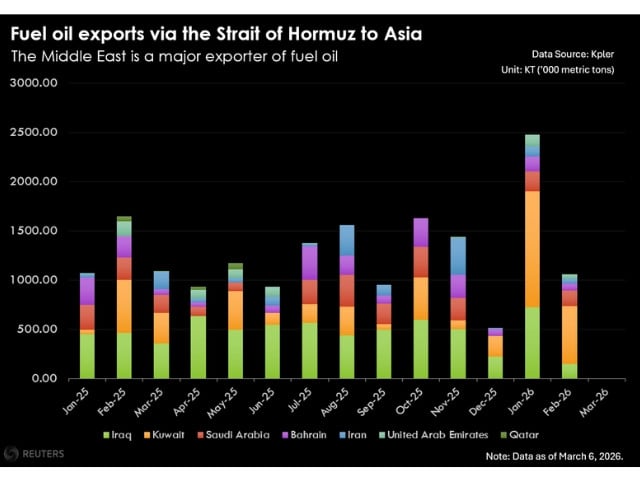
Graph showing that the Middle East is a major exporter of fuel oil. PHOTO: REUTERS
Western supply challenges
Prices for high-sulphur bunker fuel delivered in Singapore, the world's largest ship refuelling hub, have risen more than 40% since the start of the war, while prices for delivered low-sulphur fuel oil have climbed more than 30%.
Some high-sulphur supply could come from Western refineries, though sky-high tanker rates make trading economics extremely challenging, fuel oil traders said. "Everyone is struggling to find oil for the second half of March. Tankers are too expensive and arbitrage to Singapore is closed," a trader based in Singapore said.
In the low-sulphur market, price hikes were less steep as some supply still comes from Brazil and Nigeria, though cargoes from Kuwait's al-Zour refinery are shut in the Gulf.
Read More: Country has 28 days of fuel
Costs of future replenishment are expected to jump due to wider tightness in the market, said traders.
While the market is coping with an existing large build in onshore inventories in Singapore as well as volumes stored on ships, stockpiles are set to draw sharply in the coming weeks, traders said.
Global markets have been thrown into turmoil since the United States and Israel began strikes against Iran last week, killing the Islamic Republic's Supreme Leader, Ayatollah Ali Khamenei, and sparking retaliatory attacks across the Gulf.
Iran has launched hundreds of missiles and more than 1,000 drones at Gulf states allied with Washington. Most were intercepted by air defences, but some residential and commercial buildings, infrastructure and US military bases have sustained damage.















This material may not be published, broadcast, rewritten, redistributed or derived from. Unless otherwise stated, all content is copyrighted © 2026 The Express Tribune.






COMMENTS
Comments are moderated and generally will be posted if they are on-topic and not abusive.
For more information, please see our Comments FAQ