Ukranian President Zelensky asks Trump for air defence as Russia escalates strike threats
Updated 9 hours ago

Iran's UN envoy calls US maritime blockade 'clear act of aggression'
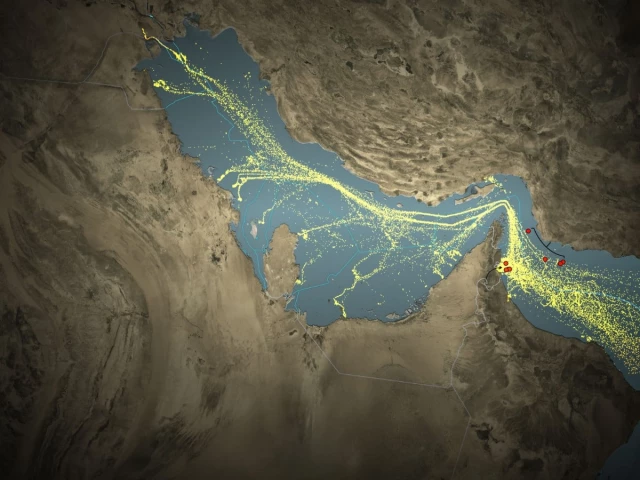
The UN General Assembly (UNGA) convened on Thursday in a veto debate session on a draft Security Council resolution on the closure of the Strait of Hormuz, with member states divided about whether the text would have eased or deepened the crisis.
UNGA President Annalena Baerbock opened the session by urging members to move beyond the council's deadlock.
"In light of the council's failure to support efforts leading to safe and unimpeded passage in the Strait of Hormuz, the General Assembly now has both the opportunity and the responsibility to ensure that the debate on the freedom of navigation in the Strait of Hormuz does not end with the casting of a veto," she said.
Warning that the crisis was not isolated, she said, "What we are witnessing is not a single crisis, but the convergence of multiple overlapping and long-standing fault lines, which did not start on the 28th of February," she said, pointing to tensions about Iran's nuclear capabilities and Israeli military attacks in the region.
Russia's Deputy UN envoy Anna Evstigneeva defended Moscow's veto, arguing the draft would have been exploited to justify further military action.
"It proposed that the Security Council give a green light to the use of certain protective measures under the pretext of ensuring the safety of navigation," she said, adding that it "would have become a carte blanche for the continuation of aggressive actions and further escalation".
She said Russia and China had put forward an alternative, balanced draft resolution to facilitate a negotiated solution.
Read More: Next round of US-Iran talks 'maybe, probably over the weekend', very close to deal: Trump
China's UN envoy Fu Cong echoed that position, warning that the council's actions "must not provide a veneer of legitimacy for unauthorised mandatory operations or grant a licence to the use of force".
US envoy Mike Waltz sharply criticised the vetoes, accusing Moscow and Beijing of choosing "to shield the world's leading state sponsor of terrorism".
He vowed that Washington would "continue to work so that food aid, fertiliser, energy, and commercial goods can flow, once again, through this vital waterway free from attack, threats, mining or extortion".
Stavros Lambrinidis, the head of the delegation of the EU to the UN, warned of severe global consequences, noting fertiliser prices had risen 20% to 35% in Latin America and the Caribbean, while global urea prices were up 50%, potentially driving 45 million additional people into acute hunger, a disruption he compared to Russia's naval blockade of the Black Sea.
Iran's UN envoy calls US maritime blockade 'clear act of aggression'
Iran's ambassador to the United Nations said that Washington's maritime blockade against Tehran represented "a clear act of aggression" under international law, while signalling cautious hope that ongoing negotiations could still yield results.
Speaking at the debate, Amir Saeid Iravani defended the Chinese and Russian vetoes and charged the US with triggering the crisis through military force.
"The imposition of the maritime blockade announced by the United States constitutes a grave violation of the sovereignty and territorial integrity of Iran," Iravani said, calling it "a clear act of aggression on the international law".
He argued Washington's actions harmed third parties as well.
Iravani stressed that Iran had acted lawfully, noting that Tehran had "implemented necessary and precautionary measures to ensure the safety and security of navigation through the Strait of Hormuz", measures "designed to facilitate the continuous and safe passage of vessels while preventing the exploitation of this waterway for hostile or military purposes".
Despite the accusations, he pointed to the need for diplomacy and said: "Despite our deep mistrust of the United States, stemming from its repeated betrayal of diplomacy, we nevertheless entered the negotiations in good faith and remain cautiously optimistic."
"We believe that, should the United States adopt a rational and constructive approach and refrain from advancing demands that are inconsistent with international law, these negotiations can lead to a meaningful outcome," he added.
Iravani also pushed back against the session itself, objecting to what he called a "biased and one-sided statement" by Baerbock, accusing her of "departing from the mandate and institutional responsibilities of that office" and failing to uphold the strict impartiality required of the role.
He ended by rejecting "all unfounded and politically motivated allegations" made against Iran during the meeting.






This material may not be published, broadcast, rewritten, redistributed or derived from. Unless otherwise stated, all content is copyrighted © 2026 The Express Tribune.


COMMENTS
Comments are moderated and generally will be posted if they are on-topic and not abusive.
For more information, please see our Comments FAQ