Universities in twin cities go online ahead of expected Iran–US talks
Updated 2 hours ago

Farogh Naseem urges FCC not to undo old judgements

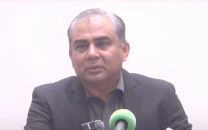
In the super tax case, counsel for various companies, Dr Farogh Naseem, argued that hundreds of thousands of protestors taking to the streets is a scenario far less dangerous than the superior judiciary overturning its own judgements.
When a three-member bench of the Federal Constitutional Court (FCC) led by Chief Justice Amin-ud-Din Khan resumed hearing the tax case, Dr Naseem — who served as federal minister for law in the PTI government — presented detailed arguments.
The lawyer argued that the Federal Board of Revenue (FBR) has a certain leeway to refuse to comply with decisions of the superior judiciary.
He said the court must consider both the FBR and taxpayers, as the FBR wants to ensure that taxpayers are left with no money, while taxpayers fear that they may eventually become exhausted and leave the country.
He said Pakistan attempted to become liberal like India, but India became liberal and then sentenced a Kashmiri leader. "Therefore, merely citing examples of liberalism is not sufficient."
He reminded the court that it is also supposed to examine the 26th and 27th Constitutional Amendments and determine whether the judiciary requires evolution or revolution.
Referring to the past, he said Gen Zia-ul-Haq's martial law succeeded because judges who took oath under the Provisional Constitutional Order considered public interest. "However, Gen Pervez Musharraf's martial law failed because public interest was not taken into account [by judges]."
He argued that the FBR's counsel Asma Hamid was currently opposing the arguments of her senior and could even state that she was not bound by the decisions of the Supreme Court and high courts.
He said if even the FCC were to refuse to follow judicial precedents, then review against its order would be filed which would be adjudicated by a six-member FCC bench. Dr Naseem said the tax has already been imposed, meaning some will have reserve funds while others will not.
He noted that worldwide, taxpayers are informed before a tax is imposed, whereas here the tax is imposed six months later, at a time when the money has already been collected.
He said there was an attempt to have the FCC dismantle 75 years of legislation, but he was confident that the court would not trample upon other judicial decisions.
"Millions of people coming out onto the streets would be far less dangerous than courts overturning their own judgments," he said. Dr Farogh Naseem will continue his arguments today.
The controversy surrounding Sections 4B and 4C of the Income Tax Ordinance, 2001 constitutes one of the most consequential fiscal and constitutional disputes in Pakistan's recent history.
It involves revenue implications running into hundreds of billions of rupees and raises fundamental questions about parliament's taxing power, equality before the law, and the scope of judicial review in fiscal matters.
Section 4B was introduced through the Finance Act, 2015, imposing a "super tax" on high-income persons, particularly banking companies and other persons earning income exceeding Rs500 million.









This material may not be published, broadcast, rewritten, redistributed or derived from. Unless otherwise stated, all content is copyrighted © 2026 The Express Tribune.






COMMENTS
Comments are moderated and generally will be posted if they are on-topic and not abusive.
For more information, please see our Comments FAQ