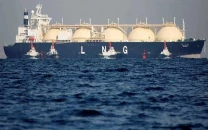
Azerbaijan ready to supply LNG to Pakistan
Updated 7 hours ago

Rising inflation blamed for disappearance of traditional programmes

Record inflation and declining purchasing power have led to a sharp drop in political and social iftar gatherings across the city during Ramazan this year.
The long-standing tradition of organising "30 iftars and 30 sehris" throughout the month has almost disappeared.
The prices of items used for sehri and iftar have risen to the point where they are beyond the purchasing power of many people. As a result, political and social iftar gatherings have declined significantly across the city. Government-funded iftar events have also been banned due to the severe financial crisis, bringing an end to official social and political gatherings.
A large number of poor fasting individuals are now forced to break their fast at mosques and imambargahs.
The iftar arrangements in government-run social markets only provide enough to break the fast and do not fully satisfy hunger.
For decades, former interior minister and chief of the Awami Muslim League used to organise a regular programme of 30 iftars and 30 sehris every Ramadan in Rawalpindi. The number of events declined last year and this year the programme has almost ended, with only a few symbolic iftars arranged. Not a single political sehri programme has been held in the first 15 days of Ramadan.
In the past two weeks, only a few discreet political iftar gatherings have taken place in the city, and even those featured significantly reduced menus, limited to items such as chicken pakoras, naan and dates.
None of the major political parties - including the Pakistan Peoples Party, Pakistan Muslim League-N, Pakistan Muslim League-Q, Pakistan Tehreek-e-Insaf and Tehreek-e-Labbaik - have yet organised a large iftar for workers in the city or cantonment areas.
In the past 15 days, only three political iftar events have been held in the city and cantonment, and even those had a very limited number of guests, with many workers and local leaders not invited.
Labourers attending small iftar events arranged by traders and social personalities along streets, near hospitals and in markets said they still have to arrange dinner themselves afterwards as the iftar meals are insufficient.
PPP City President Mian Khurram Rasool said a large iftar for party workers would soon be organised after consultation with the leadership.
PML-N City President and former mayor Sardar Naseem Khan said the party would organise iftar gatherings in the city between the 20th and 28th of Ramadan.
Vice-President of the Food Catering Association Shaukat Ali confirmed that very few sehri and iftar orders have been received this year. "Earlier we used to have no free time and all bookings were completed before the start of Ramadan," he said, adding that inflation and political uncertainty were the main reasons for the decline.
President of the Hotels and Restaurants Association Farooq Chaudhry also said there were virtually no sehri events this year and iftar gatherings had declined sharply.
Long-time political workers Maqbool Khan and Chaudhry Ikram said that in the past workers were invited to iftar or sehri daily, but during the first two weeks of Ramadan this year only one such gathering had been held.
Ramazan price surge defies control measures
RAWALPINDI: Measures introduced to control prices have proved largely ineffective, as vendors in the Rawalpindi's open market have begun charging arbitrary rates for beef, mutton, chicken, fruits and vegetables.
With the exception of potatoes, virtually all essential food items have become more expensive, and inflation has surged as Ramazan reaches its 17th day.
Adding to public concern, a significant increase in petroleum prices ahead of Eidul Fitr is expected to trigger another sharp wave of inflation in the open market.
Seven days of the second 10 days (Ashra) of Ramazan have already passed, yet all efforts made so far to curb rising prices in the open market have failed to yield meaningful results. At present, beef with bone is selling for Rs1,400 per kilogram, while boneless beef costs Rs1,600 per kilogram. Mutton has reached Rs2,600 per kg, and chicken meat is being sold for Rs600 per kg.
Meanwhile, a dozen cleaned goat trotters are priced at Rs2,600, while four cleaned beef trotters are selling for Rs4,200. Butchers and poultry vendors have effectively set their own prices, with further increases expected as Eid approaches. A similar trend is visible in the fruit market. Apples are being sold at Rs550 per kg, bananas at Rs280 per dozen, guavas at Rs250 per kg, and kinnow at Rs350 per dozen.
In the vegetable market, potatoes remain the only relatively affordable item, selling at Rs120 for five kilograms, while prices of most other vegetables have risen during Ramazan.
Citizens have urged authorities to take effective measures to curb the abnormal rise in food prices, so that people may complete the remaining 13 days of fasting without further financial strain.
On the other hand, vendors dealing in meat, poultry, fruits and vegetables argue that they are compelled to sell goods according to the rates at which they purchase them, adding transport and operational costs along with a reasonable profit margin.
They also warn that the sharp increase in petroleum prices from the 17th of Ramazan is likely to further intensify inflationary pressures in the market.
It is noteworthy that the Punjab government had introduced stringent price-control measures this year, yet these steps have so far failed to curb the rising cost of essential commodities.











This material may not be published, broadcast, rewritten, redistributed or derived from. Unless otherwise stated, all content is copyrighted © 2026 The Express Tribune.







COMMENTS
Comments are moderated and generally will be posted if they are on-topic and not abusive.
For more information, please see our Comments FAQ