Afghan national arrested
Updated 19 hours ago

From Shakarparian to H-8, large-scale tree cutting sparks public outrage
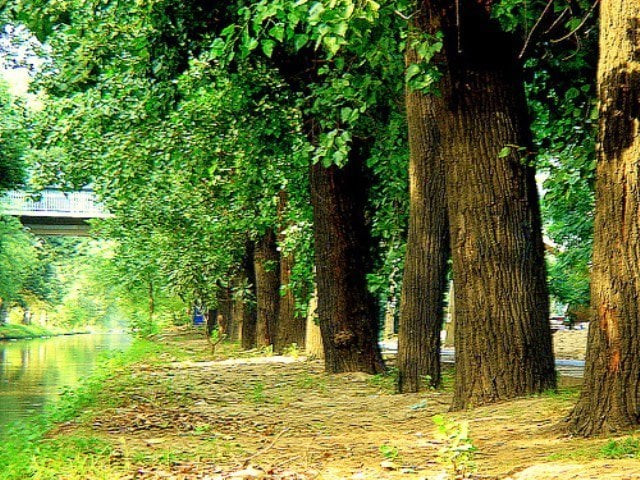
Shakarparian Road is one of those stretches in the capital that still reminds you of old Islamabad—serene and green. You drive through it without noticing the trees because they have always been there, lining the road with a kind of quiet assurance. Their shade breaks the glare of the sun, their presence softens the noise of traffic. For years, the road has looked settled, complete.
At one point, however, the green abruptly gives way to open land. The trees do not thin out; they simply stop. In their place is a cleared stretch of soil, freshly turned in parts, with a handful of labourers digging shallow pits along the roadside. A signboard planted firmly in the ground announces a promise: “Greener and Healthier Islamabad — Indigenous Tree Plantation,” carried out by the Capital Development Authority’s Environment Wing. Pine saplings lie nearby, waiting to be planted.
Yet it is the sudden disappearance of mature trees that has raised eyebrows. The sight of new plantation offers little comfort to residents and regular commuters who remember what stood here before. Questions linger persistently: why were established trees removed in the first place, what necessitated their clearance, and whether replacing decades-old growth with saplings can truly be called environmental protection?
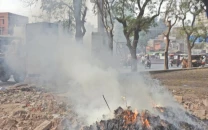
It’s not just Shakarparian where trees have been cut; massive tree cutting has also occurred in H-8 and Chak Shahzad. This widespread deforestation has left visible marks across the city.
Officials and citizens alike now grapple with the consequences, each offering their perspective on the city’s rapidly changing environment. The Capital Development Authority claims that this tree cutting is being done for the health of Islamabad’s citizens, as paper mulberry has been a major cause of allergies, and every year during spring, hospitals are filled with patients with respiratory issues.
However, the abrupt and large-scale nature of the cutting has sparked public outrage, raising questions about whether the city’s natural heritage is being sacrificed in the name of public health. After pictures of the recent deforestation went viral, Islamabad’s residents took to X to share their anger and question authorities about their actual plan.
Among the many voices, some public figures have spoken out, capturing the collective anxiety of Islamabad’s residents. Nusrat Javed, a renowned journalist, took to X and expressed regret about his decision to settle in Islamabad. He said: "Deeply regretting the decision to settle in Islamabad. I had wrongly imagined this city to remain evergreen with less population, traffic, and crime. I failed to foresee it turning into a jungle of concrete."
The outrage reached the corridors of power, and the prime minister took notice, seeking a report from the Capital Development Authority (CDA). Amid public outcry over the cutting of thousands of mature trees, Minister for Climate Change and Environmental Coordination Dr Musadik Malik claimed that paper mulberry trees, a significant cause of allergies and linked to deaths among chronic asthma patients, were removed following Supreme Court orders issued in 2023. In 2025, the order was implemented again to rid the city of this invasive, non-indigenous, and life-threatening species.
But environmental groups present a different viewpoint, highlighting that the reality is more complex than official statements suggest. WWF-Pakistan’s report sharply criticizes recent tree removal and land clearing in Islamabad, revealing that while the government’s paper mulberry eradication drive aimed at tackling allergenic invasive species is a major factor, extensive vegetation loss also stems from unchecked infrastructure development.
Field inspections from December 2025 to January 2026 highlighted massive clearing along the H-8 Islamabad Expressway, the Margalla Enclave Link Road, and Shakarparian, leaving large swathes of exposed soil and incomplete restoration. The report exposes gaps in transparency, site-specific planning, and monitoring, raising doubts about the true intent behind the removals.
Experts have weighed in, emphasizing that the city’s ecological health depends on both the method and intent behind such drives. Dr Zainab Naeem, climate policy advocate and PhD in environmental sciences, emphasized that the issue is not the removal of paper mulberry but the mismanaged way it was carried out.
The court-mandated phased approach, prior afforestation, and ecological assessments were ignored, with native species such as shisham also being cut, as highlighted in WWF-Pakistan’s report. She termed the move climate misgovernance. She added that Islamabad is already experiencing an urban heat island effect due to concretization and the loss of green buffers, warning that large-scale deforestation will further worsen rising temperatures, air quality, flooding, and extreme weather.
Dr Hassan Abbas, a water resources expert, echoed these concerns, warning that large-scale tree cutting would severely impact water resources and climate. Even if aimed at reducing allergies, such actions must follow proper mechanisms. He stressed that trees are essential for groundwater recharge, temperature regulation, and ecological balance, while replacing them with concrete worsens heat, disrupts rainfall, and accelerates environmental degradation.
Despite these concerns, CDA maintains its stance. The Capital Development Authority (CDA) rebuffed all criticism, stating that the tree-cutting activity is not arbitrary and is being carried out strictly on Supreme Court directions. According to DG Environment Ifan Khan Niazi, the apex court consulted experts and issued clear guidelines allowing only the removal of paper mulberry trees, explicitly directing that no other species be cut. While contractors were hired for the cutting process, CDA maintained that its staff supervised every step from cutting to loading the trees onto trucks—and maintained proper records.
Speaking exclusively to The Express Tribune, he explained that in the first phase, approximately 12,000 paper mulberry trees were removed from F-9 Park, while 8,700 were cut in Shakarparian. Additional sites, including H-8, were also part of the operation. In total, 29,115 paper mulberry trees have been removed so far. CDA noted that the first phase in F-9 Park was completed in 2024, during which 50,000 plants were planted as part of the reforestation effort.
However, the authorities acknowledge the limitations of immediate restoration. CDA's DG Environment also stated that during court proceedings, institutions including the Environmental Protection Agency and the Ministry of Climate Change were consulted, and all agreed on the removal of paper mulberry trees due to their adverse environmental impact. While acknowledging that newly planted trees cannot immediately replace mature ones, CDA said it is compensating by planting eight-foot-tall saplings, particularly in Shakarparian.
The development projects add another layer to the already complex narrative, raising questions about transparency and oversight. Regarding H-8, CDA clarified that tree removal is linked to the construction of Monument Park, a federal project, and assured that plantations will be restored once construction is completed.
Additionally, the authority confirmed that only 40 to 50 trees on Park Road were removed as part of a joint housing project between DHA and CDA. According to sources, neither of these projects has received approval from the Environmental Protection Agency (EPA), and there is no record of them on the EPA website.







This material may not be published, broadcast, rewritten, redistributed or derived from. Unless otherwise stated, all content is copyrighted © 2026 The Express Tribune.



COMMENTS (1)
Comments are moderated and generally will be posted if they are on-topic and not abusive.
For more information, please see our Comments FAQ