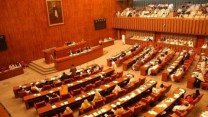
Campus harassment fears alarm Senate panel
Updated 51 minutes ago

Report says absence of transparency elevates risks, undermines confidence

A Ministry of Finance report has accepted that the absence of structured transparency in the Special Investment Facilitation Council's (SIFC) initiatives could undermine policy predictability and weaken the confidence of investors.
In its 240-page Prime Minister's Economic Governance Reforms Agenda, the finance ministry committed to bringing transparency in the SIFC affairs, showed the report released last week. The ministry prepared the report as part of an action plan of the International Monetary Fund's (IMF) Governance and Corruption Diagnostic Assessment.
"The absence of structured transparency around strategic investment initiatives, including those facilitated through the SIFC, creates informational asymmetries that can undermine policy predictability, elevate perceived governance risks and weaken investor confidence," read the report.
The report meets a condition of the $7 billion IMF loan package, which binds Pakistan to make public an action plan to address the governance and corruption-related vulnerabilities.
Pakistan had established the SIFC in 2023 with the goal of acting as a single window to facilitate investment and privatisation, promote cooperation among all government departments and fast-track project development. The body was set up after Gulf nations complained about the lack of coordination among various entities of Pakistan, which was blocking investment inflows. The SIFC did address the coordination-related issues and helped remove bottlenecks but the larger problems like undue heavy taxation, higher energy prices, weaker external sector stability and the lack of fiscal space remained unaddressed.
The SIFC had been assigned the task of increasing foreign direct investment in the areas of agriculture, defence, infrastructure development, strategic initiatives, logistics, information technology, telecommunication, energy, mining and minerals, and tourism.
During its two and a half years of life, the SIFC has not been able to bring any major foreign investment. Last month, SIFC National Coordinator Lt General Sarfraz Ahmed highlighted multiple issues, which were restricting the foreign direct investment.
The finance ministry's report underlined "Pakistan has made significant strides in attracting and facilitating investment, yet the public availability of consolidated information on concessions, fiscal implications and regulatory relaxations remains limited".
The ministry stated that without systematic disclosure, particularly regarding tax concessions, policy exemptions or regulatory relaxations, the stakeholders face uncertainty about the rationale, cost and outcomes of strategic investments. This can weaken efficiency, blur the distinction between facilitation and discretion, and constrain the credibility of investment governance mechanisms, it said.
As part of loan conditions, the government has assured the IMF that it will submit the first draft of the annual report on the SIFC by December this year and the final report will be submitted in March 2027, which will clear the air around the council.
A senior SIFC executive said that so far the council has not granted any concessions or exemptions.
The annual report will have consolidated information on all investments facilitated by the SIFC, including details of approved tax concessions, the rationale for concession decisions, the estimated fiscal value of concessions and the progress on facilitated projects, according to the finance ministry's report. The IMF had questioned the vast powers given to the SIFC under Article 10F of the Board of Investment Act, which governs the council.
In its Governance and Corruption Diagnostic Assessment, the IMF stated that Article 10F and Article 10G "raise concerns about the concentration of authority over federal and regulatory institutions through recommendations, advice and directions, including on exemptions, given the broad immunity granted under Article 10G, which may undermine accountability mechanisms".
The IMF emphasised that "greater transparency is needed to understand how these powers will be exercised and monitored in practice". It added that the provisions outlined in Articles 10F and 10G, along with subsequent clauses, appear to create a framework that prioritises facilitation of strategic projects by allowing exemptions from regulatory compliance and shielding officials from personal liability. While these measures may enhance efficiency and reduce bureaucratic delays, they also increase potential transactional risks, said the IMF.
In light of these observations of the IMF, the finance ministry's report said "addressing these vulnerabilities requires institutionalised transparency, regular publication of structured investment information and clarity regarding the implementation of Article 10F, which empowers the government to relax or exempt regulatory compliance requirements for strategic projects". The IMF's governance report also highlighted the issues arising out of the parallel existence of the Board of Investment and the SIFC. "While the SIFC was established to accelerate investment and privatisation efforts, the Board of Investment continues to exist," stated the IMF's report released six weeks ago.
The IMF said that coexistence of multiple institutions with overlapping mandates has created ambiguity regarding roles, responsibilities and accountability structures. Rather than creating new entities, authorities should prioritise addressing structural challenges and root causes that deter foreign direct investment, weaken the investment climate and hinder privatisation efforts, it added.











This material may not be published, broadcast, rewritten, redistributed or derived from. Unless otherwise stated, all content is copyrighted © 2026 The Express Tribune.







COMMENTS
Comments are moderated and generally will be posted if they are on-topic and not abusive.
For more information, please see our Comments FAQ