‘NAPA Repertory Festival’ concludes with musical finale
Updated 4 hours ago

Propaganda, misrepresentation and the question of who owns the story dominate social media

How many times are we going to watch this same story play out? Bollywood takes a slice of Pakistan’s history, strips away the political context, sprinkles in some glossy action, and wraps it up in familiar patriotic overtones. With the release of Dhurandhar on December 5—very loosely based on Karachi’s Lyari gang war—audiences on both sides of the border found themselves trapped in yet another round of déjà vu.
The film, stacked with high-profile actors, has sparked mixed reactions. But for once, the divide is not between India and Pakistan—people within each country are split among themselves. Pakistanis quickly clocked the propaganda, but many were also frustrated with their own entertainment industry for refusing to tell the stories that actually belong to them.
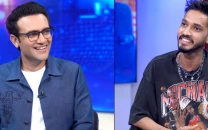
Content creator Bilal Hassan, better known as @mystapaki, summed up the conflicted reaction perfectly. “It is very, very well-made. Action sequences fantastic, Akshaye Khanna’s acting was… I wanted to be upset at it, but I couldn’t be upset at it,” he said. But when the anti-Pakistan dialogue crept in toward the end, he didn’t hold back: “If that isn’t propaganda, I don’t know what it is.”
For Hassan, the issue isn’t the politics, it is ownership. “I grew up seeing the Lyari gang wars. Chaudhry Aslam’s house was in front of my school. When there was a bomb blast on top of his house, my school’s windows broke. That’s how close to home this story was for me.” And that’s precisely why watching someone else tell it—again—stung. “We won’t tell this story. Why? Because our politicians will get dirty. Our government will get dirty. So instead, we choose to just greenlight shitty scripts like Love Guru.”
Indian audiences were not blind to the messaging either. Actor Hrithik Roshan praised the storytelling but disagreed with its politics, stressing the “responsibilities filmmakers should bear as citizens of the world” when handling sensitive histories. Film critics and social media users echoed the sentiment. “When propaganda starts looking like a spy blockbuster with catchy songs, people forget to question it,” wrote one X user.
Viewers were also frustrated by the caricatured depiction of Karachi: bomb blasts, relentless violence, and a Lyari that looks more like an action-movie set than a real neighbourhood with a complicated history and decades of resilience. BBC Asian Network journalist Haroon Rashid posted a video titled “The Karachi you see in Dhurandhar v/s the Karachi I saw last week,” contrasting the film’s chaos with the city’s food, music, and everyday warmth.
Some Pakistanis reflected on their own role in consuming this content. “We forget things very easily. For us, entertainment is important no matter how much India bans and boycotts us… But we are always promoting their stuff full of propaganda against us,” wrote one user. Then there were the smaller inaccuracies that didn’t escape notice: “Someone needs to tell them that no one, absolutely no one wears shalwar kameez with half sleeves in Pakistan,” joked another.
And once again, social media spiralled into the same cyclical debate—propaganda, misrepresentation, why Pakistanis still watch these films, why Bollywood keeps making them. It’s the same conversation that resurfaces every time, almost like a script of its own. But there’s a point people like @mystapaki keep returning to: Pakistan isn’t telling its own stories, and the vacuum leaves room for others to narrate our history on our behalf—messily, inaccurately, and often with a political agenda.
The fatigue is certainly real. Audiences seem tired not just of Bollywood’s formulaic portrayals, but of the predictable online storm that follows each release.









This material may not be published, broadcast, rewritten, redistributed or derived from. Unless otherwise stated, all content is copyrighted © 2026 The Express Tribune.












COMMENTS (5)
Comments are moderated and generally will be posted if they are on-topic and not abusive.
For more information, please see our Comments FAQ