
Victims of terrorism 2012: Read them if you can
Attacks have gone down, but precision has increased; we are numb from the battering.
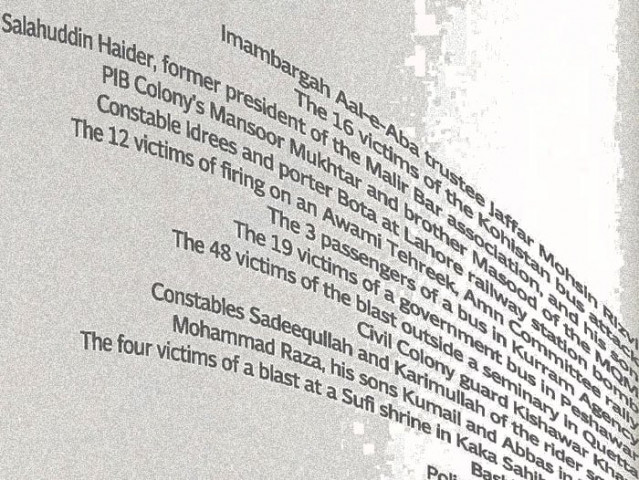
We have yet to learn how to grieve as a nation the thousands of names and the unnamed.
If we stopped for a second to make the pain register, perhaps something unimaginable would happen to us as a people. Perhaps, for now, because it is so unbearable, our grief has been stoppered in the collective consciousness. Perhaps if we actually looked into the chasm of loss, we would make it stop.
In this newspaper we tried our best to chronicle the price Pakistan is paying for the quotidian of terrorism and violence and words often failed us in the face of this indescribable time we are living in. But as the year ends, we wanted to stop and make you stop for even just one visual second to say to them, that yes, even though you are gone, and we are numb from the battering, we acknowledge your names before they are swallowed. Before they slip away and are replaced by fresh ones on these pages.
The algebra of evolving terrorism
For the 365 days of 2012 the newspapers were studded with statistics on terrorism. Reader fatigue is understandable. But as we lurch into the New Year in Pakistan, it is worth taking a closer look at them because there was a 25% drop in terrorist strikes, which some consider an improvement.
Muhammad Amir Rana, the director of the Pakistan Institute for Peace Studies, has kept an eye on the graph: Around 7,000 people died in 2011. In the year that just ended, about 4,700.
That was the ‘good’ news. The magnitude may have subsided slightly but the mark has sharpened. The agents of destruction have changed the rules of the game – their targets are more specific now. The crowded market places are slowly being replaced by an A-list of enemies.
This is why, in 2012 we saw more Bashir Bilours, Malala Yousufzais, Aurangzeb Farooquis, Birgitta Almebys, SP Hilals come in the line of fire.
More than a third of the 1,480 terrorist attacks were assassinations, according to data collected by the Pakistan Institute for Peace Studies.
It was not like this post-Lal Masjid in the summer of 2007 and till the end of 2009 when the general population bore the brunt. That two-and-a-half year period is a reference point for those tabulating and interpreting the trends because it included the deadliest months for Pakistan when attacks went up an unimaginable 154%.
Fortunately, it has been consistently winding down since then.
There were 3,816 violent incidents in 2009, 3,393 the year after. It continued to dip: 2,985 attacks in 2011. In the year that just ended, it was marginally, but still lower at 2,082.
There is an explanation for these changes.
“The militants were getting a lot of flak for targeting innocent women and children and attacking markets, schools and passenger buses,” says Imtiaz Gul, director of Centre for Research and Security Studies. “To avoid further discredit, they have stopped indiscriminate attacks.”
The new game is to pick off politicians and security forces.
“This is to simply demoralise those responsible for security… to terrorise and inject fear in the minds of people,” adds Gul.
According to data collected by the centre, in Fata and Khyber-Pakhtunkhwa there was a 32% increase in targeted attacks on prominent personalities. Attacks on the police and paramilitary increased 25%.
The bad press the militants got for killing women and children also prompted what appears to be another shift.
The uptick in the use of improvised explosive devices (IEDs) was accompanied by a recession in suicide bombers. In 2012, 27% of attacks relied on remote-controlled devices.
After a consistent increase in the use of human bombs from 2005 to 2009, suicide attacks have been dropping steadily since: 87 in 2009, 68 in 2010, 45 in 2011. “The Tehrik-e-Taliban Pakistan is increasingly dependent on IEDs,” notes Rana. “The dip in suicide bombing could be a human resource issue.”
The attacks in KP and Fata aside, Balochistan was a flashpoint with high levels of nationalist and sectarian violence.
The sectarian target was high on the list after the high-profile victim. These kinds of attacks rose 37% across the country, according to Rana.
The Hazaras were arguably the worst hit because of their sheer numbers in Balochistan. In Karachi, terror reigned in the new form of targeting Shia families and groups.
Karachi alone suffered 98% of 775 targeted attacks in the province, according to the Centre for Research and Security Studies. Indeed, the year opened with the law enforcement agencies bracing for blood on the city’s streets. But according to Ahmed Chinoy, the chief of the Citizens-Police Liaison Committee, there was no real change in patterns of violence. What was different was the police’s success.
“We broke down a number of networks, that’s why we were protected from bigger damage,” he says.
The proof lies in the shuhuda: at least 125 police, Rangers and Frontier Constabulary men. “That is a big sacrifice,” says Chinoy. “It is because of the role they played that we have been protected.”
So brace for a long fight for survival – on both sides. It is not as if we haven’t been warned.
Writer and anti-war activist Eqbal Ahmad was sounding the alarm as far back as 1998: “Not a week, often not a day, goes by without some terrible act of violence shaking public confidence in the state’s ability to protect citizens, and reminding us that a serious decline in civility has occurred in this country.” Pakistan is “moving perilously toward a critical zone from where it will take the state and society generations to return to a semblance of normal existence”.
4738 victims…
- Imambargah Aal-e-Aba trustee Jaffar Mohsin Rizvi
- The 16 victims of the Kohistan bus attack
- Salahuddin Haider, former president of the Malir Bar association, and his son
- PIB Colony’s Mansoor Mukhtar and brother Masood of the MQM
- Constable Idrees and porter Bota at Lahore railway station bomb
- The 12 victims of firing on an Awami Tehreek, Amn Committee rally
- The 3 passengers of a bus in Kurram Agency
- The 19 victims of a government bus in Peshawar
- The 48 victims of the blast outside a seminary in Quetta
- Civil Colony guard Kishawar Khan.
- Constables Sadeequllah and Karimullah of the rider squad
- Mohammad Raza, his sons Kumail and Abbas in Karachi
- The four victims of a blast at a Sufi shrine in Kaka Sahib, Nowshera
- Bashir Ahmed Bilour
- Policeman Gulzar Ahmed
- Naiber Hussain
- Mir Zaman
- The 11 unnamed migrants in Gwadar
- Journalists Jamshed Kharal, Syed Tariq Hussain, Aslam Raja
- Manglawar Peace Committee Sardar Alam
- Polio workers Hilal, Farzana, Madiha, Fehmida, Kaneez, Naseem,
- The 17 taxi drivers, cleaners, mechanics, women, children in Jamrud Bazaar on Dec 17
- Jawwad Bhatti, 45
- CID PCs Khurram Shehzad and Mohammad Sohail
- ASI Mohsin Shabbir Ahmed
- Gul Shirin
- Taj Muhammad
- Khan Ali
- Birgitta Almeby
- Imdadullah
- Rangers Enayat, 28, and Hakim, 45
- The six victims of a suicide bombing in Kaki
- Former UC nazim Intisar Alvi
- SI Manzoor Hussain
- Maqsood Ahmed
- Syed Qamar Hussain and Syed Hasnain
- Chaudhry Nusrat Mehmood
- The five victims from the Dera Ismail Khan Muharram 10 jaloos
- The two victims at Jamia Masjid-o-Imambargah Haider-o-Karrar
- The 10 victims at Qasr-e-Shabir Imambargah
- The three FC men of the Shahbaz Town, Quetta bombing
- The Nato supply truck driver in Jamrud
- Quetta bus conductor Shamsullah
- The three victims at Jamia Masjid-o-Imambargah Mustafa
- Washbood journalist Rehmatullah Abid
- Muhammad Rafiq and Sanaullah in a bicycle bomb in Quetta
- Wali Babar murder case’s last witness Haider Ali
- The three Hazaras of Mach, Ghulam Ali, Mohammad Ibrahim and Mohammad Ali Hazaras Mohammad Musa, Ali Gul and Mirza Hussain
- SP Hilal Haider
- Dawoodi Bohras Ali Asghar, Mustafa Ali, Murtaza, Shabbir
- Hazaras Mohammad Zaman, Rehman Ali and Mohammad Essa Allama Aftab Haider Jafri
- ANP Charsadda VP Sabihullah
- Presidential award winning anti-Taliban tribal chief Saeed Ahmad Khan
- Anti-Taliban tribal activistAbdur Rehman
- Migrants Muhammad Waqas, Muhammad Ibrahim, Muhammad Khaliq in Mand, Turbat
- The 18 victims of an attack at a Khuzdar petrol stall
- Swat defence committee headFazal Ghani’s four-year-old niece Samreen
- ASI Mohammad Rafiq
- CID AEC’s Saeed Mansoori
- ANP Orangi organiser Mian Jan
- Swat anti-Taliban peace committee’s Tajim Gul and Sardar Mohammad
- Aisha of Hangu’s Gulshan Colony
- ANP’s former Sindh VP Moin Gham Pasar
- Shikarpur PCs Peeran Jurio and Papoo Rahojo
- Hazaras Ali Atta, Muhammad Ibrahim, Syed Awaz and Ghulam Ali
- The polio vaccinator of Killi Jeo
- PC Hukam Khan
- On Nishtar Road in Sibbi, Khaliqdad, Nadra, Shoba Khan, Syed Hameed Shah, Mehrullah, Ghulam Haider, Mirza Khan, Raheem Khan, Nadir
- Barawal peace militia chief Malik Gul Zada Mohsin
- Ali Naqvi, the deputy director at the Geological Survey of Pakistan
- Kotgi’s Asif Iqbal and Sadiqullah
- Former Sindh MPA Malik Atta
- The eight victims of the Pakistan Air Force van attack
- The Shia pilgrims of Mastung
- The eight victims of the Hyderi Dawoodi Bohra jamaat khaana blast
- Muhammad Ahmad
- The 18 Shia victims of the Parachinar bombing
- The FC’s Hayat Khan and Hakeem Shah
- Bamphoka’s Muhammad Nauman on his way to a college interview
- Hazaras Ali Baba, Jawad, Nauroz Ali, Muhammad Raza, Nauroz, Muhammad Ali and Aziz Ali
- Additional District and Sessions Judge Quetta, Zulfiqar Hussain Naqvi
- The four family members of former Tarakzai peace committee leader Haji Salam
- PC Muhammad Tahir
- Four volunteers of the Akakhel peace militia
- Four members of the Balochistan Constabulary
- PC Mohammad Siddiq
- Active peace committee member and school principal Ghulam Akbar, of Bagh Maidan
- The nine victims of the Bajaur Agency’s pro-government Salarzai tribe attack
- The three people killed in a Dir Bala roadside bomb
- Union Council Polio Worker Ishaq
- PML-N leader Ameenullah Zehri
- The 18 Karachi residents killed in 24 hours on July 15
- Pashtun Students Federation’s Malik Muhammad Qasim Kakar and five others as ANP rally attacked
- Nine policemen at hostel rented by the National Prison Academy
- The 18 would-be migrants in Turbat
- Muhammad Saeed, the Pishin assistant director of local governments
DATA COMPILED BY RAHMA MUHAMMAD MIAN
Note: The data does not include figures from the last week of December 2012
LATEST
Karachi police arrest alleged suspect of newly married couple's honour killing
KU choked by protests
Power at night, water by day: Hyd tries new fix for old crisis
CM launches province-wide anti-rabies campaign
Ex-senator warns of protest over Pakistanis held by Somali pirates







COMMENTS
Comments are moderated and generally will be posted if they are on-topic and not abusive.
For more information, please see our Comments FAQ