Eurobond debt may be tokenised
Updated 1 hour ago

Minister says 48% of revenue goes to debt servicing, new development paradigm urged

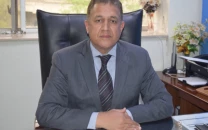
Bangladesh's Finance Adviser to the Prime Minister, Dr Rashid Al Mehmood Titumir, on Monday proposed a five-point development paradigm for South Asia to deal with disruptive geopolitical challenges, emphasising that legitimacy matters for becoming a welfare state.
In his keynote speech at the annual Sustainable Development Policy Conference, Titumir said regional countries needed to reconstruct the fiscal state, reposition industrial policies and build multilateral cooperation.
He said there was a need to rethink conventional fiscal consolidation, whose purpose should be to preserve the state's capacity to invest in the future, not simply to minimise public expenditure.
Pakistan's Climate Change Minister Dr Musadiq Malik shared those concerns, saying debt-driven growth was unacceptable as servicing was eating half the country's revenues.
"I would propose that we could come up with a South Asian framing of a new development paradigm," with at least five strategic priorities, Titumir said.
He proposed moving from efficiency-driven development to resilience-oriented development, saying recent crises showed that efficiency without resilience creates significant vulnerabilities.
Titumir also proposed repositioning industrial policy as an instrument of structural transformation, saying the challenge was no longer simply to attract investment. "It is to attract investment that builds domestic capabilities, generates employment, transfers technology, and strengthens linkages with the wider economy," he said.
He called for a production network where South Asia, Southeast Asia and the Middle East and North Africa work together across primary, intermediate and finished goods, while remaining mindful of an active industrial policy.
He suggested reconstructing the fiscal state and rethinking development financing, saying the state's capacity to mobilise and allocate resources was becoming a critical determinant of national resilience. Developing countries, he said, needed stronger domestic revenue mobilisation, more efficient spending, modernised public financial management and more sophisticated capital markets.
His fourth proposal placed human capabilities and employment at the centre of economic transformation. Fifth, he also stressed multilateral cooperation, saying no country, irrespective of economic or military strength, can independently resolve challenges such as climate change, pandemics, financial instability, technological governance, international taxation and maritime security.
Sharing Bangladesh's experience, the finance adviser said "the foremost lesson that we have learned in Bangladesh, if we are to say it in a single sentence, is that legitimacy matters."
"Legitimacy must originate from the people. So what we are trying to do is come up with a prime ministerial vision of a Bangladesh which is democratic, which is humane, and which has a welfare state," he said.
Dr Malik criticised the debt-led model, noting that money for the poor had decreased by 23% in a year. "The money that was available for development in 2015, when the SDGs started, is where we have fallen back to in one year," he said.
"We collect Rs16 trillion, of which roughly Rs8 trillion is paid in debt servicing. That is about 48% of our revenue. When shall we stop? This kind of development at the expense of our future is unacceptable."
Malik is the second cabinet minister after Ahsan Iqbal to speak against debt-led growth. The planning minister has described Pakistan's stabilisation as "stunted and borrowed."
Malik said Pakistan was willing to do development for debt swaps and open for business in equity. "We're not open for more debts. That shop is closed."
But contrary to that claim, the finance ministry is taking a $500 million foreign loan to bring local employees into a contributory pension scheme and a $600 million loan whose conditions include amending a simple import order and allowing the private sector to import urea.
Titumir said the world was not simply experiencing another episode of uncertainty but a structural transformation of the international economic and political order, with the institutions and models that shaped the post-war system challenged simultaneously and the boundaries between economics and geopolitics, technology and security, climate and development blurring.
For developing countries these disruptions are consequential and not merely external shocks to be absorbed, he said. He listed 10 disruptive forces, including the international political and economic order, trade and production networks, technology, climate change, debt, growth and distribution, institutional disruptions, information and trust, and demography.
A young population without adequate education, skills and employment can become a source of frustration but, with the right framework, a major source of productivity, innovation and domestic demand, he said.
He said investment should go into production, which would generate decent employment and could finance the social sector.











This material may not be published, broadcast, rewritten, redistributed or derived from. Unless otherwise stated, all content is copyrighted © 2026 The Express Tribune.






COMMENTS
Comments are moderated and generally will be posted if they are on-topic and not abusive.
For more information, please see our Comments FAQ