Power supply chains face a new test
Updated 2 hours ago

21% of EU population at risk of poverty or social exclusion, with Spain highest at 25.7%
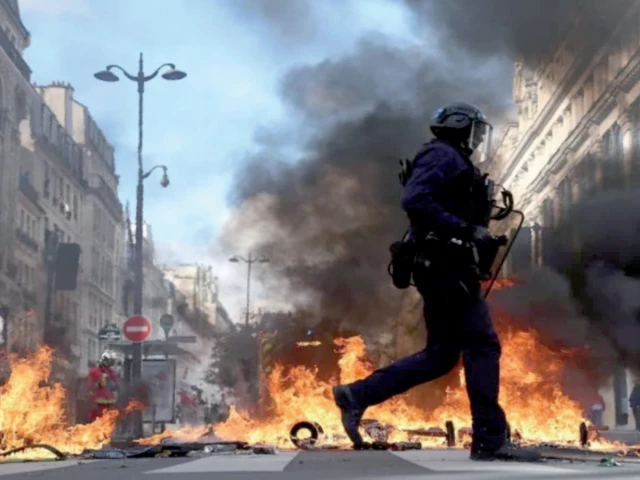
Europe is once again experiencing a series of protests. Several countries are already seeing them, including France, Portugal, Italy and Spain. France is experiencing the worst of the current wave. Protesters are burning property and looting shops, malls and anything in their path. They are confronting police and law enforcement agencies. France has had to deploy the army in major cities to control the unrest.
Italian protesters are following suit and have started looting shops and malls. The circle is expanding, with Belgium now also affected, and there is fear other countries could follow. The question is why countries are falling into protests one after another, and what drives them. A common reason is the rising, unbearable cost of living and the weakening of public welfare and service institutions. In France, protests began with students unhappy with the education system. They complained about school facilities, teacher availability and university fee structures. Other groups joined them, citing the rising cost of living. People in Spain are agitating over rising housing prices and other essentials. Italians are protesting over similar issues. The causes are the same across Europe.
Cost-of-living issues and the delivery of services such as education are rooted in Europe's economic and social system. It is unfortunate that poverty and social exclusion have worsened over the years. Let us try to understand this using European Union (EU) data. Figures for 2025 show that almost 21% of the EU population is at risk of poverty or social exclusion. This means 92.7 million people are at risk. The worst part is that 19.3 million children are at risk, which puts the EU's future at stake.
It is shocking that major economies also have high poverty risk, including Spain at 25.7%, Germany at 21.2%, Italy at 22.6% and France at 20.8%. Some experts believe the data is manipulated and the actual numbers may be higher. Ongoing violent protests and rising numbers point to this dimension. Inequality is another problem that haunts the EU over time. These indicators are disturbing, especially when the EU claims the best governance, political and economic system in the world. It claims that the economic model, capitalism, has helped the West achieve high economic growth and development. A thorough look at the history of rapid growth highlights two disturbing facts.
First, the system presented and advocated as the best in human history is responsible for the current mess. A deep dive into the liberal economic model indicates certain flaws. One, it recognises that it will create losers and winners. Losers would be compensated and winners would pay to compensate them. Thus the state, with experts, devised tools such as taxes and built institutions to implement them. This would not be possible without a strong state role. Unfortunately, the role of the state was weakened over time in the name of the free market. Powerful business groups acquired more space in decision-making and in setting the rules. They also exploited liberal democracy to occupy the driving seat by funding candidates and parties. As a result, the state continued to lower taxes for corporations and raise them on ordinary citizens.
Two, Riba is the main reason for the failure of the liberal economic model. It favours the winners and undermines the losers. It discourages investment in productive sectors and encourages wealth accumulation. The capitalist financial system offers lucrative opportunities to accumulate money, and seems attractive because wealth can be created with little effort. This creates many problems. For example, less investment in productive sectors leads to fewer jobs, which increases unemployment, poverty and suffering. Three, there is no system for redistributing wealth and resources. Tax or corporate social responsibility systems contribute little to compensating the losers. This creates the illusion of competition without building mechanisms to protect the losers.
Second, the current situation dispels the myth that the liberal economic system ensures rapid growth and development. It has revived debate about colonisation's role in Europe's growth, including how European countries exploited weak but resource-rich countries. Europe did not hesitate to commit crimes against humanity and genocide to fulfil its economic agenda. After the old colonial system collapsed, Europe, with the United States, invented the Bretton Woods institutions to continue exploitation. However, the new system is also in decay. Therefore, Europe cannot solve its problems.
In this context, Europe needs a new economic system if it wants to solve its problems and end agitation. Europe can explore two options. First, the Islamic economic system offers answers to all of Europe's questions and problems. It has a sophisticated system to ensure wealth redistribution through Zakat. It encourages investment in productive means by forbidding Riba. The whole system revolves around people's welfare and the betterment of society. It prohibits exploitative profits and keeps people's needs first. However, Europe does not believe in Islam. Moreover, the Islamic model is unfortunately not in practice anywhere in the world. So Europe can pursue a second option.
The second option is the Chinese economic model. It centres on people's welfare. It has all the ingredients of modern economies, including a free market, openness and competition. However, the state does not leave the economy to the invisible hand. Rather, the state plays a prominent role in protecting common people's interests without compromising growth goals. As a result, China has grown exponentially, eliminated poverty and ensured the welfare of its people.
Unfortunately, instead of learning from the Chinese model, the EU declared China an ideological rival and is doing everything it can to undermine it. However, it is encouraging that many European experts and ordinary citizens are discussing the Chinese model and want to learn from it to tackle European problems. Therefore, many people think now may be the time for the Red Star to shine over Europe. However, we have to wait for the final conclusion, as the liberal order's actors and beneficiaries will fight back to sustain this order and keep extracting benefits. They need to understand that no system can sustain itself without meeting people's basic needs. Thus, if they want to sustain it and revive its glory, they must listen to and care for people's needs. Otherwise, nothing can help them, and the system will continue to decay, leading to its collapse.
THE WRITER IS A POLITICAL ECONOMIST AND A VISITING RESEARCH FELLOW AT HEBEI UNIVERSITY, CHINA






This material may not be published, broadcast, rewritten, redistributed or derived from. Unless otherwise stated, all content is copyrighted © 2026 The Express Tribune.






COMMENTS
Comments are moderated and generally will be posted if they are on-topic and not abusive.
For more information, please see our Comments FAQ